
You are currently browsing the category archive for the ‘contemplative spirituality’ category.

One of the most humbling and important books I am presently reading is War on the Saints. This book has forced me to take an even closer look at testing the deceiving spirits that are ever-present in this world.
One very important previous lesson that I have learned is that as my faith in the Lord grows so does the attacks from the enemy. Every time I learn a spiritual truth from the Lord, Satan pounds back with discouragement, fear or temptation. When the Lord called me into the discernment ministry, I was filled with excitement at His calling…but I also was at first worried about the opposition I would face. When the Lord called me to teach Bible study, I was willing but afraid at my lack of experience. The enemy whispered to me…You can’t do this….This is too hard…This takes up too much time…
I only share this because the deceiving spirits are very determined to undermine our walk with the Lord in these end-times. But with the help of the Lord and the other teachers who are forever encouraging me with their training…I trust the Lord will equip me with all I need to do his His will….and He has. What a wonderful God we have!
Not only do we have to face the evil strategies Satan throws at us personally, we have to determine whether or not our spiritual leaders have been deceived themselves. All throughout the Bible we are warned of false teachers who will attempt to lead us astray. Some of these teachers will be deceived by the seducing spirits and may truly believe they are in the truth. But they are themselves deceived by giving into greed, seeking honor, and enticed by the spotlight that surrounds them. Others are truly wolves in sheep’s clothing. They know the truth, yet bury it deep into their conscience so that the truth no longer sears them. Both are dangerous and will mislead the masses into the kingdom Satan is building here on earth.
“There are many deceived ones among the most able teachers today because they do not recognize that an army of teaching spirits have come forth to deceive the people of God and that the special peril of the earnest section of the professing Church lies in the supernatural realm, from whence the deceiving spirits with “teachings” are whispering their lies to all who are “spiritual,” i.e., open to spiritual things. These “teaching spirits” with “doctrines” will make a special effort to deceive those who have to transmit doctrine and seek to mingle their teachings with truth so as to get them accepted. Every believer must test all teachers today for himself, by the Word of God and by their attitude to the atoning cross of Christ and other fundamental truths of the Gospel, and not be misled into testing “teaching” by the character of the teacher. Good men can be deceived, and Satan needs good men to float his lies inder the guise of truth.” [1] emphasis mine
So one has to ask…Self, do I know the Word of God thoroughly enough to recognize a false teaching? Self, when a teacher gives scripture do I check to see if it is given in context with the passage? Self, do I support a false teacher and mislead others because of this lack of knowledge? Self….am I deceived? What tough and humbling questions these can be.
How we hate to admit that we are vulnerable to deception. But we must!
The man is deceived if he is a hearer but not a doer of the Word of God ( James 1:22).
He is deceived if he says he has no sin ( 1 John 1:8).
He is deceived when he thinks himself to be “something” when he is nothing (Gal. 6:3).
He is deceived when he thinks himself to be wise with the wisdom of this world (1 Cor. 3:18).
He is deceived by seeming to be religious when an unbridled tongue reveals his true condition (James 1:26).
He is deceived if he thinks he can sow and not reap what he sows (Gal. 6:7).
He is deceived if he thinks the unrighteous willl inherit the kingdom of God. (1 Cor. 6:9).
He is deceived if he thinks that contact with sin will not have its effect upon him (1 Cor. 15:33). [2]
Doubt is actually a tool that can be used to question the experiences in our spiritual life. It is this doubt that leads us to question the spirits and to see if they are from God or Satan. Too often we quickly snuff out the light we would receive by turning our back to the fear of discovering a truth we have ignored. We are clearly instructed to test the spirits in 1 John 4:1-3.
“Dear friends, do not believe every spirit, but test the spirits to see whether they are from God, because many false prophets have gone out into the world. This is how you can recognize the Spirit of God: Every spirit that acknowledges that Jesus Christ has come in the flesh is from God, but every spirit that does not acknowledge Jesus Christ is not from God. This is the spirit of the antichrist, which you have heard is coming and even now is already in the world.”
Next in 1 Timothy 4:1-2
“The Spirit clearly says that in later times some will abandon the faith and follow deceiving spirits and things taught by demons. Such teachings come through hypocritical liars, whose consciences have been seared as with a hot iron.”
Teaching deceptions will abound. Verses from the Bible will be plucked and regrouped to create false theologies. Words will be twisted from their historical meanings to create “new”, “fresh”, teachings. I was taught not long ago to read the Bible from beginning to end. When done…read it again in this way. There are no “secret teachings.”
“All genuine ‘truth’ is in harmony with the only channel of revealed truth in the world–the written Word of God. On the other hand, all teachings originating from deceiving spirits:
1. Weaken the authority of the Scriptures;
2. Distort the teaching in the Scriptures;
3. Add to the Scriptures the thoughts of men; or
4. Put the Scriptures entirely aside.
The ultimate object of the forces of falsehood is to hide, distort, misuse or put aside the revelation of God concerning the cross of Calvary, where Satan was overthrown by the God-Man and where freedom was obtained for all his captives.
Countless concepts and beliefs which are opposed to the truth of God are injected into the minds of ‘Christians’ by teaching spirits, rendering them ineffective in the warfare with sin and Satan and subject to the power of evil spirits. All new insights and systems of beliefs should be therefore tested by the truth of God revealed in the Scripture, not merely by texts or portions of the Word but by the principles of truth revealed in the Word. Since Satan will endorse his teachings by ‘signs and wonders’, ‘fire from heaven’ and other supernatural signs are no proof of a teaching being from God…” [3] emphasis mine
The end-times will be filled with spiritual deceptions that will deceive many. Signs and wonders, supernatural manifestations, prophetic visions, prophetic words, inner voices, physical manifestations (jerking, shaking, falling, undulating, head wagging, slaying) will all have to questioned by the discerner. Do not let your doubts go unchecked by searing them with a hot iron or by simply dismissing them. If you do this you will open yourself up to deception. You will not be able to discern the lies of Satan.
You may want to pray something like this.
Lord, show me the truth even though I may not want to hear it. Close any doors that I have allowed to be opened that deceives my heart and mind. If I have believed any of Satan’s deceptions… immediately remove them from my life. Amen
“War on the Saints” by Jesse Penn-Lewis
[1] pg. 29
[2] pg. 22
[3] pp. 32-33

The Moses Code Movie Blasphemy and The Big Shift
Update: Since this article was published, the original movie trailer for the Moses Code was removed without explanation from both YouTube and the MosesCode.com website. They have replaced the original with a different one that does not contain the blasphemous, “I AM” statements referred to in this column. I look forward to their explanation as to why they felt they needed to remove it.
This article is from http://www.christianworldviewnetwork.com/article.php/3159/Ingrid_Schlueter
A movie will be unveiled on April 5 that should get a prize for honesty in blasphemy. Unlike the emerging church celebrity authors and speakers who shuck and jive when asked direct questions about God, salvation, and truth, The Moses Code is produced by those who will tell you right out what they believe. What they do believe is breathtaking in its Satanic audacity. In the original movie trailer, now removed mysteriously from YouTube and the MosesCode.com site, promoters of The Moses Code cheerfully announce that I AM is something all of us can say. Towards the end of the original clip, one young man looks up and into the camera and tells viewers, “I am the way, the truth, and the ‘light’.” The website says the following:
For the first time a major spiritual film release is being combined with a worldwide prayer vigil focused on shifting the planetary consciousness.
Join millions of people from every corner of the globe in learning the most powerful manifestation tool in the history of the world. Then on one momentous day we’ll use the code to promote peace and compassion for all beings through over 1000 gatherings worldwide.
This is the chance for humanity to use the Law of Attraction to create peace on the deepest level.
Coming on the heels of The Secret, the New Spirituality teachers featured in The Moses Code are in hopes that by teaching everyone about the power of declaring themselves God, they can help along the “Shift” in planetary consciousness that everyone is talking about today.
The Shift is the name of another movie under production featuring New Spirituality gurus like Deepak Chopra and Marianne Williamson, alongside leftist environmentalists like Al Gore and religious figures such as Archbishop Desmond TuTu. Their message is the same, as though it was taken from the same script.
“A massive worldwide phenomenon is in progress, offering seeds of great hope for the future…We are in the middle of the biggest social transformation in history, THE SHIFT.”
Working on the Evangelical end of things, emergent author Brian McLaren is also promoting a Big Shift, calling his nationwide tour, The Deep Shift Conference. A heretic who does not believe in hell and who rejects the penal substitutionary atonement of Jesus Christ, McLaren is taking his Shift Experience to Willow Creek Community Church in April where he will be teaching youth workers and pastors from evangelical churches across the country about how they need to change their ministries to accommodate the Big Shift in thinking.
Emergent authors Phyllis Tickle and Tony Jones are also on board promoting a big spiritual shift. They prefer to call it the “Great Emergence”. Speaking at the Zondervan sponsored National Pastor’s Convention this week, Phyllis and Tony have titled their speech, not surprisingly, “The Great Emergence.”
What is emerging is another Jesus and another gospel. The Big Shift that all of the New Spirituality gurus are buzzing about marks the advent of the worldwide apostasy that is now upon us. Just as the Lord assigns roles to fulfill in His Church, the enemy assigns roles for his purposes. Over the two decades of researching the New Spirituality teachers and the inroads they have made into evangelical churches, it is evident to me that deception comes in many forms today on many different levels. Whether it is the spiritual bubble gum from Joel Osteen that serves to deceive the shallow masses or whether it’s the quasi-intellectual postmodern poison served up to college students by men like McLaren, Rob Bell, Tony Jones, Doug Pagitt, Dan Kimball and so many others, it’s all deception working towards the same end.
It is one thing to identify the counterfeit Christ of Marianne Williamson or the latest New Age author on the Oprah Winfrey Show (Eckhart Tolle is her latest protégé ), but what happens when authors published by the big “Christian” publishers are saying the same things? What happens when our celebrity emerging church leaders are using the same language, calling for the same things, and promoting the same false doctrines that redefine Christ and the Scriptures as the New Spirituality authors?
Compare these two quotes. One is from a popular emerging author and speaker who spoke at a conference with men like Andy Stanley and Rick Warren and regularly rubs shoulders with those in the new Evangelicalism. The other quote is from one of the world’s leading New Spirituality heretics. Can you tell which is which?
Quote 1
“The first of these five untheorized observations is that New Light embodiment means to be “in connection” and ‘in-formation’ with other Christians. Deeper feeling and higher relating go together. The church is fundamentally one being, one person, a comm-union whose cells are connected to one another within the information network called the Christ consciousness. New Lights offer up themselves as the cosmions of a mind-of-Christ consciousness. As a cosmion incarnating the cells of a new body, New Lights will function as transitional vessels through which transforming energy can renew the divine image in the world, moving postmoderns from one state of embodiment to another.”
Quote 2
‘Third Jesus’ can be seen only when we move into a new human awareness that will carry us beyond tribe, prejudice and even beyond our religious systems. As a Christian, I welcome his insights into my Jesus and his provocative call to me to enter the ‘Christ Consciousness’ and thus to become more deeply and completely human.”.
The first quote is from emerging author Leonard Sweet who spoke at the Catalyst Conference in Atlanta, attended by thousands of evangelical leaders from across the nation. It’s from his book, Quantum Spirituality, in which he thanks New Agers Willis Harmon, Matthew Fox and Ken Wilbur, to name a few, for their influence on him.
The second quote is from John Shelby Spong, in a book endorsement for Deepak Chopra’s brand new book, The Third Jesus, which is a brazen introduction of the cosmic Christ of the Big Shift everyone is talking about.
Both authors are talking about the same Christ-consciousness. They are describing the same thing—one from inside of evangelicalism, one from outside. Both popular author Rob Bell and occultist/New Spirituality teacher, Barbara Marx Hubbard, speak of being co-creators with God. Bell tells us in his latest Nooma video, “Open”, that creation is unfinished and that God needs us to be fellow creators with Him to finish the job
.…we have to understand that Jesus took very seriously the creation poem Genesis, that the Bible begins with. And in this creation poem God creates, but God creates things that are capable of creating more, and so God creates trees but then gives trees the ability to create more. God creates animals and plants and fish but then empowers them to create more. And then God creates people, and gives them the ability to create more. So everything in creation is essentially unfinished, God leaves the world unfinished, and invites people to take part in the ongoing creation of the world…
Hubbard’s occult “Christ” in her channeled book, The Revelation, instructs us about our participation as co-creators of the world.
“Those of you who hear these words are to carry on the commandment given to John two thousand years ago. You are not only to prophesy the end, the tribulations, and the New Jerusalem, you are to act it out. You are to discover the blueprint and become co-creators with God. You are to see the first fruits of the NEW BEGINNING.”
Yes, there is a Big Shift underway. The two spheres that were once irreconcilably opposed to one another, (Evangelicalism and New Spirituality) are coming together. The overlap has begun. But millions of evangelical Christians in the pews are distracted. They haven’t researched these issues. They don’t know their Bibles. They accept without question whatever Zondervan or Thomas Nelson put out. They watch the DVD’s their church screens like Rob Bell’s Nooma videos and they don’t catch the language. It is slippery. It is subtle, but the enemy is getting bolder with each passing day. There is a lack of sobriety and vigilance, and now the enemy is walking boldly in the front doors of our churches and Christian colleges.
At bottom, the New Spirituality blasphemers like the producers of The Moses Code are more honest than the emergents when they state openly that they believe they are the way, the truth and the life. At its core, their message is the same as many within the emerging “conversation”. The Bible is not a product of “Divine fiat”, Rob Bell says, “it’s a human product.” (Christianity Today, 11/1/04) The end result? We become God in our own minds. We can make things up as we go. Where does it all end? Rob Bell ends up promoting doctrines of demons—that we are co-creators with God, or rejecting the existence of hell, or the atonement, like Brian McLaren. That’s where it all ends. When you abandon a high view of Holy Scripture, your rebellion will take you places you never dreamed you would go. At some point, God blinds those who willingly believe a lie. With the full counsel of God in our hands, we are without excuse if we choose to participate in the Big Shift. The Shift is here, but those who serve the risen, ascended and glorified Lord Jesus Christ will stay separate. They will reject the anti-Christ doctrine of “oneness” of the New Spirituality and they will stay faithful at all costs.
“We are discovering Christianity as an Eastern religion as a way of life.”
The Emerging Church -The Latest Heresy By Stephen Holland

Preached on: Sunday, February 10, 2008
Westhoughton Evangelical Church
King Street, Westhoughton
Lancashire, UK BL5 3AX
Online Sermons: http://www.sermonaudio.com/revholland
Now a few year ago I heard a talk given on the Emerging Church and after it went away
and thought, “I haven’t a clue what he was on about.” So I hope after this session that
you will not go away with the same opinion.
If you have not come to hear of it, the chances are you soon will. A search on the internet
search engine Google will bring up no less than 616,000 references to what has come to
be known as Emergent or Emerging Church.
A check to your local Christian bookstore and see you find such titles as A New Kind of
Christian or Vintage Christianity for New Generations or The Forgotten Ways or The
Lost Methods of Jesus or Adventures in Missing the Point, Liquid Church, A Generous
Orthodoxy: More ready than you realize, Finding Faith Post Christendom, Changing
Worlds, Changing Church, Emerging Church, Emerging Churches, emerging-
church.intro. Those were just found on one shelf in one Christian so called bookstore.
There could be added-and will be many more titles added-to the list in the coming
days. Some authors with in the Emerging Church are Brian McLaren, Ralph Bell, Dan
Kimball, Doug Paget, Leonard Sweet, Spencer Burke, Yurgin McMannis, Tommy Collolen, Jason Clock, [?], Richard Foster and Tony Jones. And we could add also to that
people like Tony Campolo and Steve Chalk.
A tour is apparently being planned in 11 states of the USA to run from February to May
of this year. That tour is called “Everything Must Change Tour.” The title, of course,
that gives almost the game away. We are told by the organizer, Brian McLaren that this
is a tour for people short on hope. This tour is named after McLaren’s latest book Everything Must Change. The subtitle of this book reads: Jesus, Global Crisis and a Revolution
of Hope. This tour is for people of all thoughts, but seems especially aimed at those who
are fed up and disillusioned with-quote-traditional church. It is for people looking for
new ways of doing church. That is the in word today, doing church.
So what, may you ask, what’s all the fuss about?
Well, the very term “Emerging Church” suggests itself that they are emerging from
something. The very titles of the books just quoted suggest the same thing. Terms like
“lost message” or “new kind of Christian” or “forgotten ways” or “finding faith” or
“missing the point” or “post-Christendom” or “changing worlds, changing church.” All
this suggests some form of revolution is taking place or is about to take place and within
branches of the professed Christian Church.
So what, again, you may be asking. After all, the Church has changed, hasn’t it, from
one generation to next and from one century to another. And, of course, our world is
every changing.
There is nothing wrong, of course, with change. None of us, I take it, came here today by
horseback like many of our forefathers would have done or are dressed like our Puritan
brethren of the 17century. We live in a very advanced age where change is happening
at an incredible pace.
Is the Church in danger of being left behind or even in danger of extinction all together
unless she adapts? These people would tell us, “Yes.”
Men can doubt that the Church of Jesus Christ is at a low point as far as man can see. We
are told that excluding deaths and transfers 1500 people are thought to be deserting
churches in Britain every week. The promised hopes of the decade of evangelism have
not materialized. In the early 1990s it was hoped that about 20,000 new churches would
be opened by the close of the century. Rather, a survey has revealed that only 1867 new
churches were opened in England while 2557 closed. We are told that the fall in church
attendance was expected to decline in Scotland from 17.1% in 1980 to 10.3% by 2005. In
Wales from 14.1% to just 6.4% while in England from 10.1% to 6.7%.
The attendance of young people in churches seems to be even more depressing. In 1979
1,000,416 under 15s attended church. In 1989 it was 1,177,000 and by 1998 it was down
to just 717,100. One has estimated that 94% of young people are not in church on a Sunday. [?] of course, in spite of all its boasts and claims has failed to stem the decline. The
situation seems bleak and desperate. The Church is being increasingly told that she is out
of date, out of touch and irrelevant to our post-modern generation.
What is the answer to our plight? Is this new phenomena, the Emerging Church, the savior of the supposed dying Church? Have we found the answer in this newest of movements? One author things to think so. Michael Moynagh in his book emerging-
church.intro he says this of his own book, “It argues that church of a different timbre is
key to Christianity’s revival, perhaps survival in the western world.” He does, though, go
on to say, “But Emerging Church is not a magic solution. Emerging Church is not a quick
pick me up for a sick body. It is a collection of new vessels for new…for all the ingredients that are essential to Church and up dimension in worship and in dimension in community, announced dimension in mission and an of dimension as individual churches see
themselves as part of the body of Christ.” End quote.
Well, how would we define the Emerging or Emergent Church? How would you define
the Church? Well, let me give you a quote from one of the leading spokesmen, Brian
McLaren, and see if you can figure it out for yourself.
On the front cover of his popular book A Generous Orthodoxy he says this. “Why I am
missional and evangelical and post Protestant and liberal conservative and mystical poetic and biblical and charismatic contemplative and fundamentalist, Calvinist and Anabaptist, Anglican and Methodist and Catholic and Green and incarnational and [?]…”
You are not surprised, “Yet hopeful and emergent and unfinished Christian.”
Well, you were beginning to thinking that here is a man who really isn’t quite too sure
what he is all about. He seems to be one who certainly hasn’t arrived at certainty. And
this really sums up the whole Emerging Church. It doesn’t quite know what it is itself or
where it is going.
Michael Moynagh says, again-quote-“Emerging Church is a mindset. We will come
to you, rather than a model. It is a direction rather than a destination. It rests on principles rather than a plan. It rises out of a culture rather than being imposed on a culture. It
is a mood scarcely yet a movement.”
The same author goes on to say-quote-“Emerging Church is more than a pragmatic
response to declining numbers. It is a theological vision, a wide eyed vision that escapes
a blinked past, challenges the status quo and calls for new forms of Christianity in which
individuals can encounter Christ authentically. Might these communities renew inherited
congregations and become the crucible of the Church in the Postmodern world?” End of
quote.
Though the Emerging Church has no leaders, official leaders or base, one widely recognized as a leading spokesman and author is Brian McLaren. He says, Brian McLaren
says, “Right now Emerging Church is a conversation, not a movement. We don’t have a
program. We don’t have a model. I think we must begin as a conversation then grow as a
friendship and see if a movement comes of it.”
Moynagh says, “The lack of a single term reflects how cutting edge it all is. Not even the
language has been defined.”
Leonard Sweet, one such Emergent pioneer, has used the acronym EPIC to describe what
Emergent is all about. E stands for experimental. You see, this is because the Postmodern man, we are told, wants to experience the spiritual. The P stands for participants because Postmodern man wants to enter into things and not just be an observer. So, you
see, we may as well do away with the sermon and have a conversation instead. The I relates to image because our Postmodern man, supposedly, in this generation is sight oriented so we might use things like images-artwork, film and video-in our presentation
and in our worship. C is for communal because Postmodern man wants essential community and belonging.
Well, these things are not necessarily wrong, of course, in and of themselves, but there is
more to it than seems to be. It is not just all innocence.
Rob Dell, who is another one of the leaders in this movement puts us in the picture when
he says, “This is not just the same old message with new methods. We are discovering
Christianity as an Eastern religion as a way of life.”
Well, having no official position as yet has caused one critic to comment, “The Emerging
Church is a rather slippery name for a rather slippery movement. By slippery I mean that
the movement is so new-originating in the late 1990s-so fragmented, so varied that
nailing it down is like nailing the proverbial Jello to the wall. There are no official leaders
or headquarters. Some have said that there are thousands of expressions yet only a few
churches have sold out to the concept. And even those claiming the name can’t agree on
what is going on. Although maybe they are not yet a force to be reckoned with, this
movement will no doubt grow, have its adherents, take its casualties and then give way to
the next heresy to attack the Church of Jesus Christ.”
We need to be very clear that what we are dealing with here in the movement Emergent
Church. We are not simply dealing with differences within evangelical theology or with
secondary issues upon which Christians must agree to disagree. We are not dealing with
what the apostle…we are dealing with what the apostle Paul would describe as “another
1
gospel.”It is another gospel which is not a gospel to begin with.
Here is another devilish attempt at muddying the waters of the pure gospel of Jesus
Christ. Well, should we be concerned? Should we be taking a few hours out on a Saturday to look at this new phenomena that is coming in to the Church and claming to be
Christian? Well, we should be as concerned as the apostle Paul was concerned in combating heresy that attacked the Church in his own day. We are called to “earnestly con
2
tend for the faith which was once delivered unto the saints.”And Paul says that we are
3
“set for the defence of the gospel.”
So the answer is a definite yes. We should be concerned about this false, heretical Emerging Church that is coming upon the scenes and you will soon see to hear about it or get to
hear about it.
One pastor on the fringes of the movement, although it is not entirely Emergent in the
heretical sense of it, Mark Driscoll, who was one of the early young pastors who got involved in this and how it all started in the United States as a group of men gathering together to meet. None of them seemed to have much theological understanding at all, but
they seemed to get together and hold conferences. And out of this grew the Emerging
Church. But he says, “I have to distance myself from one of the many streams in the
Emerging Church because of theological differences. The Emerging Church is the latest
version of Liberalism. The only difference is that the old Liberalism accommodated modernity and the new Liberalism accommodates Postmodernity.”
This really brings us to the heart of the movement. The Emerging Church is a move to
make the gospel attractive and acceptable to Postmodern man. The big challenge, we are
told, is how to tap in to the heart and mind of our Postmodern generation. In order to do
this we must start, of course, they say, with 21st century man, start with where he is at.
1
See Galatians 1:6
2
See Jude 3
3
See Philippians 1:17
How do we do that we ask. Well, we must start with experimentation. After all, as one
Emergent leader tells us, “That is exactly what God did when he created the world.”
Moynagh says this. “Experiments are one of the defining features of Emerging Church.
What is evolution if it is not a history of experimentation? One species flourishes. Another doesn’t. A third mutates.”
Of course we tell him if he read Genesis he would know there is no such thing to begin
with so his movement would flop there.
But he goes on and it gets even worse. He then goes on to say that that is exactly what
God did, experimented when he created Adam. To quote him again, “Does Genesis
two,” he asks, “contain a picture of God in experimental mode? He places Adam in the
Garden and then decides that it is not good for man to be alone. ‘I will make a helper
4
suitable for him.’He forms all the animals and brings them to Adam to see what he
would call them. But for Adam no suitable helper was found. Has God’s experiment not
succeeded? So God tries again. He creates the woman. The experiment produced the
desired result. God seems to be learning.”
He quickly, of course, see the heresy cries coming and admits that seems to go against
one of the basic attributes of God. But he says that God seems to limit himself. He goes
on to say, “It is a part of God’s perfection that he can be surprised by creation. He has
created in us, for example, with not the songs that humans compose. Each new chart
buster can amaze and perhaps delight him. There is something [?] fitting about a wonderful surprise. Is God to be denied that emotion?”
Do you see where these people are coming from? No understanding of a theology of
God.
One fellow Emergent leader, George Lings, takes great delight in what has been said.
And he adds this complement in the book, “I am glad Mike has been daring and picked
up on the open and creative relationship God has with his creatures to which the Bible
testifies,” to which I say-and this is me-it most certainly does not. And then he goes
on, “And which makes so much better sense of a world where things go wrong. I would
only add that God’s grand experiment or risk was to choose to create beings who have
genuine freedom to love him or not. All the rest flows from this audacious fact.” We are
also told, “Experimentation is part of human being. So it will be second nature for Christians to try and try again with church.”
So after 2000 years we have still not got it right and we must keep on trying and experimenting.
To say that the Emerging Church has a faulty theology of God is an understatement. Any
heresy usually has a defective view of God himself and the Emerging Church has gone
4
See Genesis 2:18
wrong on its attempts to spread the gospel because it has a wrong view of God and a
wrong view of the Bible.
Well, at the heart of the Emerging Church is the adopting of a Postmodern culture. We
are living in what has come to be termed as Postmodernism. You see, we pass through
the Premodern era, a period stretching from Medieval times up to the French Revolution
of 1789. That was the Premodern era. In such a period man had difficulty in believing
the supernatural. Spirits, demons, hell, heaven and an afterlife and even much superstition is said to have abounded in that period. You would not have had difficulty in persuading people that God or even gods existed. Such beliefs, however, began to be challenged and their sources of authority. This began the Modern era, said to have begun with
the Enlightenment period. Philosophers like Emmanuel Kant (1724-1804) began to challenge and question the dogmas of the past age. The Enlightenment would bring in the
age of Modernity.
One writer, Michael Kruger, says, “With the rise of the Enlightenment there came a new
guardian of truth to replace the Church. Science. No longer would human beings stand
for the irrational musings and archaic dogmatism of religion. Science, with reason as the
foundation, was the new god. And all intellectual theories had to bow and pay homage in
order to be seriously considered. Science viewed Christians as being naively committed
to ancient myths, unable to see past their bias and to take an objective and neutral look at
the world. So Modernity proffers the idea that mankind, armed with rationalism and science, is able to access absolute truth and make unlimited progress toward a better life for
itself. Therefore at its core Modernity is a celebration of human autonomy.”
Well, such a period, of course, was a very exciting period in the history of mankind. It
was a period of discovery, a period of development and a period of growth. It appeared
to offer mankind hope for the future. However, the discoveries being made were not too
deliver. Not only has science and learning not provided man with the satisfaction desired
and prayed for, but it has neither provided him with an answer to life’s most perplexing
questions.
In the area of religion the Modernist theologians have destroyed any belief in a supernatural God who spoke through a divinely inspired and infallible Bible. These two
worldviews, then-Premodernism and Modernism-have failed miserably. Of course,
we would expect them to do so as neither can be said to be firmly rooted in the Word of
God.
Well, we now come to our present worldview today. It is called Postmodern,
Postmodernism, a Postmodern generation. Well, it is a matter of debate among scholars
as to when this new period began, but many place it at the time of the collapse of the
Berlin wall in 1989. Some have put it somewhere in the 70s with the sexual revolution
and all the rest. But whichever we say, it is a new era that has come in, Postmodern.
With both Premodernism and Modernism failing to satisfy, man has become disillusioned. Answers to the meaning, purpose and direction of life have not been found. Man has been looking for truth and meaning. The Premodernist stores it in a revelation-albeit
the wrong one-the Church. Well, at least the Church of our day. The Modernist stores it
in science and reason. The Postmodernist now sees his worldview as one in which, for
example, that there is really no such thing as truth. So that is Postmodernism. There
really is no such thing as absolute truth. Absolute truth, he tells us, cannot be. Truth is
rather created and not found. So a culture, for example, may invent its own truth. And
yet another culture, its own version of truth even though they may be contrary to each
other. But there can be no universal truth that belongs to all and everyone. In other
words, there is no absolute truth and it must not even be sought.
Michael Kruger says, “Postmodernity, in contrast to Modernity, rejects any notion of objective truth and insists that the only absolute in the universe is that there are no absolutes. Tolerance is the supreme virtue and exclusivity, the supreme vice. Truth is not
grounded in reality or in any sort of authoritative text, but is simply constructed by the
mind of the individual or socially constructed.”
Another author says, “For the Postmodernist thinkers the very idea of truth is decayed
and disintegrated. It is no longer knowable. At the end of the day truth is simply what
we, as individuals and communities, make it to be and nothing more.”
If you think that is not yet affecting your worldview you are wrong. It is. We have so
many different paths in society, don’t we? So many religions. We are not allowed to say
that one has absolute truth, somebody else is wrong. No, no. You can’t say that. Everything is relative. If it is right for them, then it is right. If they are happy, if that is their
belief, then it is acceptable.
But for Postmodern thinking, “Well if it is…if to them, you know, it’s a flower, it’s a
flower. If to somebody else it’s a weed, it’s a weed. It is whatever you think it to be.”
And hasn’t that come in even in subtlety in things like, with so called, certain crimes,
homophobic crimes, so called, racist crimes, so called. If the person perceives it to be
such then it is. There is no real objective truth.
If such is now the culture and the world we are living in how are we to get the gospel
across?
Well, first we must…first we are to remember that the world in which we live must never
be allowed to shape the gospel that we believe. The Emerging Church has embraced-
like its forefather the Modernist-the belief of its age. It, too, denies that there is such a
thing as truth.
Take the words of Brian McLaren, one of its main architects, “Ask me of Christianity.
My version of it, yours, the pope’s, whoever’s, it is orthodox meaning true. And here is
my honest answer. A little, but not yet. Assuming by Christianity you mean the Christian’s understanding of the world and God, Christian’s opinion on soul, text and culture. I
have to say that we probably have a couple of things right, but a lot of things wrong. And
even more spreads before us unseen and unimagined. But at least our eyes are open. To
be a Christian in a genuinely orthodox way is not to claim to have truth captured, stuffed
and mounted on the wall.”
This is a man who claims to give adherence to the Word of God.
Christians for over 2000 years have believed, rejoiced and often died for the absolute
truth they find in the teachings of Christ and his Word. Yet after all these years we are
now told that there really is no such claim on truth.
Interesting that, McLaren’s latest book is called The Secret Message of Jesus. He and those who follow him are constantly telling us that they are dissatisfied with doing church the traditional way. They are tired of evangelical right they tell us. They are seeking to break free from all that they belonged to the past. Could it be, I ask, that such people have never known the truth and have never known the real Jesus of the Bible? Could it be that they are so dissatisfied because they have never known the liberating power of the gospel of Jesus
Christ? I believe that is so. Christians have traditionally and robustly rejoiced in the certainties and steadfastness of the foundation of the gospel. We have read about it,
preached it with conviction and sung about it with rejoicing. It houses the Emergent
Church, Emerging so called Christians see such.
Rob and Christine Bell, his wife, in the beginning of being interviewed said this concerning the Bible, but they have discovered the Bible as a human product. “I do the thinking,”
she says, “that we figured out the Bible, that we knew what it means.” Now she says, “I
have no idea what most of it means. And yet I feel life is big again like life used to be
black and white and now it is color.”
Brian McLaren sums it all up in the closing of his book A Generous Orthodoxy. “Consider for a minute what it would mean to get the glory of God finally and fully right in
your thinking or to get a fully formed opinion of God’s goodness or holiness. Then I
think you will feel the irony. All these years of pursuing orthodoxy ended up like this, in
front of all this glory, understanding nothing.”
So McLaren would like us to believe at the end of it all we really end up understanding
and knowing nothing. And yet the Christian can say with a certainty like Jeremiah nine
verse three, “And they bend their tongues like their bow for lies: but they are not valiant
for the truth upon the earth; for they proceed from evil to evil, and they know not me,
5
saith the LORD.”
Unbelief and uncertainty like this is found nowhere in the teaching of Christ or the New
Testament epistles. In fact, the Christian message is not only solid, but simple, too. The
message of the Bible is neither lost, uncertain, complex or difficult. It is a message that is
clear, plain and easy to understand.
5
Jeremiah 9:3
Oh, yes, there may be a few difficult passages in Daniel or Revelation to interpret, but the
overall message of the Bible is simple and plain. And for people like Christine Bell we
would say she ought to get on her knees, humble herself before the God of heaven and
submit to his authoritative, inspired, easy to understand revelation.
The message of the Bible is not complex. They seem to great delight in saying, “We can’t
understand anything. We don’t know truth. We don’t know what it is all about. And yet
life is big again.”
We say, “The god of this world hath blinded the minds of them which believe not, lest
6 the light of the glorious gospel…”
How do we share the gospel, then, in their eyes with the unchurched? Well, one of the
key words in the Emerging Church is missional. That is the big word, missional. We
want to be a missional church.
What do we understand by missional? Well, the old meaning, of course, of doing missions, going to the lost, preaching the everlasting gospel of God’s saving grace and rescuing sinners from hell and seeing them get into heaven is not quite what they mean by
missional. A clue to what being a missional Christian is all about is found in the
McLaren’s work, his most well known, although he seems to be spewing out these books
and heresies one after another. But in [?] he says this. “But what about heaven and hell
you ask. Is everybody in? My reply. Why do you consider me qualified to make this
pronouncement? Isn’t this God’s business? Isn’t it clear that I do not believe this is the
right question for a missional Christian to ask?”
Let me break in and say there what caused men like William Carey and others to leave
everything behind was the eternal soul of the people that they were to go and preach to,
but that they were concerned about the eternal destiny of man’s never dying soul.
Not so being missional within the Emerging Church. McLaren goes on, “Can’t we talk
for a while about God’s will being done here on earth as it is heaven instead of jumping
to how to escape earth and get to heaven as quickly as possible? Can’t we talk for a
while about overthrowing and undermining every hellish stronghold in our lives and in
our world?”
Doesn’t this sound very much like the old “damnable heresy” of the Modernist, Liberal
social gospel that emptied our churches and robbed the gospel of all its saving power?
He goes on to say, “Missional Christian faith asserts that Jesus did not come to make
some people saved and others condemned. Jesus did not come to help some people be
right while leaving everyone else to be wrong. Jesus did not come to create another exclusive religion, Judaism having been exclusive based on genetics and Christianity being
exclusive based on belief which can be a tougher requirement than genetics.”
6
2 Corinthians 4:4
McLaren has no understanding of the New Testament gospel at all. He himself admits
so. He says, “We must continually be aware,” and this is him speaking, “that the old, old
story may not be the true, true story.” He goes on, in other words, “We must be open to
the perpetual possibility that our received understanding of the gospel may be faulty, imbalanced, poorly [?] or downright warped and twisted.”
Here we must retain the good, Protestant, evangelical and biblical instinct to allow Scripture to critique tradition including our dominant and most recent tradition and including
our tradition’s understanding of the gospel. In this sense, Christians in missional dialogue
must continually expect to rediscover the gospel.
Note how he is prepared to us-or we would say misuse-Scripture to critique what he
says is tradition. He wants us to rediscover the gospel he says. Yet he doesn’t even know
what the gospel is himself. This really is the gospel according to Brian McLaren. It is a
gospel full of uncertainty, mystery and we say falsehood. And he wants us to join him in
his journey of rediscovery?
The gospel of McLaren and the Emerging Church is not the saving gospel from sin and
hell, but another gospel of making a better world and a better you.
But he goes on to say, “From this understanding we place less emphasis on whose lineage, rights, doctrines, structures and terminology are right and move emphasis on whose
action, service, outreach, kindness and effectiveness are good in order to help our world
get back on the road to being truly and wholly good again the way God created it to be.
“We are here on a mission to join God,” he tells us, ” in bringing blessings to our needy
world. We hope to bring God’s blessing to you,” he says, “whoever you are and whatever you believe. And if you would like to join us in this mission and the faith that creates and nourishes, you are welcome.”
I say, “No thank you.”
Note his intention is to join God in bringing blessing to a needy world. He tells us it
really doesn’t matter what you believe. Why, of course, would you when none has arrived at truth anyhow or orthodoxy anyway because he has imbibed a Postmodern age?
His gospel is not to get you into the kingdom, but to bring the kingdom to you.
Dan Kimball, another Emergent leader, says, “Our faith also includes kingdom living.
Part of which is the responsibility to fight local and global and social justice on behalf of
the poor and needy. Our example is Jesus,” he tells us, “who spent his time among the
lepers, the poor and the needy.”
Are we saying that these thing are unimportant and unnecessary? Well, by no means.
Jesus did, in fact, heal the sick, raise the dead, feed the hungry and perform other miracles. We are not saying doing good works is a bad thing. No, they follow the fruits of the gospel. Yet we must always remember that the forming of such miracles was first and
foremost to point to who he was and what he had come to do, of course, to testify that he
was the Savior of lost sinners.
Jesus, in fact, said virtually nothing about social injustice, nothing about the environment
or political tyranny or eradication of poverty or making the world a better place.
What is the true gospel itself? Whereas it has transformed the lives, that society has been
so changed for the better, this was never the priority of Christ, the apostles or the early
church. Christ did not come to bring a paradise to earth through his Church. He came to
rescue sinners from the wrath to come, to give spiritual life to the dead, to draw men back
to the Father, to be a propitiation for men’s sins, to shed his blood for the forgiveness of
those sins, to provide a mansion in heaven, to reconcile sinners to a holy God. He himself
7
has said that he had not come to bring peace on earth, but a sword.As the truth divides
and brings a different color…literal thought, of course where people fight each other. That
is not the gospel. Christians willingly lay down their lives for the gospel, but the sword is
the Word of God which cuts against truth and separates from truth and error. That can
never happen with McLaren’s gospel or the gospel of the Emerging Church because it
has imbibed a Postmodern culture that tells us there is no such thing as truth.
So he certainly can’t earnestly contend for the faith because he doesn’t know what that
faith is. This aspect of the social here and now gospel is seen in McLaren’s two questions that he asks which are these. What are the biggest problems destroying our world?
And what do the life and teaching of Jesus have to say about these global crises?
The Emerging Church is more world focused than heaven focused. The early Church
8
looked for new heavens and a new earth wherein dwelleth righteousness.The Emerging
Church is man centered. Its starting point is not with the truth as expressed in God’s
Word, but-imbibing a cultural philosophy of the day-truth cannot be established anyway.
The well being of man is the beginning. We hear things like, “We will come to you
rather than you come to us.” “We’ll do church on your terms rather than on ours or the
Bible’s terms.”
Rob Bell writes for the media in the States, but all this may be new to you, but it is big
news in the States and it will come over here. They consider him the next Billy Graham
although why I am not sure. He has neither gifts nor theology, well, as he had in his
younger day. Rob Bell says, “For Jesus the question wasn’t how do I get into heaven, but
how do I bring heaven here. The goal isn’t escaping this world, but making this world the
kind of place God can come to. And God is making us into the kind of people who can do
this task, this kind of work.”
7
See Matthew 10:34
8
See 2 Peter 3:13
One wonders which Bible are these people reading. He seems to be ignorant of the fact
that Scripture teaches, “The heavens shall pass away with a great noise, and the elements
shall melt with fervent heat, the earth also and the works that are therein shall be burned
9
up. Seeing then that all these things shall be dissolved….”What does Peter say? Not
put on a global mask to solve the world’s dilemmas and problems, but in light of this Peter says, “What manner of persons ought ye to be in all holy conversation and godliness,
looking for and hasting unto the coming of the day of God, wherein the heavens being on
10
fire shall be dissolved, and the elements shall melt with fervent heat?”There, and as we
have quoted earlier, “We look for new heavens and a new earth, wherein dwelleth right
11
eousness.”
I want to look-the time is moving on-to the mystical aspect of the Emerging Church.
Due to the fact that the Emerging Church is not truth based means it is susceptible to all
forms of error and falsehood as one might expect. As we are not moved by the truth of
God’s Word then we will seek experiences outside of that Word. And that is exactly
what we find in the Emergent movement. There is no real Jesus in the Emerging Church.
I believe it is not the Jesus we find in the Bible. Christ himself warned that, “Many will
12
come in my name.”And there appears to be as many Jesus’ in the world as there are
Jones’ in Wales. The big question is: Which Jesus do we have and which Jesus are we
following?
Peter Rollins, an Emergent Leader in Northern Ireland-so it has come over into this
country already-Icon. They all have strange names. They don’t have, you know, Emergent Evangelical Church or Emergent Church. They have stupid, silly names. And here is
one Icon. And the very name will suggest where it is going.
Icon, “We as Icon,” they say, “are developing a theology which derives from the mystics,
a theology without theology to complement our religion without religion.”
You notice all this double talk. It doesn’t make sense. And you read their books. It
doesn’t make sense. Much of the Emergent Church thinking is not based on what the Bible teaches. And they do not derive their theology from the Bible, but rather, their theology-if it can be called that-from experience.
Dan Kimball, another Emergent leader says, “The old paradigm taught that if you have
the right teaching you will experience God. The new paradigms says that if you experience God you will have the right teaching.”
Another Emergent leader [?] in England, so it has arrived on our shores near to here,
Sanctus One, you know, so it is not, you know, the Baptist Tabernacle or somewhere.
They adopt one of their silly names. Sanctus One which is actually in Manchester says,
9
2 Peter 3:10-11
10
2 Peter 3:11-12
11
2 Peter 3:13
12
See Matthew 24:5, Mark 13:6, Luke 21:8
“We believe that God is not defined by theology. Experience is vital and experience defines us.”
Now in our second talk I am going to jump to the next section because we will be all afternoon otherwise, but I want to jump on briefly and then we can close with some questions. You see, this searching for meaning and experience has not driven this movement
to the Word of God, but back into the world of Medieval Catholicism and Eastern mysticism.
Of course the Roman Catholic Church will endorse anything that furthers its own cause.
An official endorsement in 1965 by the Vatican reads this. “In Hinduism men seek release from the trials of the present life by ascetical practices, profound meditation and
recourse to God in confidence and love. Buddhism proposes a way of life by which man
can with confidence and trust attain a state of perfect liberation and reach supreme illumination either through their own efforts or by the aid of divine help.” And then they go
on to say, “The Catholic Church rejects nothing of what is true and holy in these religions.”
The Second Vatican Counsel then or some time afterwards mentioned, “It longs to set
forth the way it understands the presence and function of the Roman Catholic,” in this
context, “Church in the world today. Therefore the world which the Counsel has in mind
is the whole human family seen in the context of everything which envelopes it. This is
the reason why this sacred synod in proclaiming the noble destiny of man and affirming
an element of the divine in him offers to cooperate unreservedly with mankind in fostering a sense of brotherhood to correspond to this destiny of theirs.”
You are not surprised, then, at the Emerging Church going down the pathway not just to
Eastern mysticism, but to Romanism as well. In Soul Shaper: Exploring Spirituality and
Contemplative Practices in Youth Ministry Tony Jones advocates 16 ancient future, both,
spiritual tools or disciplines such as-quote-“the Jesus prayer, [?] diviner, silence and
solitude, stations of the cross, center in prayer, [?] and the labyrinth.”
Richard Bennett, a former Roman Catholic priest says this, “Assuming that the Roman
Catholic Evangelical split over the gospel is a thing of the past,” which we know it is not,
“Jones begins by defining his Postmodern approach to youth ministry by combing aspects
of what he sees as common spirituality and evangelicalism, Roman Catholicism and
Eastern Orthodox traditions along with Eastern religious practices gleaned from Buddhism and Hinduism.” Then it goes on, “Tony Jones’ involvement with youth ministry
and leaders of youth ministry is particularly dangerous. This is the cause of cases of obscure heretical practices from papal Rome when he then passes off on the unsuspecting as
if he has rediscovered a long hidden spiritual treasure for Postmodern Christianity. His
major goal is to make his very Roman Catholic view of the past come alive in the present,
something Bible believers should consider carefully especially regarding his very young
audience.”
This man, by the way, Tony Jones, is a foul mouthed individual who uses foul language
of the worst kind even in describing the Bible. It is for this reason that you will find some
Emergent Churches lighting candles, crosses and other ritual things being performed, all
done in seeking a deeper experience of the divine. So they light their candles. They will
have their crosses They will have their music and their lights. Of course, they will all be
different.
But what are they doing? They are seeking an encounter with the divine. They are seeking an encounter with the spiritual. For the true evangelical we say we are not seeking or
searching for the divine God out there whoever he may be. We have found him in Jesus
Christ, the Jesus alone in the pages of God’s Word.
We are never against experiences, but experiences come from the Word of God and are
based and tested by that very Word.
You will notice many of these people talk about seeking the divine and their masks that
they are having with McLaren and all this everything must change in 11 states of the
United States. They are all telling, “We are seeking something.”
I am not seeking anything. I found it. I am not seeking God or deeper experiences. He is
there in the Word in the written page.
And just in closing: Many young people will be attracted to this Emergent Church. They
will pack them out. The man we just quoted from, Tony Jones, you have seen his influence as to so many Emergent leaders among the youth. The Emergent Church targets the
young and is of particular attraction to young people. One of the reasons is that it uses an
anything goes approach in worship. You can have your bands. You can have your hip
hop, your reggae, whatever music you want. You can have it. You can bring your drums
and whatever you want into worship, whatever is appealing, whatever you want, whatever you are into. Bring it along.
And people will think, “This is great.”
But it is just like the world. You can bring anything into it. All forms of worship and
fleshiness come in. It would not amiss to say it is an almost anything goes approach. Any
form of music no matter how much it represents the debased culture around us seems to
be acceptable and even encouraged. So it will attract the young people who have no understanding of the gospel.
Another reason for why it attracts and will attract the young people is because it appeals
to their sinful nature. It has almost a no rules policy. If you are to go into an Emerging
Church you will find standard. Whatever is right for you is right. You will find one
standing, another sitting, another slouching because anything goes. Just fill out whatever
takes your fancy. We will have appeals, not appeals. There is no such thing as, “Let all
13
things be done decently and in order.”However, this pandering and [?] to the young is
sinful.
The young of our church-and they are to be those who are shown authority and leadership-they are not to be those who are considered as to what they would like to see in
church or what pleases them or what will attract them or what will keep you here. Leadership shall be done by those who are mature adults in the faith. And this pattern of lead
14
ership is seen right throughout Scripture. “Children, obey your parents in the Lord.”
“Obey them that have the rule over you, and submit yourselves: for they watch for your
15
souls.”Considering those who would be leaders there is one that ruleth his household
well having his church or household in subjection.
See, man’s heart is rebellious and will be attracted to this fleshy, false gospel of the
Emergent Church. It is a denial of the clear truth oriented certain foundation of biblical
Christianity.
And I am going to close by summing up two quotes from the Emerging Church and then
we will hand back to our chairman. Sanctus One, an Emerging Church in Manchester
says, as stated on their blog site, “Churches in the West are increasingly experimenting
with more symbolic, reflective spiritualities [?] from Orthodox and Celtic traditions and
sing digital technologies and ambient music. How far can we engage with the Eastern
spiritualities of our Sikh, Hindu and Muslim neighbors whilst retaining our Christian integrity? What might an Emergent Church look like in a multi faith context?”
Our second quote, “Does a little dose of Buddhism thrown into a belief system somehow
kill off the Christian part?”
Real Christians would say a loud, “Yes.”
“My Buddhism doesn’t, except for the unfortunate inability to embrace Jesus,” as if that
is a side issue, “is a better Christian based on Jesus’ description of what a Christian does,
but almost every Christian I know…”
It could be well, he doesn’t know any Christians.
“If they are using Matthew 26 as a guide she would be a sheep and almost every Christian I personally know would be a goat.”
And I say in the Emerging Church they are all goats and may be warned and discerning
about Emerging Church?
13
See 1 Corinthians 14:40
14
Ephesians 6:1
15
Hebrews 13:17
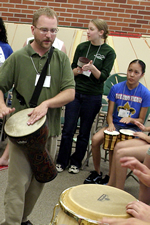


Article from: http://www.calvin.edu/worship/stories/drumming.php
What is it about percussion that appeals to worshipers in so many cultures? How does drumming together help Christians build community?
John Meulendyk, pastoral lay assistant at Zion Evangelical Lutheran Church, could plainly see the problems facing Ferndale, Michigan. Like many inner-ring suburbs of Detroit, Ferndale is losing people, jobs, and income. Meulendyk gathered five women at his church to pray and discern how to  address these changes.“We wanted to do a worship renewal project that would be ecumenical, something to unite the congregations in our community. We sat in prayer. We thought about this question: If we put aside all the theology, what unites us? “It’s our Heartbeat..
Human beings are created in the image of God. However, because of sin we have lost our connection with God and with each other. Through Christ’s redemption we receive the courage to explore our lost connections with one another. In the syncope of our beating hearts echoed through the African drum, Christ creates a way for us to confront our most daunting fears and prejudices of others. In terms of worship renewal, by following the rhythm of our beating hearts through the drum, God gives to us an embodied connection with others.
This new relationship creates worship – a space, whereby, we and others are renewed in sensing God’s own heart beat. We all have that in common. And 90 percent of cultures have a drum beat,” says Meulendyk, who has degrees in divinity, pastoral ministry, osteopathic medicine, public health administration, and dental surgery. So Zion invited local congregations to join them for a worship drumming project. Its results continue to resound in worship services and new relationships.
Many cultures use percussion in worship. Thirty years ago, when Meulendyk was a missionary dentist in Guatemala, he noticed that using hand drums and marimbas helped missionaries spread the gospel and connect with Quiché Indians.
Young and old, black and white, richer and poorer, Baptist and Episcopal, people fell under the spell of recreating rhythms from a Catholic liturgy in Ghana. Not that it was easy to learn the multi-layered patterns of metal gankoqui bells, gourd rattles, djun djuns (double-sided drums), and djembes (single-headed, goblet-shaped drums). “The big struggle is to hold on to your rhythm when everyone else is doing a different one,” Meulendyk said.
***********************
Let us reread some of these statements:
“If we put aside all the theology, what unites us? “It’s our Heartbeat..”‘
“Through Christ’s redemption we receive the courage to explore our lost connections with one another”
“through the drum, God gives to us an embodied connection with others.”
Put theology aside? Lost connections with one another? Through the drum, God gives to us……?
“People fell under the spell…”
We have learned from studying eastern religion that the occult practices of meditation and mindless repetitions, cause an altered state of consciousness. This is the doorway to divination. The Bible forbids this. So, this is yet, another sickening practice that is being brought into the church under the guise of spirituality. Worshiping in an altered state will NOT connect you with the Lord Jesus Christ. It will bring you into harmony with the angel of light. Satan is the angel of light the deciever.
This is just one more form of apostasy, and it weighs down my heart to see these Christians so vulnerable to deceit. God will give us nothing through the drum….God is reached through prayer and reading of the Holy Bible.
MARCIA’S STORY: A STRANGE BUT TRUE SPIRITUAL JOURNEY
Spirit guides, meditation, astrology, the “higher Self,” raising the kundalini, developing psychic abilities, praying to gurus, astral travel, numerology, Tarot cards, contacting the dead, hanging out with witches, Sufis, followers of Muktananda, Rajneesh, Sai Baba, Maharaji, — all these and more were part of my journey. How did I get on this path?
The beginnings
I grew up with an agnostic father and a mother who was raised going to church. My sister and I had to attend church, because my mother thought that was the right thing to do, although she did not always go. Due to my father’s job in the Foreign Service, we moved around a lot, so we ended up in different churches located overseas and in the Washington, DC, area. Eventually, I became serious about religion. In high school, I had the idea that being good would please God and get me into heaven. But reading about other religions and meeting those who believed differently made me wonder. Maybe there was more to it than what I had — some knowledge of God and Jesus which was mostly superficial. I wanted something deeper, more experiential. I was also rejecting the idea of hell and was disillusioned with Christians. Christianity seemed defined by sermons, going to Sunday School, and doing good works. How boring! I was missing out on something! Also, I never fit in during my high school years. Being someone who wrote poetry, being in an alcoholic home, having no real roots all combined to make me feel different and unlike other people. I started my journey at the end of high school.
That journey continued through college where I had paranormal experiences, made friends with someone who said she saw auras, and attended spiritualist meetings where the ministers received messages from the dead. One bright sunny Florida afternoon, as I rested on my bed fully awake with eyes partly closed, I felt myself floating. I opened my eyes and was stunned to see my body on the bed below me as I hovered near the ceiling. I thought I had died. The shock slammed me back into my body in an almost painful way. This was my first out-of-body experience and I had no idea what it was or that it even had a name. I told no one about it.
The journey stretched into the 70’s when I visited psychics and an astrologer, and did a lot of reading on the paranormal, and about Hindu and Buddhist beliefs. I remember reading a book on Vedanta (sect of Hinduism) each morning in the cafeteria of the building where I worked. I started to see connections in my life with the colors of the chakras, the seven psychic centers of energy in the body according to Hindu beliefs. This and other experiences pushed me into an active plunge into the alluring worlds of the paranormal and Eastern beliefs.
Into the fire
In an Inner Light Consciousness class, I was introduced to my “spiritual master” during a guided visualization. This guide, a spirit being, looked kind and wise. I felt his presence with me and sometimes saw him in dreams and meditations until 1990. I also had unpleasant, scary and weird experiences and visitations, once seeing a tall hooded figure in dark robes looking at my body in the bed as I hovered out-of-body nearby. Although extremely frightened by this apparition, I rationalized it by telling myself that I was being tested. Another time, as I was out-of-body, I not only saw my body on the bed, but also saw a double of myself floating across from me. I had spontaneous out-of-body experiences that sometimes kept me from sleeping and that were also often very eerie. But to me, the paranormal was spiritual, and spiritual was good.
Another reason I accepted the scary stuff was my attitude. I liked to think I was tough and nothing could frighten me away. So I would think, “Go ahead, scare me. I can take it!” I had a lot of anger and defiance in me which probably came from dealing with an alcoholic parent. This angry defiance proved useful to me in many ways. It helped me get through a lot of painful situations, and it was going to help me deal with the bizarre experiences I would face. But anger and defiance over a long period of time easily turn into cynicism. I did become cynical although it was usually hidden, even from myself, behind a desire to help people. This defiant cynicism was my defense, as in “No one is going to stop me doing what I want; nothing can scare me away; and don’t try to impress me.” Later, after many occult experiences, the cynicism was deeper. I knew a lot of people had not done what I had, and I thought most people were wimps and satisfied with superficial lives, not searching deeply as I was. But this was my defense against getting hurt or feeling helpless.
I also learned to meditate, do psychic healing, analyze dreams, and chant. It was mystical and magical. When I first started to do Eastern meditation, I felt an incredible peace. I felt that I was fading away and merging with something greater. It seemed I was literally one with the universe, and the teaching that we are all connected to one force seemed true. After all, I believed that truth was in experience, and here my experience was confirming that belief. At last, I thought, I was connecting to that spiritual realm. Later, my studies took me on many paths — Tibetan, Hindu and Zen meditation and philosophy, spirit contact, numerology, psychic development, past life regression. Reincarnation seemed to answer questions and I experienced what I thought were memories of past lives. However, it was sad to think that my next life might not be so great so if I did not learn lessons from this or previous lives. But why dwell on that?
Finally, it seemed I was on the edge of a hidden wisdom, a truth higher than the everyday superficial thinking around me. Books by Edgar Cayce, Ruth Montgomery, Chogyam Trungpa (Tibetan Buddhism), Annie Besant (Theosophy), Hanz Holzer (ghosts), and Ram Dass (Hinduism/New Age), and titles like Seth Speaks, The Tao of Physics by Fritjof Capra, The Metaphysical Bible Dictionary, and Autobiography of a Yogi by Yogananda began to fill my shelves, along with books on astrology, tarot cards, numerology, and other occult teachings. My spiritual progress seemed assured, especially since I was having so many paranormal experiences. The natural result was that I felt I was an “insider” in the spiritual realm.
Unanswered questions
Over the years, my psychic experiences escalated. I studied astrology and took a 7-hour exam on astrology in Atlanta, Georgia, administered by the City but formulated and graded by an astrology board, in order to qualify for the business license. Passing the test, I started practicing astrology, and eventually I taught astrology, gave public talks, wrote for astrological and New Age journals, and sat on the board of astrology examiners that gave and graded the exams, becoming chairman of that board. I became president of the Metropolitan Atlanta Astrological Society in June, 1989. My Halloween birthday and astrological skills made me popular with witches and others.
I noticed that while doing chart readings for clients, I would “tune in” to the chart in a paranormal way, during which I felt an energy connecting my mind to the chart, and felt guided through the chart. It often seemed that I was being fed information or led to specific things to say about the client. After so many years of Eastern meditation techniques, I was slipping without effort into an altered state of consciousness while doing astrology. I gave credit to my “past lives” as an astrologer and spiritual counselor, to the help of spirit guides, and to astrology itself. In those years, the only source of such information could be good since I did not believe in evil.
Yet, with all the knowledge and experience I had acquired, what were the answers? Since I came to believe there was only ignorance, not evil, stories of vicious cruelty and murder made me uncomfortable. Though I believed I would be coming back after my death, where would I go in between and for how long? Some taught that we would go somewhere that was like a school, then choose our next life. Others taught that we go somewhere to be spiritually purified – how, it was not explained – then our next life would be chosen for us. By whom? That was not explained. We were supposed to just trust the process.
There was also the disquieting teaching that whatever thought was in my mind at the moment of death would determine the after-death experience for some time. Better not have a bad thought for too long! Better not fall asleep with fearful images! This was scary to contemplate — but that contemplation was itself a negative thought! I would often soothe myself by meditating or chanting something — maybe the “Hare Krishna” chant I had taught myself, or repeating a Tibetan Buddhist mantra like “Om Mani Padme Om.”
I sought peace in Zen Buddhism. Trying to detach myself from all desire involved a meditation that allows thoughts, fears, or desires to come up and then not to respond to them. This was to be applied to life outside meditation as well. For someone like myself, carrying a lot of emotional pain from my past and my present, this was appealing. But though detachment sounded good in all the books, there was a price to pay. The detachment seemed contrived and unnatural. Seeing “the emptiness” behind my surroundings, another sign of spiritual acumen, struck me as nihilistic and depressing. Maybe if I had pursued these practices more devoutly, I might have gradually replaced my natural reactions and feelings with non-feeling. But is it human to be non-feeling, to accept every thought, action, and emotion without judgment?
Being taught to be natural and “holistic” on one hand, but then learning to let go of my natural reactions on the other, seemed a contradiction. Of course, rational analysis like this was discouraged, even attacked. Therefore, contradictions could and should be accepted. If it didn’t make sense, so much the better. The idea was to transcend the rational mind which was a barrier between me and enlightenment. Although I failed in achieving detachment, I clung to the paradoxical teachings of Zen, reading books with Zen tales, and continuing the meditation. I noticed that the peace I had felt with my initial meditations had decreased, causing me to meditate more in an attempt to re-capture that elusive peace.
I also learned that the nature of occult and New Age thinking is that there is no one answer. There is no one single truth, and there is no one reality. Truth is based on your experience, so it changes and can differ from person to person. If there are multi-levels of reality and there is no absolute truth, then there must be many contradicting truths and realities. In the abstract, this was fascinating food for thought, and led to being comfortable with whatever truth I wanted. But on the practical level, what difference did truth make if one finally discovered it? Or how did we know if there really was such a thing? And if not, what did anything that anyone believed matter anyway? These teachings gave answers that only raised more questions.
Death and love
We are just drops in the ocean, I learned, and the goal is to eventually, after many lifetimes, rejoin the cosmic oneness that some call God. This God-force was what we came from and was our final destiny. So that meant my identity, memories, talents, and personality would be swallowed whole into the cosmic One. Where would I be? The disturbing answer was that I would no longer be. Death became an absorbing but uneasy topic for me.
The best way to help others and stay true to your path, I heard and read over and over, was to work on yourself and love yourself. Although talk of “love” was common and was taught to be the basis for everything, it also seemed that some used the “law of love” as a way to justify whatever they were doing. So, if your husband was not your spiritual match, then “real love” allowed you to leave him or find another with whom you had a true bond. After all, this was a “law” of the universe: the law of love. But this love was not defined. It was just sort of out there – a love force that pervaded the universe. There was no personal being to love me; there was this energy coming from the cosmic One and that was it. Could a force care?
Despite the meditations, trying to live in “the now,” and the talk of love, I continued to have frightening experiences. One of the worst was waking up to see an older woman staring at me from the bottom of the bed. I knew she was not flesh and blood, but a spirit. She did not speak, but I heard her in my mind say to me, “I am here to take over your body.” Too scared to speak, I said in my mind, “No! No!” This seemed to go on for a long time, although I have no idea how long it really was. Finally, she simply faded away. I was left trembling, perspiring, and my heart racing. By the way, I was not doing drugs.
The compulsion
An unexplained compulsion to go to a church gripped me in the spring and summer of 1990. Since I hated Christianity, churches and Christians by now, this made me angry. I first ignored this compulsion, then resisted it, and then, after struggling against it for awhile, I decided to give in, hoping that it would go away. It was probably from one of my former lives as a priest or monk, I reasoned.
In the opening minutes of a service in a large church in downtown Atlanta, I felt a love I had never known wash down over and through me, so powerfully that I started crying. I knew this love was from God, not from the music, the people, or the place. That love was the real thing. Coming from an alcoholic home, I was starving for that love. I returned the following Sunday, not to have another experience, but so that I could be where that love had happened to me.
After several weeks, I began to feel unclean about astrology although no one in this open-minded church said anything about it. All I knew was that it was somehow separating me from this God of love. I then got the impression that God did not like astrology and wanted me to give it up. Give up my life’s work? Give up my identity and purpose? Outside of my son, nothing was more important to me than astrology. But I felt I had no choice; it was so clear to me that God did not like astrology. Not even believing what I was doing, I decided to give up astrology in late 1990. At the time, I was chairperson of the curriculum committee, a member of other committees at the astrological society, and scheduled to teach an upcoming class. I had to find another teacher. I had to tell clients who called I was no longer an astrologer. (I did give a talk in February, 1991, after bad advice from a pastor and not liking what I was doing but not strong enough to get out of it. It took over a year for full comprehension of what I had been involved in to sink in.) Now what happens? Thinking I should read the Bible, I started reading in Matthew, the first book of the New Testament. Reading the Bible put me in touch with something pure, but I didn’t know what it was. Although I had read the Bible before while growing up and had quoted from it for astrological articles, this time it was different. I felt as though I was being cleaned from the inside out as I read it.
As real as it gets
This person Jesus fascinated me. It was as though I was learning about Him for the first time. One evening while reading part of the 8th chapter of Matthew, right before Christmas of 1990, I saw who Jesus really is. On the boat with His disciples, a terrible storm arose. The disciples were afraid and woke Jesus up, telling Him that they were going to perish. Jesus stopped the storm in its tracks! How? He did not visualize calm waters, He did not perform sorcery. He rebuked the winds and the sea, and they obeyed him. That means He has authority over nature. I was separated from God by everything I had done in my past — I had lived my whole life based on my will, a will that had rejected and defied God and His word. I realized that the only way to be forgiven, the only way to be reconciled with God, was through Jesus, the God-man who suffered and died for me out of a great and unconditional love. I realized Jesus is the Savior, He is the Son of God and God the Son. I understood for the first time why Jesus died on the cross. In those several minutes sitting on my bed with the Bible, I knew that the truth and the answer to all my questions were one and the same: Jesus Christ. What a simple but awesome truth! And so I gave myself to Christ and knew I belonged to Him from that moment on. Several months later, I found out that a young Christian man at the part-time job where I worked had been praying for me with a fellowship group at his church during 1990.
Jesus was different from the masters I had studied. He was more real than the spirit guides, the Ascended Masters, the Higher Self — all those airy, elusive things that gave no evidence of their existence — because He came to earth in flesh and He hungered, thirsted, felt pain and sorrow. He did not give a message that denied the dirt and dust of life, but He sat with the outcasts, the prostitutes, and the hated tax collectors yet remained sinless. He was as real as it gets. Though fully man, Jesus was fully God incarnate, equal to God in nature but setting aside that glory (not deity) to be among suffering men and women. Jesus Christ willingly was tortured, laid down His life and died an agonizing death to pay for our sins. He bodily rose on the third day, conquering death, so that we can have eternal life with God. No sorcerer, no spiritual master, no Buddha, no shaman, no witch, no psychic has conquered death, but all still lie cold in their graves. But Jesus has power over death and is living today.
Truth and satisfaction
Spiritually, I had been in a grave with the buddhas and the sorcerers and the seekers of wisdom who had rejected the truth of Christ. The complicated and intricate studies that had enthralled me, the endless layers of truths and realities I had pursued, the constant effort to evolve, the paranormal experiences, the need to believe in one’s own goodness at all costs, were all a maze and a trap. The truth was simple enough for a child because the truth is a Person. Jesus did not teach the way or say He had a way. He said that He is the way — not a way, but THE way.
Many people want to know if I had to wage spiritual warfare after trusting Christ. Well, a few months later, as I was about to go forward in a church to publicly proclaim faith in Christ, I got incredibly ill. When I went home, I got sicker. I felt an angry presence in the room and I thought it was my spirit guide. I basically told him I belonged to Christ and there was nothing he could do about it, that even if I died, it was too late. “You lose,” I said. I was addressing Satan, although I was really talking to my spirit guide. I do not believe in doing this now; I do not address demons nor Satan. They have already been spoken to and defeated by Christ. I prefer to speak to the ruler of the universe, Jesus Christ. I do not want to give demons any attention at all. Yes, I have had a few strange attacks that could be construed as demonic. But I do not like to focus on them. My focus is on the One who is worthy of attention: Jesus Christ, who has power over all rulers and principalities, in both the physical and spiritual realms.
What is the biggest difference between my former life and my life in Christ? That I am happier, that life is easier? Not at all. The difference is that I am spiritually satisfied. There is more to learn and much room to grow, but the learning and growth spring from Christ as the foundation, not from a search outside Him. The search has ended; the thirst has been quenched; the hunger within has been filled.
(You will find Marcia’s story with more detail in Chapter 10 of The Unexpected Journey (Zondervan) by Thom S. Rainer. This book contains the firsthand accounts of 12 people who came to faith in Christ from other spiritual beliefs and told their stories to Dr. Rainer. This book is sold on Amazon’s site and also on the CBD site at www.christianbook.com, and can also be found in or ordered by bookstores).
Jesus speaks
“I am the way and the truth and the life. No one comes to the Father except through me,” – John 14:6.“But whoever drinks of the water that I shall give him shall never thirst; but the water that I shall give him shall become in him a well of water springing up to eternal life.” – John 4:14“I am the bread of life; he who comes to Me shall not hunger, and he who believes in Me shall never thirst.” – John 6:35“And Jesus came up and spoke to them, saying, ‘All authority has been given to Me in heaven and on earth.'” – Matthew 28:18
“Here I am! I stand at the door and knock. If anyone hears my voice and opens the door, I will come in and eat with him, and he with me.” – Revelation 3:20
*************************
Here is Marcia Montenegro’s site
CANA Christian Answers for the New Age.
http://christiananswersforthenewage.org/AboutCANA_Background.html

http://www.letusreason.org/Default.htm
Mike Oppenheimer of:
Let Us Reason Ministries
MY TESTIMONY
I was brought up Jewish, went to Shabbat quite faithfully each Friday and celebrated the holydays at the temple and with family. Our family like many others, gathered together on the high holy days in observance. I attended Hebrew school twice a week and learned the language and eventually was Bar Mitzvahed and confirmed. While attending classes I asked a lot of questions about God the Rabbi could not answer. Though I continued each year, mainly to please my parents, I became less interested in the traditional religion of my parents and feeling hindered in my spiritual development, leaped head first into my own brand of freestyle spirituality after graduation.
By my own search in reading and attending lectures and gatherings I got involved in the New Age Movement, became a vegetarian and for 15 years practiced yoga and meditation. I ended up using psychedelic drugs for a time (LSD, mescaline etc.), as part of my regular religious observances and smoking “pakalolo” (pot) became part of my normal lifestyle. During these times I also experimented with various religions and the occult. I felt they each contained some part of the truth of the one “true” religion, just as Rosicrucianism teaches all religions are petals on the same flower.
I studied about the Ancient Masters of the East, learning about Buddhism and Zen I picked up on a number of the practices. I had a number of spiritual experiences which at the time I was sure were from God and leading me to a greater knowledge of myself and Him. I discovered and believed in the Ascended Masters that were guiding our world into a greater evolutionary path. I was involved with UFO’s and channeled messages. I was sure I was on the right spiritual path because of the various signs things just fell into place. At the same time I also read the Bible (even the New Testament), not denying my Jewish roots. I began reading over 50 books a year, having an insatiable spiritual appetite, but God was working on my exit out of this spiritual bondage.
I had also started to surf before beginning my spiritual pilgrimage. I fell in love with the sport and began traveling, surfing and entering contests. Surfing became my livelihood after I learned to shape surfboards for a living. I became the NY champion for a number of years and eventually the eastern surfing champion for two years. Hawaii proved to be an irresistible attraction due to its fantastic surf. I moved permanently to Hawaii with my girlfriend Kathy in the mid 70’s. This gave me more freedom to pursue both my first love of surfing and my freelance spirituality. We thought we were becoming enlightened. Reading books about the Ascended Masters involvement and “learning” about Earth’s past history on Lemuria and Atlantis. We desired to become servants of the New age movement, convinced that if we all united we could usher in an age of spiritual cooperation and enlightenment that so many were talking about. After nine years my searching came to a head when my girlfriend Kathy and I started to pursue our spiritual hunger more seriously and became involved in the “I Am Movement” (the Saint Germaine Society of the Ballard’s). Through calling on angels and powers unknown to us and by “decreeing” and using the Violet Consuming Flame to eradicate past life karma, we were learning to become active in the New Age Movement. At the time, Kathy was practicing affirmations, mantras, studying herbology, polarity therapy, kinesiology and learning about the supposed spiritual energies of the body. She also was a manager of a health store on the Island of Oahu.
At the same time, the Lord started moving ahead with His rescue plan and during one week we had two friends over who had recently became Christians. One was also a surfer that I knew from New York. We talked about end-time events for hours. Since I was familiar with, as I had been reading the Bible for years, and was especially fascinated about the end of the age. (At that time we both thought Christians were very narrow minded about their view of the Bible, God and the world. Kathy and I used to laugh about how the New Age was coming in without Christians even being aware of it, and were still trying to live in the old traditions and were not going to be part of it). Later that week my friends invited us to a seminar that just so happened to be on the New Age Movement with speakers Dave Hunt, Johanna Michaelson and Hal Lindsey. Talk about timing! It was also during that same week that I heard an audible voice say, “I am the Lord your God, you shall not want.” I recognized this was from Psalm 23 from my Jewish upbringing and had never experienced anything like it. Inside I knew this was the God I was searching for but still did not know. It was only later I would understand why this voice was outside and not from inside me.
I attended the Christian conference on Bible prophecy and the New Age Movement that week while Kathy stayed home doing her New Age affirmations. She wasn’t feeling well that day and unknowingly had really been going through a spiritual battle all that week. At the conference, I was shocked to hear the other side of the story. The information I heard seemed incredible. The speakers knew all about the occult techniques Kathy and I were following and practicing, and about the New Age Movement’s master plans. I spoke to Dave Hunt briefly during a break and he answered a number of important questions. One was why Jesus said, “why you have forsaken me?” Though I was reading the Bible all these years I could not understand the gospel contained in it. I was blinded by the viewpoints ingrained from the New Age influences. I was also challenged by Dave on the occult practices in which I was personally involved practicing. He was aware of the “I am societies” practices. One question he asked was, “If you’re God did you create the universe? I had never thought this through. If I’m trying to become god through all these New Age techniques, how could this be possible, when God was always all knowing and all powerful (according to the Scriptures and what I had heard through their speaking that night). It was through this question that a chain of events led to the Lord really ministering the truth to my heart and mind. When the conference resumed Johanna spoke and I was relating to a lot she had experienced, especially in regards to the Ascended Master “Jesus”. Then she spoke about another Jesus – the true Jesus of the Bible, which came as a total shock. I never thought there could be false Jesus’ parading around as the real one. They were only Jesus by name but not the One who is God come in the flesh. It all made sense. When she prayed my heart was pierced, I knew I had heard the truth, but the question was; what would I do about it?
All the way home I wrestled with the realization that I had wasted the past 15 years believing and doing the wrong things. (Prior to this I thought Christians were very narrow minded but now I had to reconsider that I was too open-minded and had bought into a lie.) I asked my friends who took me to the meeting numerous questions that were running through my mind. Being new Christians, they could answer only a few of them. They just kept saying to me, “we know the Bible is God’s Word and Jesus is the truth.”
Kathy was waiting up for me when I got home. It was late and she was actually scared that I would come home a Christian from the meeting! As I came in a peace came in the house and on her, as I sat her down and shared about how the Christians viewed the last days and how it wasn’t anything like what we were being taught in the New Age Movement. It was then that the Holy Spirit revealed to Kathy that not only were we following the wrong Jesus (2 Cor.11:4), but that we were worshiping Satan, and that he is a real being. Then the fear of God fell upon us and for the first time we got down on our knees and prayed to the true living God to forgive us for the occult beliefs we had been deceived into practicing. The Lord got the last laugh, but it was a pleasant one of victory.
The next morning we both went to a Christian church and the pastor got to the pulpit and said that he was told to change the sermon. He spoke on sin, Satan and Jesus Christ, we thought our friends had tipped him off but it was the Lord. We heard the gospel explained and dedicated our lives to the Lord, repenting and asking Christ to forgive us. Thank the Lord He intervened. We were saved together in the year 1986. It was later that week I found out that it was on the 20th anniversary of my confirmation day when God spoke that previous week to me Psalm 23. The last thing I read in front of the congregation in the temple 20 years before had been Proverbs 4:1-2 “Hear my children, the instruction of a Father, and give attention to know understanding. For I have given you good doctrine, forsake not my law.” Unfortunately, I did forsake His Law, for 20 years- but God brought me and my soon-to-be wife back. Five weeks after our spiritual birth Kathy and I were married and today have a 15 year old son who has been learning and become very interested in the debate of creation versus evolution among other interests.
Immediately, I began to study the Bible and learn apologetics in order to give answers to those who ask why we believe in Christ and why Jesus is God in the flesh. Since 1988 I have continued teaching on the cults and aberrant world views including how the cults deny grace and opt for works to be accepted by God. These include the Jehovah’s Witnesses, Mormonism, and also the occult (New Age world view) which is now very present inside the Church.
By the grace of God I have had the privilege to have taught at Hope Chapels, Calvary Chapels, Church of Christ, Youth With A Mission, United Methodist Church, Grace Brethren, Assembly of God and various other Hawaii congregations. I have also had the opportunity to share in small group studies around the Island and have been involved in a number of debates. The Lord has currently provided us with the opportunity to host a TV program and had live call-in broadcast called “Let Us Reason” on a local Christian station as well as featured on several other live radio broadcasts in Hawaii. I am currently a missionary for Witness Inc., the world’s largest counter cult ministry reaching out to Jehovah’s Witnesses.
In 1994 Let Us Reason Ministries was founded as an up-to-date apologetic resource center to instill both confidence and a desire to lead others to Christ. This is done by helping equip believers with both Biblical, and logical answers for their Christian faith. I have learned many things along the way that need to be passed on to others to encourage as well as equip them in their witnessing. It’s my hope that this ministry will be able to prompt believers to personally meet and evangelize people who are in cults and false religions as well as discern and call attention to false doctrine within the Church.
Mike Oppenheimer
(used with permission from Let us Reason)
Here is another testimony that you might like to read.
kim
https://kimolsen.wordpress.com/2007/12/25/a-testimony-of-a-former-new-ager/
and another
https://kimolsen.wordpress.com/2007/09/13/the-toronto-deception-by-former-tacf-pastor-paul-gowdy/
This article is from CONTENDER MINISTRIES. I was impressed by the Rast’s, who give us a great example of how to respond to the New Age Movement with a biblical response.

New Agers are the real Christians –
It is people like you who are actually the anti-christ….the ‘so-called’ Christians like yourself who condemn and ridicule the new agers (or any other religion) like you do. You, like the Pharisees at the time of Christ cannot see beyond your own limited world-view. Christ was able to see the divinity in man….the wonderous power that man owns (the holy spirit) He was telling the Jewish people of this ….and they called him a blasphermer. He died telling us all that God lives inside of each and everyone of us…not just some of us…as you the Anti-Christ would like us to believe!You like to divide us…..with your judgemental, narrow-minded rhetoric, placing hatred and fear of other religions into the innocent minds of children and adults. You place New Agers and eastern philosophies in the seat of evil and yourself in the seat of God.. You point fingers at anyone you consider to be a sinner….judging their conduct as good or evil….. exactly what Christ said NOT to do. (don’t judge another, lest you be judged yourself)the power of evil (satan) lives and thrives in the division you try sooo hard to create…and you know that. The division between Christian and what you term “new age” is only in the minds of people like yourself, and other radical christians. Satan grabs hold you …in your fear of the new age, in your judgemental accusations, and in your hate and anger toward us. We (new agers) never point fingers at others because we know that all religions are in the pursuit of the same God, and eventually, through the wonderful process of self-realization (yoga, meditation, prayer, kind acts, forgiveness), we will find God because that was Christ’s ‘Way”…. that was Christ’s teaching to us!! We know that God lives in each one of us…even people like you. God doesn’t see religions, colors, sex or any other kind of groups like you do.You say we call ourselves ‘divine’…but the truth is that we are all part of God…who is divine .. thereby we have that holy spirit within each of us. However the power of this spirit is only available when it is combined with others who also have this glorious realization…. because it is in the unity of our spirits that there is power.The new age is here to stay, and unlike you and other ‘so-called’ Christians (not the Christian Jesus was) , we belive that it will be GOODNESS that prevails, not guided by intolerance and conformity to man-made religious dogma, but by tolerance for all people (love, acceptance, support) , intelligence and kindness. Your ‘Way’ toward tomorrow is paved with fear and anger. Christ spoke of Wolves in Sheeps clothing, and after reading your article on the New Age influence …. I see what he meant. You try to appear as though you were on Christ’s side, but I can see clearly that you are part of Satan’s handiwork.
I hope this letter helps you to find peace and re-directs you on your search for God. Open your heart and your mind (as Jesus tried to get the Pharisees and all people to do)…and you will find tha Jesus was right when He said “even greater things than this can you do …if you only had faith as big as a mustard seed”!!! Don’t fight the glory of this new age, when Christ’s truths will be made evident to all.
Sincerely,
Diane
CONTENDER MINISTRIES RESPONSE:
Greetings Diane, and thank you for contacting us at Contender Ministries. There seems to be a lot of anger/frustration in your message to us, but I’d like to reply to your views and interpretations of Christ’s teachings, as opposed to the name-calling.
You say that we are all divine. You contend that the Holy Spirit is a “power that man owns,” and that He dwells in all of us, as we are all part of God. You attempted to back this assertion by saying that Christ taught of the divinity of man, yet you included no scripture reference from the gospels as evidence of your claims. I have read the gospels, and in fact re-read them today before responding to your email. I can tell you conclusively that Jesus never taught that man was divine. The cornerstone of New Age doctrine has no basis in the gospels, or anywhere else in the Bible for that matter. In fact, Jesus taught quite a different theology than that which you espouse.
In Luke 18:19, Jesus said, “No one is good – except God alone.” That certainly seems to belie any claim to the divinity of man. Only God alone is good. To make any claim to divinity is to exalt our own nature, which is inherently sinful (Romans 3:23). Jesus said, “For everyone who exalts himself will be humbled, and he who humbles himself will be exalted,” (Luke 18:14). Anyone who exalts him or herself by claiming divinity will eventually learn a lesson in humility.
In John 14:16, and again in chapter 16, Jesus talks of the Holy Spirit that will remain after Jesus is taken back to God the Father. In these verses, Jesus is speaking to His disciples. He tells them that the Holy Spirit will act as Counselor to His followers. He will convict sinners of their actions. He will reside in the hearts of the followers of Christ. In no way do any of these passages indicate that the Holy Spirit will reside in the hearts of all men. The Holy Spirit does not reside in the heart of unrepentant sinners. However, if such a sinner accepts the gift of eternal life offered through Jesus Christ, and is cleansed of his sins, then he truly can receive the Holy Spirit.
You said we judge people. We do not. We recognize that only Jesus will judge men, on behalf of God the Father (John 5:22,27). A question you should ask yourself is this: If all men are divine, and all are a part of God, then what need would there be for a judge? God does not judge himself, so we cannot be parts of God. If all men are divine, there would be no need for judgment. There is a Judge though, and there will be a judgment.
Why is a judgment needed? Because the truth of the gospels is that there is a path to Heaven, and not all men are on that path. In John 14:6, Jesus said, “I am the way and the truth and the life. No one comes to the Father except through me.” Jesus also taught us, “For God so loved the world that he gave his one and only Son, that whoever believes in him shall not perish but have eternal life. For God did not send his Son into the world to condemn the world, but to save the world through him. Whoever believes in him is not condemned, but whoever does not believe stands condemned already because he has not believed in the name of God’s one and only Son,” (John 3:16-18). Do all men believe that Jesus is the Son of God, and the only path to salvation? Unfortunately, the answer is “no.” In Matthew 7:13-14, Jesus said, “For wide is the gate and broad is the road that leads to destruction, and many enter through it. But small is the gate and narrow the road that leads to life, and only a few find it.” Jesus is the small gate, and his teachings are the narrow road. You said we were “narrow-minded,” and in light of the previous verses I would have to agree. But truth is not relative, and it does not change to suit the desires of each person. Truth is inherently a narrow path. Since not all men accept that Jesus is the Messiah and the Savior of mankind, there is a need for a judgment, and Jesus will be that judge.
Jesus will be the judge of men, but we at Contender Ministries are following scriptural instructions to judge doctrines, beliefs, and theologies. We must judge them so we are not deceived by the false prophets Jesus said we would encounter (Matthew 7:15, 24:11, 24:24, Mark 13:22). As Christians, we must stand in judgment of teachings that are not in accordance with the gospel of Jesus Christ. At Contender Ministries, we expose these teachings. We do not presume to judge the followers of the false teachings, but we expose those teachings so that others might be warned, and come to salvation through Jesus Christ before they stand before Him to receive their judgment.
You said that we were the antichrist. There are actually two different versions of antichrist mentioned in the Bible. On one hand, you have Antichrist with a capital “A,” spoken of in the book of Revelation as well as Old Testament prophecy. He will be the great deceiver that will defile the temple in Israel and become possessed by Satan himself. There are also antichrists with a lowercase “a.” John defines these as follows: “Who is the liar? It is the man who denies that Jesus is the Christ. Such a man is the antichrist – he denies the Father and the Son,” (1 John 2:22). We believe that Jesus is the Christ, and we believe in the Father and the Son. Therefore, your characterization of us as the antichrist is inaccurate.
You said our “Way toward tomorrow is paved with fear and anger.” Nothing could be further from the truth. Our way, the only way (John 14:6), is Jesus Christ. We are angry at no one, and we go on without fear. In an age where Christianity is the most persecuted religion in the world (as Jesus predicted), we endure suffering for Him, because our salvation with Him for all eternity is secured. He paid the price for us, and we accepted His free gift of salvation.
The belief in the divinity of man is a lie. It is, in fact, the original lie that Satan used. He convinced Eve to eat of the forbidden fruit with the lure that if she did so she would “be like God.” Satan has used this lie throughout history to deceive many. The New Age has bought into this lie. You said the New Age is here to stay. I happen to agree with you – to a point. I believe that the New Age will thrive until Jesus Christ returns to defeat the Antichrist and establish His Kingdom on earth. We urge you to resist this lie of Satan. We urge you to recognize that, like the rest of us, you have a sinful (rather than divine) nature. We implore you to turn to the one true and living God, and seek forgiveness for your sins. If you do so, God has promised to cleanse you of your sins. May God reveal Himself to you, and may you turn to Him. Then, may God bless you in your new life.
In Christ,
Ben and Jennifer Rast
Contender Ministries

Prophesying and preaching the Gospel at a Psychic Fair
A group of IHOP–KC evangelists went to a psychic fair in Kansas City recently. They set up a table and began prophesying God’s destiny over approximately 100 people involved in New Age religion and witchcraft. God broke in and did amazing things. Since the weekend of the fair, people from the fair have contacted the evangelism team wanting to know where they can meet with them to recieve ministry, and several have been saved since. It was an exciting weekend, where the Lord moved and people were born again, including one of the mediums working the fair. Click below to read and listen to the testimonies. http://www.ihop.org/group/group.aspx?id=1000003885
Please read this article that I found on the IHOP website. There is so much wrong here that I can not begin to fathom it. Remember that the New Age Jesus is not the same as our Lord Jesus Christ. Satan comes as an angel of light and professes love and peace. I have highlighted many of the red flags in red….my comments in blue. I would like to add that it sounds as though some good came out of this, but hard to say.
***UPDATE*** IHOP has pulled this article from their website so the above link no longer works, but it is preserved here on my blog.
A Weekend with the Witches
By Ken DeBenedictis
I’ve been having these conversations with fellow believers about the “New Age
Movement” for years now. I know, I know… it’s evil. It’s deceptive. Witchcraft.
Demons. Cooties.. Look out their gonna get you..blah, blah, blah. I have to admit that the
very fact that it causes so much nervousness and controversy amongst the prophetic Body
of Christ makes me want to set my coordinates and head straight in. So when the
opportunity came for some friends and I to go to a Psychic Fair, I couldn’t have been
happier.
My friend, Erika had noticed an ad on a billboard announcing the fair and felt a tug from
the Lord to explore the idea of being involved. She gave me a call and the two of us
began to search out the contacts on the website that she read off the billboard. I gave the
organization a call and had a real interesting conversation with one of the head
organizers. He asked me who I was what I was wanting. I simply told him that we were a
network of friends called the “Mystics of Yeshua” ( this is deceptive) and that we wanted to be involved as
venders. He began to interview me and wanted to know just what kind of “vendors” we
were. Wisdom began to speak through me (to deceive another person?) and I explained that we work as a group of
interconnected “readers” and “seers” who channel Yeshua’s energy into people. We also
do aura cleansing. He seemed to like that answer and began to ask further about the
cleansing. I said that if people coming to us had any negative energy that they wanted to
get rid of, the pure light from Yeshua would remove any dark energy that they might be
carrying. I figured the answer was satisfactory, because the next thing out of his mouth
was him telling me we could have a section of the “reading room” and share it with the
other psychics and mediums.
“How much do you charge?” he asked.
“Uuhm…nothing”, I replied. “We believe that if you give this kind of service away free
of charge, it comes back to you somehow”.
He said he knew what I was talking about and put me on hold.
We exchanged information and were told the process of how to apply. Apparently the
registration was already past and this was a “unique situation” for the organization.
Nonetheless, within minutes I was told that we could have two tables and we could pretty
much set up the way we wanted. I thanked him very much for the opportunity and knew
right then that Yeshua was on the move.
Within two days we had assembled a team of eleven people through cell phones and
emails and gathered together at a coffee shop to get everyone on the same page. Our first
rule of thumb was no Christianese or church-language of any kind. (sounds like Willow Creek) If we were going to
get through to anyone in this environment, we had to speak THEIR language, not try to
make them understand ours. Speaking “energy” was a key and walking with Wisdom was
essential to this mission. In order to follow Him in this strategy, we truly had to be sheep
in wolves clothing.
Erika, Liz and myself arrived at the Community College where it was to be held and
strolled in past the crystal tables, wolf skins, and witchcraft how-to books. A hypnotic
toned base flute was playing in the background, as was the lingering smell of Nepalese
incense. It couldn’t have been more ideal. We found a stocked pond full of fish and we
were the only ones at this derby! We met the director of the fair and she told us that she
had been expecting us. We signed the code of ethics statement, which to my surprise
impressed me with their integrity more so than some of the prophetic ministries I have
been to. (?) We walked in with our gear to a wide-open expo center. There were stalls of
tarot card readers, psychics and mediums all around the edges of it with rows of chairs
for people to wait in the middle. I couldn’t help but think of some of the prophecy teams
that I have ministered with at prophetic conferences. Surprisingly, it was very similar in
appearance until I looked to my right to notice an albino woman’s eyes roll back in her
head as she read her cards for a nice young couple. Not exactly lining up with
1Corinthians 14:3, but it seemed to flow with the spirit of the thing. We proceeded over
to our area and by the director’s recommendation and grabbed two stalls next to each
other at a corner so that “our energies could stay together”. We politely thanked her for
her help and suggestions and began to set up shop. I looked over at Erika who was now
hugging one of the witches, and realized we had just entered into a large door of God’s
grace. It was truly remarkable how cooperative everyone was being and how much love
seemed to be exuding from us. The Lord was opening doors one right after the other.
It didn’t take long to get started. We put up our sign, anointed ourselves with oil and
prayed in tongues for a few minutes. When the time was right, Yeshua’s Spirit began to
lead people over one by one. Our first customers was a grandmother, mother, daughter
trio who sat there intently listening as Erika began to speak Word’s of Love into their
hungry hearts. It truly flowed like a river and within seconds woman number one was in
tears. We couldn’t believe how easy it was. Before long, a steady flow of people began to
come. We started getting in the groove pretty quick. We’d introduce ourselves, explain
what “Yeshua” meant, informed them that one person would be the “channel” while the
other would be the “oracle”. That there was no need for fear because it’s the same spirit
that’s working through both of us. We told them it would be pure love and light that they
would feel and to be open to receive it. Time quickly went by under this anointing and we
all felt the power of the Spirit upon us. I looked over at Liz who was now having a good
time with the folks, as she had her hands in the air trying to catch the next wave of Love
Energy. The wide-eyed couple across from her was whispering, “Yes, we feel it! Yes we
feel it”. It was quite a scene. The Lord was loving it. By now we were beginning to create
quite a buzz at the expo center and people began to ask about us to the people in charge
of the fair.
Like any good leadership group would do, they sent an inquiry.
“What is Yeshua?” a woman would ask.
We’d explain it in its most basic terms until; they decided that they too wanted a reading.
We knew we were being tested and gave them a quick prophetic word in the most loving
way we knew how. I didn’t think it was much, but apparently she did because within a
half hour we learned the registration people were sending people over to us. According to
them and a lot of the other readers, our energy was the “hottest”.
By the second day, we were in our flow. We now had three booths given to us and up to
five people ministering. My friend Doug who had stall number two had told me he had
never prophesied the way he was that day. His last customer had been prophesied over,
fell into conviction, (wow, this is actually good) accepted Yeshua, and was baptized in the Spirit in one shot. Many
were having similar experiences. I was finding that the majority of the people we were
talking to and “reading” were from denominational backgrounds and had never
considered this kind of thing coming from the “church”. It was truly amazing to learn just
how many people had been hurt by careless and uninformed pastors. I felt like for many
former Christians, this was their turning point. Many times, after “channeling” love
energy for a while, I would prophecy in the first person as if the Father was speaking to
His daughter or son. I’d begin to tell them about how I (or He) had made them, their
calling and their importance to Me (Him). How the Father had been there through any
specific hurt, wound or trauma in their lives and wanted to heal and wash them. That He
had now sent a prophet into their lives in a Psychic Fair to reach them in a personal way.
It was like an arrow being shot into their hearts. Tears of relief and joy rolled down the
cheeks of person after person. At one point, I looked over at all of our tables and noticed
every person was weeping.
One of those I spoke with reminded me of a female Bob Jones. I discerned she was a
psychic reader and began to prophesy accordingly. She gazed into my eyes intently as I
was speaking and then glared an evil glare. I stopped to look into her and told her that we
had a little negative energy problem and said that I would be not talking to her, but to it.
After sending Mr. Negative away in the name of Yeshua, the woman thanked me and I
continued to explain that her gift was a gift from Yeshua and that she had abused it. (this gift was not from Jesus!) That
instead of using it for the King of Kings, she had been using it to serve herself and the
spirit of Baal. Her eyes rolled back and she grinned a demon smile. But then the strangest
thing happened, as she seemed to come to her senses and looked at me as if for help.
Tears welled up in her eyes and she said that it had become so hard. She truly knew that
God had spoken to her and wanted to change. I told her that a prophet’s life was a hard
one and then we both started to weep as the Holy Spirit began to rest on us. I told her that
that the King was returning and sides were being taken. Who was she going to serve? I
looked into her eyes and I knew that for her to give this up meant that the demons would
kill her.( i have never heard this before) She grabbed my hand and thanked me and got up and left. I couldn’t believe
what the enemy was doing. It enraged me. There were so many of the Lord’s end-time
prophets stuck in the trap of sorcery and witchcraft. It made me all the more determined
to go in and pull out these trapped prophets.
Later that afternoon, Erica and I were approached by an older woman who had been a
reader/psychic in one of the other booths. She was about to go home for the day, but said
that something had made her come over to talk to us. My friend Liz had already
connected with her once and I knew that the Spirit had been working on her. She sat
down and Erika just bathed her in love and acceptance. I was ready to speak and the
Spirit began to swirl around my head. I know when this happens, it’s time to let ‘er rip. I
opened my mouth and began to speak the Word of the Lord to her. For some reason I
bypassed the “energy” language and spoke of Christ the King. How He was coming back
and that she was being called as a prophet to this nation. That she was loved and that the
Lord wanted her back home. Tears were streaming down her face as she wept in
repentance. She went on to say that as a Baptist, she was hurt by a pastor and never
returned. That someone had prophesied that her husband would lay hands on people and
see them get well. It had never been realized. I explained that the Lord had forgiven her
and was calling her to serve Him. Today. Right now. She nodded in agreement and the
Lord told me to anoint her with oil right there. I told her that I was accountable to God if
I did this and wanted a real commitment. I wasn’t playin’. I signaled for LeeAnna who
was sitting at the table next to us, to help us. She came over and the three of us baptized
this dear woman in the Holy Spirit for everyone to see. I continued to prophecy over her
life and spoke of how God had had spoken to her at thirteen years of age about so and so
and this and that. After we had finished, her eyes as big as saucers, she said that no one
but God would know what I had just said. (or the demons) She went on to explain that she had given her
life to the Lord at thirteen and He was reminding her of that. The swirl of the Spirit was
all over everyone. She cried, we prayed, and she said that she had been dreading the car
ride home, but now she couldn’t wait to talk with the Lord. She got up drunk in the Holy
Spirit and went home to do some “house cleaning”. The next morning at the fair, I arrived
to the expo to see the directors of the fair taking her belongings and her name badge out
of her booth. Joan had retired from her practice. She was now a prophet to Yeshua.
There were many other stories of salvations and tears. There were miraculous words of
knowledge and battles in the spirit. I even had a conversation in tongues with a witch. It
was pretty awesome. All in all, we all felt the Lord’s heart for people following the New
Age movement and how He is building teams like ours to go and plunder the enemy’s
camp. It just goes to show you that where the darkness is darkest, the brightness of His
light shines that much brighter. Let’s not miss these opportunities to shine.
The people who walked in darkness have seen a great Light; those who dwelt in the
land of the shadow of death, upon them a Light has shined. You have multiplied the
nation and increased it’s joy; they rejoice before You according to the joy of
harvest, as men rejoice when they divide the spoil.
Isaiah 9:2-3

I have two books by Ray Yungen, “A Time Of Departing” and “For Many Shall Come In My Name”. Both of these books are packed with information regarding the universal spirituality which is “preparing the world for the end of the age”.
What caught my interest in this article is the mention of Marcus Borg. I have studied him previously because of his involvement in a seminary board which demotes Jesus to a historical spiritual man.
In September this year, a local Episcopal church about 2 miles from my home, advertised in our local newspaper, a study group based on the book “The Meaning of Jesus” by Marcus Borg. “It explains ways to relate to Jesus in a new way.” This alone made me shudder. Also they promoted “prayer and meditation in the Celtic tradition”.
I read about apostate churches all over the country but when it happens so close to home, I weep inside because of the reality of it all.
kim
Filling the Vacuum with Mysticism
Source: Ray Yungen
by Ray Yungen
Why are the mainstream denominations so open to meditative and holistic practices? David R. Griffen, professor of theology at a United Methodist college in Clairmont, California, states:
A spiritual vacuum exists in organized religion that might he filled by theologies that draw–for better or worse–from what is called parapsychology, paranormal studies, psychic phenomena and, somewhat pejoratively, the “New Age” movement.1
New Agers have become very much aware of this “spiritual vacuum” and have directed their efforts toward filling it. Metaphysical leader James Fadiman makes the following observation:
The traditional religious world is just beginning to make changes, but it’s a slow process–denomination by denomination. When religious institutions begin to lose members year after year, they eventually become aware that they’re not meeting people’s needs. Before long they’re scurrying around looking for innovative programs and improvements.2
Even atheists have observed this trend. Science-fiction writer Richard E. Geis comments in his personal journal that:
The mainstream Christians are lip-service religions in the main, convenience religions, social religions, and they are the ones most subject to erosion and defections and infiltration and subversion. A large and successful effort seems to have been made by the occultists’ New Age planners to dilute and alter the message of most of the mainstream Christian religions.3
This is made evident by a quote which appeared in a newspaper interview with the owner of a New Age bookstore. She reveals:
A lot of people come in who are very Christian. They are looking, by whatever means, to move closer to God on an individual basis.4
This shows that a great number of people who consider themselves to be Christians have a rather dull and dreary attitude toward their faith. They are looking for something to fill the void. One of the foremost individuals who has attempted to fill this void with the New Age is Marcus Borg, professor and author of many widely read books. In one of them, The God We Never Knew, he lays out very concisely how he went from being a traditional Christian to a “mature” Christian. He relates:
I learned from my professors and the readings they assigned that Jesus almost certainly was not born of a virgin, did not think of himself as the Son of God, and did not see his purpose as dying for the sins of the world…. By the time I was thirty, like Humpty Dumpty, my childhood faith had fallen into pieces. My life since has led to a quite different understanding of what the Christian tradition says about God.5
Like multitudes of liberal Christians who believe as he does, Borg turned to mysticism to fill the spiritual vacuum that his way of thinking inevitably leads to. Borg reveals:
I learned about the use of mantras as a means of giving the mind something to focus and refocus on as it sinks into silence.6
This is a recurring theme in all his books, including his very influential book, The Heart of Christianity. Even though Marcus Borg would certainly not call himself a New Ager, his practices and views on God would be in line with traditional New Age thought (i.e., God is in everything and each person is a receptacle of the Divine, which is accessed through meditation).
Borg is a key example of what I am trying to convey. He is not some Hindu guru or counter-culture type personality. He represents the mainstream for millions of people in liberal churches. But his spiritual platform is pure New Age as he makes clear when he expounds:
The sacred is not “somewhere else” spatially distant from us. Rather, we live within God … God has always been in relationship to us, journeying with us, and yearning to be known by us. Yet we commonly do not know this or experience this…. We commonly do not perceive the world of Spirit.7
This perception is, of course, as I have shown [in Yungen’s book], the outcome of mantra-induced silence.
The following is another barometer of Christian tolerance to New Age ideas. The late psychologist M. Scott Peck wrote a phenomenal best seller on psychology and spiritual growth titled The Road Less Traveled. The book contains insights and suggestions for dealing with life’s problems, which is why it has generated the interest it has. But the book also incorporates the central theme of the Ancient Wisdom:
God wants us to become himself (or Herself or Itself). We are growing toward godhood. God is the goal of evolution. It is God who is the source of the evolutionary force and God who is the destination. This is what we mean when we say that He is the Alpha and the Omega, the beginning and the end….
It is one thing to believe in a nice old God who will take good care of us from a lofty position of power which we ourselves could never begin to attain. It is quite another to believe in a God who has it in mind for us precisely that we should attain His position, His power, His wisdom, His identity.8
Madame Blavatsky and Alice Bailey [New Age occultists] could not have said it any better. Peck revealed where he was coming from when he said, “But (The Road) is a sound New Age book, not a flaky one.”9 This book, which was on the New York Times best seller list for over 400 weeks, has been incredibly popular in Christian circles for years. Peck himself said the book sells best in the Bible Belt.
What is happening to mainstream Christianity is the same thing that is happening to business, health, education, counseling, and other areas of society. Christendom is being cultivated for a role in the New Age….
This ultimately points to a global religion based on meditation and mystical experience. New Age writer David Spangler explains it the following way:
There will be several religious and spiritual disciplines as there are today, each serving different sensibilities and affinities, each enriched by and enriching the particular cultural soil in which it is rooted. However, there will also be a planetary spirituality that will celebrate the sacredness of the whole humanity in appropriate festivals, rituals, and sacraments. There will be a more widespread understanding and experience of the holistic nature of reality, resulting in a shared outlook that today would be called mystical. Mysticism has always overflowed the bounds of particular religious traditions, and in the new world this would be even more true.10
The rise of centering prayer is causing many churches to become agents of transformation. Those who practice it tend to embrace [a] one-world-religion idea. One of the main proponents of centering prayer had this revelation:
It is my sense, from having meditated with persons from many different traditions, that in the silence we experience a deep unity. When we go beyond the portals of the rational mind into the experience, there is only one God to be experienced…. I think it has been the common experience of all persons of good will that when we sit together Centering we experience a solidarity that seems to cut through all our philosophical and theological differences.11
In this context, we may compare all the world’s religions to a dairy herd. Each cow may look different on the outside, but the milk would all be the same. The different religious groups would maintain their own separate identities, but a universal spiritual practice would bind them together–not so much a one-world church as a one-world spirituality.
Episcopal priest and New Age leader Matthew Fox explains what he calls “deep ecumenism”:
Without mysticism there will be no “deep ecumenism,” no unleashing of the power of wisdom from all the world’s religious traditions. Without this I am convinced there will never be global peace or justice since the human race needs spiritual depths and disciplines, celebrations and rituals, to awaken its better selves. The promise of ecumenism, the coming together of religions, has been thwarted because world religions have not been relating at the level of mysticism.12
Fox believes that all world religions will eventually be bound together by the “Cosmic Christ”13 principle, which is another term for the higher self.
As incredible as this may sound, it appears to be happening now. The New Age is embedded in American religious culture far deeper and broader than many people imagine. If your concept of the New Age is simply astrology, tarot cards, or reincarnation, then you could easily miss the real New Age as it pulses through the religious current. If mystical prayer continues its advance, then we could one day see, perhaps sooner than we expect, many Christian churches becoming conduits of New Age thought to their membership.


“FAITH UNDONE” by Roger Oakland
the emerging church…a new formation or an end-time deception
One would be hard-pressed to find a more complete description of the various end-time deceptions currently exploding in our churches in one single paperback book. Roger has accomplished this feat in “Faith Undone”.
Why is his book so relevant today? Consider this statement. “In the near future, Christians of every denomination will have to decide whether to support or reject the spirituality behind the emerging church.”
Here are some of the topics he covers in his 13 chapters.
- Emerging Spirituality
- Mysticism
- Post-Modernism
- Labryinths
- Contemplative Spirituality
- Yoga
- The “Eucharistic” Christ
- Purpose Driven Ecumenism
- The Kingdom of God on Earth
- The New Reformation
From Chapter 1 – A New Kind of Church
“It is not the ambience of the emerging church that causes me to write this book. It is the theological underpinnings….But is this ‘new reformation’ actually the way God has instructed us to go?… A new form of Christianity will replace faith with a faith that says man can find his own path to God and create a perfect kingdom of God here on the earth. The Word will become secondary to a system of works and rituals driven by ancient mystical practices.” (pp. 12-13)
This last sentence “The Word will become secondary to a system of works and rituals driven by ancient mystical practices”, is so very true of every deceptive practice being introduced into the church and the world today. This falls in line with occultist Alice Bailey who said “the teachings of the East and of the West must be fused and blended before the true and universal religion could appear on earth”.* When the church embraces occult teachings, we have to come to our senses and take notice of what is happening right in front of our eyes. The Bible warns of this deception but people do not want to listen.
Roger also says:
“This book does not attempt to identify every key player in the emerging church movement. There are too many…my objective is not to attack individuals but rather to unveil a belief system. Thus, this is not a book out to get the bad guys. On the contrary, it is a book that seeks to rescue those involved with the emerging church and countless others heading in that direction.”
“In the near future, Christians of every denomination will have to decide whether to support or reject the spirituality behind the emerging church. If the emerging church continues unfolding at its present pace, mainstream evangelical Christianity will be restructured so that the biblical Gospel of Jesus Christ will be considered too narrow and too restrictive.” (p.20)
This is happening this very instant and many are totally unaware. This is why Roger’s book is so important. Let’s take a look at some of his other findings. This is from Chapter 6, When West Meets East.
“In the early ’80s, I became aware of a major shift in thinking that was sweeping the Western world. Religious pagan practices of the past, once relegated to a world of darkness, were now being embraced as the ways and means of ushering in an age of enlightenment….Every method and therapy imaginable imported from Hinduism, Buddhism and every form of Eastern mysticism suddenly was in vogue. The age of enlightenment had arrived, we were told.” (p.93)
This cannot be more true. Think back even farther when the Beatles swept in from England in the mid 60’s. They themselves delved into Hinduism and Transcendental Meditation because of George Harrison’s fascination with the East. The baby-boomers of today are already familiar with these practices so it is no wonder that it is not a stretch for them to readily accept yoga and meditation into their life. What does Roger have to say about this?
“Today it is becoming increasingly common to hear about churches promoting Christian yoga or Christian leaders suggesting the best way to enhance one’s prayer life is by getting in tune with God through repeating a mantra. What was once described as New Age and occultic is acceptable now in some Christian circles. ”
“Anyone who cares to do the research will find that yoga and its connection to Eastern religion remains the same. Linking oneself with the universal energy is still its goal. A Christian can believe that yoga is for health and well being if he or she wants, but the facts have not changed.”
“Can a Christian incorporate Hindu spiritual practices in order to get closer to the Jesus Christ of the Bible?” (pp. 94,96)
Roger goes on to explain why the answer to this question is NO. But you will have the read the book for the remaining argument. Let’s go on to Rick Warren and some of his extraordinary quotes found in Chapter 9, The Kingdom Of God On Earth.
“Rick Warren’s reformation, which will bring in the Kingdom of God through global cooperation for a common cause, will include Catholics, Muslims, and homosexuals – a combination hardly similar to the 16th century reformation…Rick Warren believes that God has shown him not only the boundaries (or lack of them) of this coming global kingdom, but also the strategy to bring it about. Before Warren came up with the plan, he says he asked Jesus to show him how to reach the world. He explains:” (p.149) (Warren’s comments in red)
RW “Then I said, ‘How did You do it? You wouldn’t have left us without a strategy.’ And I found the answer in a passage in Matthew 10 and Luke 10 where Jesus sends His first followers out…He says, ‘When you go into a village, you find the man of peace in every village, in every government, in every business, in every church.* The man of peace does not have to be a Christian believer. Could be Muslim. Could be Jewish. Because when Jesus said, ‘Find the man of peace, there were no Christians yet. Jesus hadn’t died on the cross. There was no resurrection. He’s just saying, go out and find somebody to work with.” (pp. 149-150)
“Jesus did not say they were to look for a man of peace of every town, Rather he said ‘whatsoever city or town ye shall enter , enquire who in it is worthy; and there abide till ye go hence” (Matthew 10:11)…it is important to realize that the criterion for staying in a house was not the greeting of peace itself but whether those in that house received their message.
“And whosoever shall not receive you, nor hear your words, when ye depart out of that house or city, shake off the dust of your feet.” (Matthew 10:14)
“Let me speak very boldly here: if we are going to link hands with those who believe in another gospel or no gospel at all for the sake of establishing an earthly, unified kingdom, we will not be building the kingdom of God.” (p.151)
RW “I stand before you confidently right now and say to you that God is going to use you to change the world…I’m looking at a stadium full of people who are telling God they will do whatever it takes to establish God’s Kingdom ‘on earth as it is in heaven.’ What will happen if the followers of Jesus say to Him, ‘We are yours’? What kind of spiritual awakening will occur?” (p. 153)
“What does Warren mean by ‘whatever it takes’?
I am going to advance to Chapter 12, A New Reformation, for the next Rick Warren quote.
“In an article written by Rick Warren, “What Do You Do When Your Church Hits a Plateau?”, Warren told pastors and church leaders not to be discouraged about slow change in their churches. He told them it would take time…and in many cases, it would take these resisters either leaving the church or simply dying. Warren exhorts:” (p.204)
RW “If your church has been plateaued for six months, it might take six months to get it going again. If it’s been plateaued a year, it might take a year. If it has been plateaued for 20 years, you’ve got to set in for the duration. I’m saying people are going to have to die or leave. Moses had to wander around the desert for 40 years while God killed off a million people before he let them go into the Promised Land. That may be brutally blunt, but it’s true. There may be people in your church who love God sincerely, but who will never, ever change.” (p.205)
“By making statements like this, Rick Warren marginalized those who won’t go along with the new reformation that he is hoping for. While Warren doesn’t say that people should kill them, he does say that God may have to end their lives, just like when ‘God killed off a million people before he let them go into the Promised Land.'” (p.205)
These are frightening statements and I am sick of Rick but he will have to be dealt with. There is so much more in “Faith Undone”, like Warren telling his followers that the details of Christ’s return are none of our business, (I can’t tell you everything!), but we must move on to the emergents.
There are so many involved in the emergent movement that one needs to go to www.lighthousetrailsresearch.com or http://www.lighthousetrailsresearch.com/blog/ to check out all the names, but Roger gives much attention to Brian McLaren. (blue comment) McLaren was named one of the country’s top 25 “Most Influential Evangelicals” in 2005 by Time magazine.
“In an interview, Brian McLaren questioned the idea of God sending His Son to a violent death, calling it “false advertising for God”:
BL “One of the huge problems is the traditional understanding of hell. Because if the cross is in line with Jesus’ teaching then-I won’t say, the only, and I certainly won’t say the primary–but a primary meaning of the cross is that the kingdom of God doesn’t come like the kingdoms of this world, by inflicting violence and coercing people. But that the kingdom of God comes through suffering and willing, voluntary sacrifice. But in an ironic way, the doctine of hell basically says, no, that’s not really true. That in the end, God gets His way through coercion and violence and intimidation and domination, just like every other kingdom does. The cross isn’t the center then. The cross is almost a distraction and false advertising for God.”
“What an extraordinary example of faith under attack and the consequences of thinking outside the box. If McLaren is right, all those who have ever lived and believed in Christ’s atonement have been misled and wrong. McLaren has taken the freedom to to reconstruct what faith means by distorting the Scripture, or worse yet, saying the opposite of what the inspired Word of God says. This is blasphemy!” (pp.192-193)
I have resisted taking the final comment from Roger’s book from the last chapter, Or An Endtime Deception, even though there are many gems to pick from, and have selected this from p.217
“The emergent reformation, when it comes to fruition, will stand on the side of the line drawn in the sand that says all humanity is One–regardless of religion, beliefs–we are all One. That One-ness will mean one with all creation too, and inevitably with God. This is what the New Age movement is striving for–a time when all of mankind will realize both their unity and divinity–and the Gospel as we know it, according to Scripture, will be no more.”
******************************************
Others mentioned in the book – Alice Bailey, Rob Bell, Ken Blanchard, Marcus Borg, Bob Buford, Tony Campolo, Peter Drucker, Richard Foster, Matthew Fox, Thomas Keating, Dan Kimball, Barbara Marx Hubbard, Erwin McManus, Thomas Merton, Henri Nouwen, Doug Pagitt, Leonard Sweet, and Robert Webber among others.
How is it that this one book can cover so many names and issues? It is because they are all related and together they have one goal and purpose in mind, which is Faith Undone, a must read for every Christian.
Order this book at Lighthouse Trails Publishing.
* Marilyn Ferguson, The Aquarian Conspiracy p.280
* Government, business, church is Druckers 3-legged stool.
 DiscernIt

Recent Comments