
You are currently browsing the category archive for the ‘Spiritual Life’ category.
Mike Bickle admits Catholic Contemplative influence on IHOP-KC
From the Office of Public Relations, Franciscan University of Steubenville, 11/9/12:
“The International House of Prayer (IHOP) was founded in 1999 by Mike Bickle, who says that many IHOP teachings draw upon the works of St. John of the Cross and Teresa of Avila, as well as contemporary Catholics including Father Henri Nouwen and Father Thomas Dubay, SM. The IHOP 24 hour prayer room, he says, was inspired by the spiritual practices of Catholic European monks, such as St. Bernard of Clairvaux. ‘I’ve always had a passion for Catholic-Christian unity, and enthusiastically welcome this years Catholic track,’ says Bickle. ‘We may have different religious traditions, but we focus on fellowship, and unity and Jesus being glorified in prayer, worship, and teaching.’” [1] (bold mine)
Read article HERE
I pulled out of all private/secret Christian groups I was involved with a couple of months ago. They often foster a lot of haughtiness and ridicule of “sheeple.” Truth was explained as ” hard to take” for those who saw something a bit differently in another group. In another group which someone added me to, false prophecies did not have to be explained to the public.
I Corinthians 13, the passage on love is inserted in a very important section in the Bible. Paul was explaining that love was “the most excellent way.” It is no wonder that unless we have love we will sound like a “clanging cymbol.”
Our love for the Lord can change the motives of our hearts in all that we do that is pleasing in His sight.
As discerners continuing to weigh and test all things against scripture it is important to keep the following warning signs of our own hearts in mind.
******
6 WARNING SIGNS WE’RE BECOMING ACCIDENTAL PHARISEES
Larry Osborne
Pharisees are more than mere tidbits of ancient history.
The Pharisees’ sad transition from God’s most zealous defenders to Jesus’s archenemies is important for every Christian to understand. As long as our only image of a Pharisee is that of a spiritual loser and perennial enemy of Jesus, we’ll never recognize the clear and present danger in our own life.
I’ve found that becoming a modern-day, accidental Pharisee is a lot like eating at Denny’s. No one wants to go there. We just end up there.
The journey usually starts out innocently enough. It begins with a desire to be at the front of the “following Jesus” line. We step out in faith, make some big changes, clean up areas of sin and compromise, and begin to pursue new spiritual disciplines.
So far, so good. But as we press forward, it’s hard not to notice those who lag behind. And it’s at this point that we have an important decision to make: will we keep our eyes glued on Jesus or will we turn our focus onto those who lag behind?
DON’T LOOK DOWN!
I remember once meeting with a group of men who were passionate about their walk with God. Somehow our conversation turned toward those in the church who were not so passionate. Next thing I knew, they were ripping on the way everyone else raised their children, spent their money, read their Bible, and set their priorities.
Now these were quality men. They were doing far better than most raising their kids, spending their money, reading their Bible, and setting priorities. The problem wasn’t that they noticed the difference. The problem was what they did with the information. They used it to justify looking down on everyone else.
HE HATES HAUGHTY EYES
When I called them on it, they were mildly remorseful, sort of like they’d been busted for a speeding ticket. But it was clear to me that no one felt particularly convicted or determined not go there again. So I decided to take them on a little journey through Scripture to see God’s perspective on the conversation we’d just had.
We started with Satan’s prideful fall and moved on from there. But the shocker for most of them was a list of things God hates. It’s found in Proverbs 6:16–19. Right at the top of his I-hate-it-when-you-do-that list is “haughty eyes,” the disgusted and disdainful look of arrogance that parallels the harsh conversation we’d just had.
There are lots of things that can anger God. Few would guess that looking down on others would be at the top of the list. Yet it is.
Now that got their attention!
But it’s true. Their dismissive and judgmental take on others wasn’t minor chitchat—it was major sin. Top-of-the-list sin.
I wrote Accidental Pharisees because I’ve become increasingly concerned that many in our tribe are making the same mistake. We strive to be at the front of the following-Jesus line. Yet the closer we get to the front, the more we’re tempted to compare ourselves with those in the back.
So here’s a brief list of six of the most telling indicators that we may have inadvertently started down the road of an Accidental Pharisee, looking down on others and trusting in our own righteousness.
1. DISDAIN FOR THOSE AT THE BACK OF THE LINE
Instead of a Jesus-like compassion for those who can’t keep up, we view them with a deepening sense of frustration, cynicism, and a cocky arrogance.
2. A SPIRIT OF EXCLUSIVITY
When thinning the herd becomes more important than expanding the kingdom; or raising the bar becomes more important than helping people climb over it, something has gone terribly wrong.
3. EXTRA-BIBLICAL RULES AND EXPECTATIONS
Few of us would see ourselves as legalists. We think we’ve moved on from old-school legalism because we no longer judge people by what’s in their refrigerator. But the spirit of legalism still runs strong. We now judge people by what’s in their driveway and how big their house is.
4. A PATTERN OF IDOLIZING THE PAST
Whether it’s the New Testament church or the scholars of old, we tend to give them a free pass for their failures. But the present-day bride of Christ and the current crop of leaders whom Jesus has put in place are assailed for their blind spots, failures, and feet of clay. Like the Pharisees of old, we rip on the living prophets and then build monuments to them once they die.
5. A QUEST FOR CLONE-LIKE UNIFORMITY
Jesus had room for Simon the Zealot and Matthew the Tax Collector. Yet sometimes, the more biblically grounded we become, the less room we have for anyone who hasn’t yet learned all that we’ve learned. The result is a circle of fellowship that’s tighter than Jesus’s circle of acceptance.
6. GIFT PROJECTION
“Gift projection” the toxic belief that my calling is everyone else’s calling. It disfigures the body of Christ by insisting that ears become eyes and hands become feet. It looks like passion for the mission, but in reality, it’s candy-coated arrogance.
TWO ROADS DIVERGE
The good news is that even if we’ve inadvertently started down the road of an accidental Pharisee, we don’t have to end up there. We can repent, turn around, and reset our gaze on Jesus. But for that to happen, we have to recognize that we’ve left the path of discipleship. And that’s why I wrote Accidental Pharisees, to highlight the warning signs that we’ve left the path and turned down a dangerous detour that turns well-intentioned zealots into accidental Pharisees.
SEVEN KEYS TO FRUITFUL CHURCH MEMBERSHIP
By David Cloud
Way of Life
FEBRUARY 14,2012
A few years ago, I received a letter from a young couple who exhorted me as follows:
“Your book on separation is very good, but you may want to add a caveat that a person must have a better church to separate to before he separates from a church. We were shocked at the liberal doctrines held by the fundamental churches in our city.”
Later they wrote to share more detail about the “liberal doctrines.” Following are specific things that they mentioned:
“(1) Their former pastor did not teach that women should not work outside the home, and the wife of the associate pastor worked. (2) The church held parties or fellowships on Valentines Day, Halloween, and Christmas. (3) The pastor allowed a divorced person to work in the bus ministry. (4) The pastor failed to correct publicly certain erroneous statements which were given during testimony times and certain (supposed) erroneous statements which were made by visiting preachers. (5) The pastor failed to do anything about missionaries who joked and told stories in the pulpit. (6) Though the church took a stand for the KJV, this man did not think there was sufficient teaching on the subject of Bible versions. (7) The pastor “used humor to break the tension” in his preaching, whereas this one felt that sober- mindedness required that such levity in the pulpit cease. (8) The pastor seemed to prefer to let God change people about such things as appearance (long hair, ear rings on men, etc.) rather than approach them directly.”
The couple eventually wrote and said they had “separated” from this fundamental Baptist church and from its pastor “because of his liberal teaching on remarriage, women working outside the home and his refusal to correct error.”
It is natural that in any church we will find things with which we do not agree. To practice Bible separation based on the type of things discussed in this letter, though, is not proper or healthy. These are matters of preference, or, at best, relatively minor issues. Church members must learn to deal with many such things.
While we are to separate from error, we are also exhorted to submit ourselves to pastoral authority and to exercise grace in the church. I believe there are many types of things about which we can disagree in a church while continuing to submit ourselves to God-ordained authority. There does not have to be a contradiction here.
I know of others who have separated from practically all churches because none of them take what they believe is a proper stand in all matters. Many times these are good people who want to contend for the truth in a confused and apostate hour. (Many others, though, are contentious people who simply refuse to submit to God-ordained authority.) I praise the Lord for anyone who has a zeal for the truth, but I also believe there are some important lessons in the Word of God that can help us deal with the complex matter of church membership.
The following thoughts, which are an enlargement of my original reply to the aforementioned couple, can help us to have a more fruitful attitude toward the assembly in spite of the many problems and imperfections we find there.
No Ecumenism or Compromise
Let me hasten to say that I am utterly opposed to ecumenism and spiritual compromise. I realize that New Evangelicals and ecumenists take some of the things we will deal with in this article and misuse them to excuse their disobedience. They speak much of love and grace and liberty, but they take verses on these subjects out of context and refuse to deal with the enormous amount of teaching in the Word of God on other matters, such as rebuking sin and error, contending for the faith, warning about apostasy, and exercising separation and discipline.
In this article I intend to deal with grace and liberty and submission to church authority, but I have no intention to ignore these other issues.
Those who know us will not have to be told this, but I say this for the sake of those who do not know us. For thirty-nine years, we have stood unapologetically for Bible separation. In this instance, though, we are dealing with other important matters.
Keys to Fruitful Church Membership
Please bear with me while I offer seven things we must know and do in order to be a fruitful member of a New Testament church. I think of these as “keys to fruitful church membership.”
A Vibrant Relationship with Jesus Christ
The first and foremost key to fruitful church membership is a real and vibrant relationship with Jesus Christ.
“Then said Jesus unto the twelve, Will ye also go away? Then Simon Peter answered him, Lord, to whom shall we go? thou hast the words of eternal life. And we believe and are sure that thou art that Christ, the Son of the living God” (John 6:67-69).
“Abide in me, and I in you. As the branch cannot bear fruit of itself, except it abide in the vine; no more can ye, except ye abide in me” (John 15:4).
“And now, little children, abide in him; that, when he shall appear, we may have confidence, and not be ashamed before him at his coming” (1 John 2:28).
In order to submit to godly pastoral leadership and to have the spiritual discernment to know right from wrong in churches, one must be born again and have the indwelling Spirit of God.
Many church members who cause unnecessary problems in the church and who injure the welfare of the church do so because they do not have a saving relationship with Jesus Christ. They lack spiritual discernment; they walk after the flesh rather than the Spirit; they do not know how to submit to authority; and they do not care how they harm the church.
The Bible warns that God will deal severely with those who harm His churches. “If any man defile the temple of God, him shall God destroy; for the temple of God is holy, which temple ye are” (1 Cor. 3:17). The reason many troublemakers do not fear God’s retribution for their actions is that they are not saved.
In order to be a fruitful church member year after year, one must not only be saved but he also must abide in Christ. He must walk in fellowship with Christ. When we walk with Christ and have our eyes on Him, we do not become offended at what man does. “Great peace have they which love thy law: and nothing shall offend them” (Psalm 119:165).
This is why some church members throw up their hands and quit or become disgruntled and spiritually ineffective when they witness a pastoral failure or some such serious problem in the church, whereas other church members keep on for the Lord in spite of any discouragement that comes their way. They are disappointed when men fail them, but they do not quit or turn aside because their eyes are upon One who never fails!
Abiding in Jesus Christ is the most essential key to fruitful church membership.
The Importance of the Church
Another thing we must understand to be a fruitful church member is that the church is a divine institution and it is at the center of God’s work in the world today and is to continue until Jesus returns.
The Bible emphasizes that the church is God’s appointed means of accomplishing His purposes in this age. Even the most cursory study of the New Testament proves this. There are more than 100 references to the church in the New Testament. This shows how much the Holy Spirit has emphasized the church, and the vast majority of those references refer unquestionably to the local assembly, not to a general or prospective aspect of the church.
Men have corrupted churches, but the church is God’s plan. The Lord Jesus said, “I will build my church; and the gates of hell shall not prevail against it” (Mat. 16:18). The church is Christ’s program.
The church is the pillar and ground of the truth (1 Tim. 3:16), and the context is a church with elders and deacons (1 Tim. 3:1, 8).
Most of the New Testament was written directly to churches. And even those portions not written directly to a particular church refer to the church. The theme of Acts is the planting and multiplication of the first churches. The Pastoral Epistles (1 and 2 Timothy and Titus) were written to instruct church planters.
Even the General Epistles, which are not written to particular churches, always have the churches in mind. Hebrews refers to the church in chapters 10 and 13. Hebrews 10:25 exhorts God’s people not to forsake the assembling of themselves together. In Hebrews 13:7 and 17 Christians are exhorted to obey church rulers.
The last chapter of James refers to the church. Those who are sick are to call for the “elders of the church.”
The final chapter of 1 Peter also refers to the church, in exhorting elders in their duties.
John refers to the church in his third epistle, when he mentions the proud Diotrephes.
The book of Revelation, of course, is addressed to seven churches that existed in that day.
Consider, too, that there is no Bible instruction about the discipline and watch care of Christians apart from the church. There is no instruction about leadership among Christians apart from the church. The entire life and work of God’s people for this age appears in the context of the assembly.
We must also understand what a church is. A proper New Testament church has certain biblical ingredients. It is not merely a group of Christians meeting for prayer and Bible study. Paul wrote to Titus about church work in Crete. The gospel had been preached and believers were meeting together, but that was not sufficient. Paul instructed Titus that certain things were lacking (Titus 1:5). Those things were qualified leadership and biblical organization, the things Paul emphasizes in his epistle to Titus.
The very first thing that Paul mentions is the ordination of elders. “For this cause left I thee in Crete, that thou shouldest set in order the things that are wanting, and ordain elders in every city, as I had appointed thee” (Titus 1:5).
We see the same thing in the book of Acts. When Paul and Barnabas raised up groups of believers in various towns through the preaching of the gospel, they were careful to “ordain elders in every church” (Acts 14:23).
A proper New Testament church, therefore, is a body of baptized believers who are congregated together under the oversight of qualified and ordained pastor/elders and who are following the pattern of government and accomplishing the work described in the apostolic epistles.
It is clear from Scripture that it is God’s will that every believer be a faithful and fruitful member of a sound New Testament church. That is what we see in Acts 2. Those who were saved on the day of Pentecost “continued stedfastly in the apostles’ doctrine and fellowship, and in breaking of bread, and in prayers” (Acts 2:42)
If there is not such a church in the area, the establishment of such a church must be the highest priority. A believer should never be content merely to listen to recorded preaching sermons, or to read sermons from a book, or to listen to preaching on radio or television, or to meet together with a loose-knit group of believers without proper leadership and organization.
The reason I have remained a faithful member of a church for 39 years is not that I have found perfect pastors and perfect churches, but because I know that this is God’s will and anything less would displease Him. It is my understanding of the doctrine of the church that keeps me going in spite of grave imperfections I have found in churches.
No Perfect Church
Another key to fruitful church membership is to understand is that there are no perfect churches. We have mentioned this, but it needs to be emphasized. It sounds like a simple matter, but it is not. It is something that must be relearned frequently.
Even the early churches founded and pastored by the apostles had problems. In fact, there were very serious problems in many of the early churches.
Consider the church at Corinth. The members were carnal and divided. They refused to discipline one of their own although he was living in open fornication with his father’s wife! They were taking each other to court. They were getting drunk during the Lord’s Supper. They were misusing the spiritual gifts. They allowed false teachers to discredit the Apostle Paul. What a church! Yet Paul was thankful for the grace God had given them (1 Cor. 1:4).
The seven churches mentioned in Revelation two and three also had many serious problems, including spiritual coldness, false teachers, and immorality.
Two women in the church at Philippi had to be corrected for being antagonistic toward one another (Phil. 4:2).
Paul had to rebuke Peter for his hypocrisy (Gal. 2:11-14).
Paul and Barnabas had a contention that was “so sharp between them, that they departed asunder one from the other” (Acts 15:39).
Need we go on? There never has been a church that did not have problems, and the simple reason for this is that church members are sinners.
It is not therefore surprising to find many problems in independent Baptist churches today. I have been a member of independent Baptist churches for four decades and have spoken in more than 500 churches across North America and in many other countries, and I have observed the problems firsthand.
When I was a young Christian at Bible school, I saw problems that almost devastated me. As I started Bible school training in 1974, I was almost 25 years old, but I was only one year old in the Lord, and I was shocked at many things. Forty years later, I am still saddened by these same things! These were things such as Sunday School promotionalism which turns the church of Jesus Christ into a carnival; extreme levity at times in the pulpit; little biblical content in much of the preaching; exaltation of men above that which is proper; shallow, manipulative methods of evangelism, and an overemphasis on “decisions” and “prayers” rather than on repentance and regeneration.
Because of issues like these, I left after the completion of my first year of Bible College, determined to attend a different school. The Lord gave me no peace over my decision, though, and within a few weeks I returned and completed my studies.
In looking back, I am thankful for the Lord’s leading, though I did not understand it very well at the time. The other school that I was looking at was Calvinistic and was part of a group that was already part way down the path to New Evangelicalism, and I would have faced an entirely different set of problems–problems even more unhealthy to my Christian life than the ones I was trying to flee.
I still believe the aforementioned issues are wrong, and I try to avoid them as much as possible; but I have also learned some things that have helped me, I believe, have a more balanced attitude toward church problems in general.
In spite of the fact that all churches are imperfect, we do not see in Scripture any healthy examples of Christians who disregarded the assembly. In fact, those who separated themselves were considered unregenerate. John says, “They went out from us, but they were not of us; for if they had been of us, they would no doubt have continued with us: but they went out, that they might be made manifest that they were not all of us” (1 Jn. 2:19).
Keen Spiritual Discernment
Another key to fruitful church membership is keen spiritual discernment which enables us to distinguish between the important and the less important issues.
Observe the following Scripture:
“Woe unto you, scribes and Pharisees, hypocrites! for ye pay tithe of mint and anise and cummin, and have omitted the weightier matters of the law, judgment, mercy, and faith: these ought ye to have done, and not to leave the other undone” (Matt. 23:23).
In Matthew 23:23, the Lord Jesus Christ taught that not all things in the Bible are of equal importance. Some biblical teachings are “weightier” than others. Everything in the Bible has some importance, but everything is not of equal importance. Knowing the difference between the two requires a thorough knowledge of God’s Word and keen spiritual discernment.
This is the lesson of the following passages:
“And I myself also am persuaded of you, my brethren, that ye also are full of goodness, filled with all knowledge, able also to admonish one another” (Rom. 15:14).
“Study to show thyself approved unto God, a workman that needeth not to be ashamed, rightly dividing the word of truth” (2 Tim. 2:15).
“For when for the time ye ought to be teachers, ye have need that one teach you again which be the first principles of the oracles of God; and are become such as have need of milk, and not of strong meat. For every one that useth milk is unskilful in the word of righteousness: for he is a babe. But strong meat belongeth to them that are of full age, even those who by reason of use have their senses exercised to discern both good and evil” (Heb. 5:12-14).
Such discernment comes only through diligent study of God’s Word and the exercise of the spiritual senses to discern good and evil.
Paul told the church at Rome that the reason they were able to admonish one another was because they were full of goodness and filled with knowledge (Rom. 15:14). this refers to the maturity of their Christian lives and to their Bible knowledge.
It is my conviction that the friends who wrote to tell me that they were separating from all independent Baptist churches lacked the maturity to distinguish between the “weighty” matters of biblical truth and those matters that are less significant. Although they lacked such maturity, they were convinced they had better discernment than even their godly pastor.
This happens frequently. In fact, it is a characteristic of young Christians. Someone has wisely stated that a little knowledge is a dangerous thing. This is one reason why God forbids a novice to be a church leader (1 Tim. 3:6).
The young Christian begins to gain some knowledge of the Bible and the ministry, and suddenly he “knows it all” and tries to straighten out everybody else, blithely ignorant of his own serious shortcomings. This happens frequently to young Christians who are in Bible College. They have some knowledge, but often they don’t have the experience and maturity to use it correctly. If they are not careful with their newly found knowledge, they can cause more problems than they solve!
Pastors and churches are to be judged by the Word of God (1 Thess. 5:21), but church members cannot do this until they first gain the necessary biblical knowledge and discernment required for such judgment. Young Christians need to be extremely cautious and patient about exercising judgment against a pastor. Unless the matter in question is something that is exceedingly plain in the Bible and unless there are mature Christians who can confirm the judgment, it is wise for the immature Christian to defer to the pastor’s greater knowledge and maturity.
Some of the “weightier matters” of God’s Word in relation to churches are things such as sound doctrine, the gospel, Christian love, godliness, separation from error, and soul-winning and missions. Some of the less weighty matters are things like promotions, youth activities (unless the are clearly worldly), and political involvement. Good examples of less weighty matters are the list of eight things mentioned at the beginning of this article: whether or not the church has fellowships at Christmas or jokes being told from the pulpit, etc.
I am not saying that the child of God should ignore Christian rock music or false teaching or unqualified leadership or anything like that. I am not saying we are to be blind to things that are clearly unscriptural. I am simply saying that not all matters are of equal importance, and we must learn to weigh various issues of church life before the Lord in order to exercise mature judgment.
We see this in Christ’s judgment of the churches in Revelation 2-3. The problems He rebuked were of a truly serious nature. He did not rebuke a church for having a church social on Valentine’s. I’m not trying to be facetious. I’m not trying to make light of the less important things, but the fact remains that Christ did not treat all church problems with the same degree of seriousness, and we must follow His example.
This is exactly what we see in the church epistles. The problems rebuked by the Apostles under inspiration of the Holy Spirit were of a serious nature. The Church at Corinth was not rebuked for allowing a divorced man to work in the evangelistic ministry, but for drunkenness and immorality and carnal divisions.
Conviction vs. Preference
Another key to fruitful church membership is to understand the difference between conviction and preference. Conviction is based upon a clear teaching of God’s Word. Preference is not. A Christian can have preferences on all sorts of church matters, but he is not at liberty to make his preference a law for others. This is discussed in Romans 14:
“Him that is weak in the faith receive ye, but not to doubtful disputations. For one believeth that he may eat all things: another, who is weak, eateth herbs. Let not him that eateth despise him that eateth not; and let not him which eateth not judge him that eateth: for God hath received him. Who art thou that judgest another man’s servant? to his own master he standeth or falleth. Yea, he shall be holden up: for God is able to make him stand. One man esteemeth one day above another: another esteemeth every day alike. Let every man be fully persuaded in his own mind. He that regardeth the day, regardeth it unto the Lord; and he that regardeth not the day, to the Lord he doth not regard it. He that eateth, eateth to the Lord, for he giveth God thanks; and he that eateth not, to the Lord he eateth not, and giveth God thanks” (Romans 14:1-6).
This passage is often misused by ecumenists to support their phony idea of legalism. They claim that it is not right to judge others even in matters of doctrine, but that is nonsense. It is not legalism to cry out against sin, to judge false teachers, to set standards for God’s people based on the clear teaching of the Word of God, to demand that Christians obey the details of the Bible. In Romans 14, the Lord forbids us to judge others IN MATTERS THAT ARE NOT CLEARLY TAUGHT IN SCRIPTURE. Two examples are given: what we eat and how we respect holy days. These are issues that the New Testament does not address. There are no dietary laws for Christians, and there are no Old Testament holy days that we must keep. These are matters of Christian liberty. I am free to eat meat or not to eat meat, but I am not free to judge others by my conscience in this matter or in any other matter that is not plainly taught in the Scripture.
When the Scripture speaks plainly, we must speak; but when the Scripture does not speak, we have no authority to speak. In such matters I am free to follow my conscience and the Lord’s leading for my personal life, but I am not free to make my conscience a law for others. That is the teaching of Romans 14.
The things mentioned earlier in this article fall into this category. There is the matter, for example, of holding fellowships on Valentine’s Day, Christmas, and Halloween. Obviously it is wrong to be involved in witchcraft, idolatry, or immorality, but as for the days themselves, they are nothing. The Lord made the days. Why would it be wrong to have a church fellowship on October 31, for example, as long as the church does not promote things associated with evil, such as a haunted house or things connected with ghosts and goblins? If the church tries to incorporate such worldly things into the youth activities, this should be resisted loudly, but if they are simply having a youth activity on or near October 31 in order to reach the unsaved or for the edification of Christian young people, there is nothing wrong with this. It is a matter of preference rather than law. Our former church had a Harvest Fellowship at Halloween time, primarily to provide an activity for to help keep young people away from the wicked things that go on in the world then. I see nothing unscriptural about this.
Likewise, the Lord made February 14. The Lord made romance. If a church wants to have some sort of fellowship on that day, so be it.
Don’t get me wrong. I am not giving a blanket endorsement of the world’s holidays. There is much that is evil there. Cupid is connected with a pagan god of lust, and the Christian must avoid every form of immorality; but I don’t believe it is wrong for a church to have a fellowship or some sort of sweetheart banquet at Valentine’s Day for married couples.
I am convinced that there is freedom of conscience in such matters. These are matters of preference. If a person doesn’t want to have any type of get together on such days, he shouldn’t have them. He doesn’t have to participate in something at the church if his conscience will not allow him to do so, but he shouldn’t make his own opinions about these things a law for others when God has made no such laws.
I know some are going to groan when they hear this, but I believe this principle is applicable for certain Christmas practices, as well. We know that the Christmas season has come from Rome. I am as opposed to Romanism as anyone. I have written many unpopular books against Rome. Yet while I am sickened at the commercialism and debauchery that characterizes the Christmas holidays on the part of some, I don’t think it is wrong to enjoy some aspects of that season. I am convinced there is Christian liberty in many of these things. Definitely we must not be involved with Santa Claus, which is a combination of a pagan god and a Catholic “saint,” but I believe a person can enjoy the social and family aspects of the season without worshipping false gods or committing sacrilege. I don’t believe in setting up Christmas trees in or having a Santa visit the church, but I don’t think it is wrong to have a nativity play and sing some of the Christmas carols that are Scriptural and otherwise involve one’s self in activities that do not bring dishonor to the Lord Jesus Christ.
I know this is a delicate subject, and there are strong feelings on all sides. My objective is not to defend Christmas. I am simply talking about one’s attitude toward those things that other people or churches do that I might not agree with, but that are not directly and plainly condemned in the Word of God. I am trying to illustrate this with some concrete things that we face in everyday life.
I don’t expect every reader to agree with me in all of these matters; I am simply saying that we have liberty in matters not directly addressed in Scripture.
The very fact that each of these matters is highly controversial illustrates my point. I must be careful that I am not trying to make my own preference a law for others.
While we must stand for the Word of God, we must also be careful that we not take away God-given liberty and hold our own conscience up as a law for others. Anything that is not clearly taught in Scripture falls into this category–whether or not a church uses musical instruments, times and days of services, evangelistic methods, how to conduct children’s ministries. The list is very long. It is a blessing to understand that God has given us much liberty in Christ and that in these matters each Christian and each church is free to follow the Holy Spirit’s leading.
Avoiding Hypocrisy
Another key to fruitful church membership is to beware of hypocrisy.
It is much easier to criticize and judge others than it is to live a consistent spiritual life in my own right. The sin that Jesus reproved in Matthew 7:1-5 is the sin of self-righteous hypocrisy, the sin of judging others for things of which I am guilty.
We must never forget that we are sinners, too. We must not forget that God has been very, very patient and merciful to each of us. We must not forget the long path that has taken us to where we stand today, and how many sins and failings the Lord forgave in order to bring us along in our Christian lives.
To require perfection of others when we have never had such perfection in our own lives is hypocrisy.
I think of my own Christian life. I think of the early years of my Christian life and what a mess I was in so many ways. It took me months even to cut my long hair or to give up smoking, which are quite superficial things. Even today, after decades of growing in the Lord, I am so very far from what God wants me to be spiritually. We are to lay aside the old man and put on the new man, which is Christ. We are to be conformed to His image. He has the Spirit without measure. He is the definition of love as described in 1 Corinthians 13. He is the perfect holy man of Psalm 1. That is our objective, yet how terribly far we fall short. Each and every one of us!
Let’s flee from that hypocrisy whereby we are so quick to judge others about things that we are guilty of in God’s eyes if the truth be known, even if it perhaps in a smaller measure than those we are judging.
Judging is something we are accountable to do. We are to judge righteous judgment (John 7:24). But let us be more severe in judging ourselves than others.
Building the Church
Another key to fruitful church membership is to be busy building the church to the glory of Christ.
It is easier to criticize what others are doing than to do something constructive ourselves, but we are less likely to criticize improperly when we are busy building.
Many church members aren’t actually building the churches. They are spectators, and spectators are naturally critics. They are “Monday morning quarterbacks.”
Before I have a right to “criticize” others, I need to get in the battle and be an effective part of building up the church and furthering the Lord’s Great Commission. If I am bringing people to the Lord and helping them grow, I know how very difficult this job is and how much patience and wisdom is required and how far from perfect our converts are.
Those who zealously participate in the work of joining hands with the leaders to build the church for the glory of Christ are invested in the church in a very real way, and they will be less likely to criticize unnecessarily and unwisely and destructively than those who are mere spectators.
The question to ask is this: what am I doing to build the church? Have I dedicated myself without reserve to this important business? If I were to leave, would the church even miss me?
Pastoral Authority
Another essential key to fruitful church membership is to have a right attitude toward pastoral authority.
“Remember them which have the rule over you, who have spoken unto you the word of God: whose faith follow, considering the end of their conversation” (Heb. 13:7).
“Obey them that have the rule over you, and submit yourselves: for they watch for your souls, as they that must give account, that they may do it with joy, and not with grief: for that is unprofitable for you” (Heb. 13:17).
We have looked at the emphasis God has placed on the local church. That emphasis is woven into the very warp and woof of the New Testament and is undeniable. It is God’s will that every Christian be a faithful, fruitful, contributing member of a sound church. That being the case, it is not surprising that we are exhorted to obey those who have the rule over us. The verses quoted above are strong; we are to obey our church leaders. They are not to be dictators; they do not have unlimited authority; they are not to be obeyed unquestioningly; but they ARE rulers. Hebrews uses plain language, and I believe it means exactly what it says. Not all Christians have equal authority in this world. Some are rulers and the others are to obey those rulers.
The pastors of a church have the major responsibility before the Lord for the teachings, practices, and direction of that church.
The Bible says that the church leaders watch for our souls and that we must not cause them grief for that is unprofitable for us. I believe that this points to the judgment seat of Christ. If I am a grief to my pastor, it will be unprofitable for me at Christ’s judgment bar.
The notable exception to this, of course, is if the pastor himself is not obeying the Word of God or is leading contrary to the Word of God in some area of his ministry and is grieved at me simply for my stand for truth.
(In the free eBook “The Pastor’s Authority and the Church Member’s Responsibility” we deal with the abuse side of pastoral authority. This is available at the Way of Life web site under the Free eBook tab.)
In light of exhortations such as Hebrews 13, 7, 17 I must find a church that is following the Word of God, and I must then obey my leaders in that church; I must support that church in every way possible. That is the will of God for every Christian.
The leaders, in turn, will give an account to the Lord for their teaching and decisions. THEY HOLD THE GREATER RESPONSIBILITY, AND I, AS A CHURCH MEMBER, WILL NOT GIVE ACCOUNT FOR EVERYTHING THAT GOES ON IN THE CHURCH.
Obviously, this does not mean that we are to close our eyes to false teaching and sin, but it DOES mean that I am not to try to impose my views in all matters upon the church and its leaders. I must remember that I am not the pastor of the church; I therefore don’t have the wisdom, the unction, or the responsibility for that. I must submit to those who are the pastors and I must allow them to make decisions with which I might not agree, submitting myself because God has told me to do so.
The church member will never find a pastor with whom he agrees 100%. Think about it. This would be impossible. The only one with whom I agree with 100% is myself, and sometimes I disagree with myself! We all know this in theory but the practice of it is often a difficult matter.
I must recognize that if I am ever to submit to a pastor, it will be to an imperfect one.
Isn’t it reasonable to believe that God will guide the man he has placed over the church? Who am I to try to impose my views upon him?
I must understand this if I am to learn to get along in a church and be a fruitful member. God works in this world through our imperfections. This, of necessity, is the way He works in a church.
The friends who wrote to me that they were separating from a certain fundamental Baptist church said that the pastor holds what they believe to be a weak position on divorce and remarriage. By this, they meant that the pastor allowed a divorced person to work in the bus ministry. I take a strong position personally against divorce and remarriage. I believe we must preach against divorce, and I don’t believe a divorced man is qualified to be a pastor or a deacon, but I don’t believe it is wrong for a divorced person to work in the bus ministry. There are difficulties with any position one might take on this issue, and the more perverted our society becomes, and the more fragmented our families become, the more difficult it will be to deal with these issues.
The problem with divorce and remarriage is not so much whether a pastor believes divorce is wrong; practically all Bible-believing pastors believe this. The difficulty comes in how we treat those who are divorced. Do we allow them to join our churches? I know of one fundamental Bible church that does not allow divorced people to be members. Does the pastor perform the weddings for those who are divorced? If so, under what conditions? Do we allow divorced people to serve in the church? If so, in what capacity? Can they be Sunday School teachers? Ushers? Can they work in the bus ministry? Good churches differ in these matters, and I believe this is an example of something in which a church member can submit to his leaders, leaving it in the hands of the Lord.
The pastors will answer to God about these things, and there are many matters like this.
I might disagree with my pastor over his teaching on giving, for example. Some believe tithing is a law in the New Testament dispensation and others don’t.
I might disagree with some of the music in my church. Some Christians don’t like any “canned” or recorded background music to be played during the services; others don’t like guitars to be used; others don’t like gospel quartets. In my estimation, none of these things are wrong in themselves; it is the character of the music that is performed that makes such things right or wrong. I have heard some spiritual recorded music, and I have heard a lot of unspiritual recorded music. I have heard guitars used in a spiritual manner as well as in a worldly manner. I have heard spiritual quartets and unspiritual ones. The point is that there is room for some variety in the music program of the church, and I might not agree with all of the decisions that are made. (Our video series “Music for Good or Evil” deals with this issue extensively.)
I might disagree over the standards my church has for workers, thinking the standards are too strict or not strict enough.
I might disagree over whether or not a pastor has a TV and whether or not he preaches against this enough. We would never encourage someone to stay in a church that has low moral standards for workers, if they listen to rock music, for example, or wear immodest clothing, or where the pastor and other leaders watch ungodly television programs and movies. I am merely saying that my exact standards might not be enforced by the pastors, and that alone does not mean that they are wrong or that I should leave.
I might disagree with how my church conducts its business meetings. A church we were once members of, for example, doesn’t include women in the business meetings. The women can attend if they choose, but they do not make motions or vote. The men conduct the business. Imagine such a thing in this feministic society! I am sure there are many who would not agree with this, but it is not contrary to Scripture.
I might disagree with some of the missionaries the church supports.
I might disagree with some of the ways the church finances are used.
I might disagree with the kind of materials that are used in Sunday School, about whether or not promotions are used, about whether or not puppets or plays or such things are used, about whether or not there is a bus ministry.
I might have problems with how the missions program is conducted. I might not like some of the special speakers that the pastor brings in. I might disagree with my pastor over his involvement in or lack of involvement in political issues. I might disagree with him regarding his dealings with erring members. He might seem too patient or too harsh.
I’m simply saying that there are many things that we must leave in the hands of the pastors, and this is never an easy matter.
In every church I’ve been a member of I’ve disagreed with some things. There is a time to leave a church over things that we believe are wrong, when we have a clear scriptural basis and the direction of the church is set, but we must also learn to put many things into the hands of the Lord and do what He has told us to do: submit to the church leadership and be a blessing.
The pastors must be allowed to be the pastors. They will answer for things that I will not answer for, and they have an authority that I do not have. This is not shirking responsibility; it is obedience to the Bible; and it is the path of wisdom and blessing.
Grace
Another essential key to fruitful church membership is to bathe all of our judgments in love and mercy and graciousness.
“But speaking the truth IN LOVE, may grow up into him in all things, which is the head, even Christ” (Eph. 4:15).
“Preach the word; be instant in season, out of season; reprove, rebuke, exhort WITH ALL LONGSUFFERING and doctrine” (2 Tim. 4:2).
“Hold fast the form of sound words, which thou hast heard of me, IN FAITH AND LOVE which is in Christ Jesus” (2 Tim. 1:13).
“And the servant of the Lord must not strive; BUT BE GENTLE UNTO ALL MEN, apt to teach, PATIENT, IN MEEKNESS instructing those that oppose themselves…” (2 Tim. 2:24-25).
“Brethren, if a man be overtaken in a fault, ye which are spiritual, restore such an one IN THE SPIRIT OF MEEKNESS; considering thyself, lest thou also be tempted. Bear ye one another’s burdens, and so fulfil the law of Christ” (Gal. 6:1-2).
Some of the things mentioned in the letter from the friends who “separated” from the fundamental Baptist church remind me of these verses. God tells us that we must maintain an attitude of meekness, patience, and compassion when dealing with others about their problems.
The friends mentioned some instances in which their pastor supposedly “failed to correct error in the church.” The examples they gave made me think of the above verses. While it is essential to stand for the truth and to rebuke sin and error, there is also such a thing as wisdom and patience and caution when dealing with people. You don’t necessarily come down hard and publicly on every problem that arises.
They mentioned the rambling testimony of a new convert. She believed a woman who had recently died went to Heaven because of the peaceful expression on the face of her corpse. That’s a weird testimony, to be sure, but I don’t think it is something the pastor should necessarily have corrected publicly. Lack of wisdom can easily turn a slight problem into a very large one. The pastors are the ones who have to make those calls.
They mentioned a deacon who testified that “he liked to put God in impossible situations just to see what He will do,” and they seemed shocked that their pastor and the other deacons said “amen” to this. They said this contradicts Matthew 4:5-7, in which the Lord told the Devil that we are not to tempt God. But the deacon was probably just saying that it is a great thing to be in a situation in which God must do something special to help us, or something to that effect. I read a little ditty in the Maranatha paper a few years ago that said, “When God is going to do something wonderful, He begins with difficulty; if it is going to be something very wonderful, He begins with an impossibility!” That is probably the same idea that the deacon was trying to convey. His way of saying it might have left something to be desired, but this is not a serious matter. We must judge such things in a spirit of graciousness and patience, always giving the benefit of the doubt and giving room for people to grow.
They mentioned that the song leader said one night that Satan was the king of this world, and that Christ was not king. They said that since Christ is Prophet, Priest, and King, they felt the title of king is reserved for Christ. That is not so. Christ is King of kings and Lord of lords, but there are kings many and lords many in this present order of things. Satan is called the god of this world (2 Cor. 4:4) and the prince of the power of the air (Eph. 2:2). He is not necessarily spoken of as king of the world, but I do not believe it would be wrong to call him that in light of these verses. He is king in the hearts of lost people. Again, this is a petty matter that requires more graciousness and spiritual maturity than that which was displayed by the couple who wrote to me.
A pastor has to exercise supernatural wisdom and kindness. This is one reason I have a tremendously high regard for godly pastors who are committed to God’s Word. They must always walk that fine line between caution, concern, and compromise, between zeal for the truth and patience with the erring. I believe they have the most difficult job in the world. If they make mistakes and fail to do everything exactly as we think they should, we shouldn’t be surprised! How would you do in the pastor’s shoes?
We must always season our judgments with grace. Mel Rutter, late Vice President of Maranatha Baptist Mission, once told me, “Dave, be as firm as the rock in your position for truth, but as sweet as the honey from the rock in your disposition when striving for truth.” That’s good advice, and though I have often fallen short of practicing this, it is definitely one of the chief goals of my ministry. I want to be a gracious Christian and a gracious preacher. Anything less is un-christlike and wrong.
Conclusion
There is much more that could be said, but I will stop here.
I must add that I am definitely not giving a blanket endorsement of independent Baptists churches. There are MANY I would not join because of matters I count too serious to overlook. In fact, I am on the periphery of the Independent Baptist movement and the number of churches I can recommend with a good conscience is relatively small, probably 10% or less. Some are New Evangelical. Some use corrupt Bibles. Some remind me more of a carnival than a church. Some appear not to know anything of old-fashioned Bible holiness and separation from the world and have very low or nonexistent moral standards. Some use the world’s music. Some have a strutting Poobah for a pastor, a man who requires unquestioning loyalty to himself. (The pastor’s authority is limited by the Bible, and he is to be proven in all things — 1 Thess. 5:21. Further, a biblical pastor is not a proud lord; he is a humble shepherd, 1 Peter 5:1-5.)
Please understand, too, that I am not trying to quench anyone’s zeal for doing right. We need more zeal for truth and righteousness, not less. It is not wrong to try to correct perceived problems in our churches or to talk to the pastor about things about which we disagree. The Bible instructs us to “prove all things” (1 Thess. 5:21) and to judge all preaching (1 Cor. 14:29). There is a ministry of correction that is taught plainly in Scripture, but I did not set out to address that subject in this article. Here, I am dealing with other important issues.
I want to be a blessing to the Lord’s churches. The Bible makes it plain that God wants His work to be done through the church; thus it behooves us to make a supreme effort to submit ourselves to this institution except in matters of clear doctrinal error and entrenched moral corruption.
POSTSCRIPT: The people to whom I originally addressed the above information did not receive my counsel. In fact, they cut off all fellowship from me and counted me as their enemy and as a compromiser of the truth. The last I heard about them, they were moving from church to church, becoming increasingly bitter, in search of that ideal congregation. This is very sad, but I have seen the same thing happen many times.
Television and movies increasingly are glorifying the occult. Once upon a time seances, mediums, and spiritism were looked upon as evil and something to avoid. Curiosity about UFO’s is increasing and there are basically two levels of thought. Some movies show that they are evil and world-destroying, but others may show them as friends who are bringing answers to solve all of our problems. What they rarely suggest is the third scenerio and that is demonic deception.
Jacob Prasch has said that he is amazed at how many trusted teachers are now being compromised. He also points out that in Matthew 24 we are told of events to come but there are MORE warnings about being deceieved.
From Got Questions?….
Is it truly possible to see the spirits of dead people? Is there such a thing as a “sixth sense” or “third eye”?
A sixth sense can also be described as ESP, or extra-sensory perception. Extra-sensory perception is the means by which we acquire information through any sense other than the five basic senses (sight, smell, taste, touch, and hearing) or other well-documented scientific physiological senses. Depending on one’s culture and beliefs, a sixth sense can be attributed to anything from the spiritual to the technological.
Parapsychology addresses certain types of ESP—such as those possessed by psychics and mediums—including clairvoyance, telekinesis, and communication with the dead. The Bible makes it clear that these types of experiences should be avoided. We should not exercise any sort of spiritual abilities outside the realm of what the Bible deems acceptable, nor should we consult with anyone who does so.
If such a thing as a sixth sense or third eye truly exists, it is not of God. Those who claim to practice such abilities are either deceivers, self-deceived, and/or under the power of demonic forces. Leviticus 19:31 says, “Do not rely on mediums and psychics, for you will be defiled by them. I, the Lord, am your God.” Consulting spiritists is foolish and angers the Lord (2 Chronicles 33:6). Acting as a medium or psychic was punishable by death in the Old Testament (Leviticus 20:27).
The Bible tells us that the Holy Spirit of God has been given to each of us who has received salvation through faith in Christ (Romans 8:9-11). This Spirit will be our guide and teacher of all truth (John 16:13). For Christians, all spiritual leading and communication should come from God, through prayer and revelation from His Word. The only “sixth sense” we need is the Holy Spirit; everything else is counterfeit. But if we allow the Spirit to fill and control us (Ephesians 5:18), we will not be led astray by deceiving spirits.
http://www.gotquestions.org/sixth-sense-third-eye.html
Also see read this article.
https://kimolsen.wordpress.com/2007/08/31/opening-the-third-eye-christians-beware/
HEAVEN IS FOR REAL: A DANGEROUS BOOK FOR AN APOSTATE AGE
October 25, 2011
From Way of Life – David Cloud
Heaven Is For Real, a book about a four-year-old boy’s supposed visit to heaven, has sold over 1.5 million copies and is currently the # 6 best seller on Amazon. It has broken Thomas Nelson’s sales records and is popular with Independent Baptists. One pastor told me that it is “circulating around many of our IBaptist camps; many are recommending it.” The book is the true story of Colton Burpo, a Methodist pastor’s son who allegedly visits heaven during emergency surgery. There he meets a dead sister and great grandfather, sees Jesus and God the Father and the Holy Spirit and Satan, and learns things not revealed in Scripture. We don’t doubt that the little boy is convinced that he visited heaven, but we don’t believe for a minute that it actually happened.
First, the book is contrary to the testimony of Scripture that the apostles were the last to see the resurrected Christ. This was one of the evidences of apostleship (Acts 1:22; 1 Corinthians 9:1; 15:7). Paul said that he was the last of the apostles to see Christ, meaning that he saw Christ some time after the other apostles had seen him (1 Cor. 15:8). This occurred on more than one occasion in his life as described in the book of Acts. Paul gave this testimony in the context of giving the eyewitness evidence for Christ’s resurrection. We also know that the apostle John saw Christ on the island of Patmos as described in Revelation 1. All of the evidence we need for our faith is found in the testimony of Scripture and in these particular eyewitnesses.
Second, the book is contrary to Paul’s statement that when he had visited heaven he heard things that he was not allowed to repeat (2 Cor. 12:4). Obviously, then, a person cannot visit heaven and describe whatever he sees and hears there.
Third, the book Heaven Is for Real is contrary God’s emphasis on the priority and sufficiency of faith and Scripture. The book contains testimonies of how people have believed in God and heaven because of Colton’s alleged visitation, but the Bible says that without faith it is impossible to please God (Heb. 11:6), and faith comes by hearing God’s Word, not by signs and wonders (Romans 10:17). In his account of the rich man and Lazarus, Jesus taught that if someone does not hear the Scriptures, he will not “be persuaded, though one rose from the dead” (Luke 16:31). All of the signs and revelation we need are found in the completed canon of Scripture (John 20:30-31). The Bible is able to make the man of God “perfect, throughly furnished unto all good works “(2 Timothy 3:16-17). God has told us everything He wants us to know about heaven at this time.
Fourth, the book Heaven Is for Real is contrary to the Bible’s plain teachings. For example, Colton says Jesus’ horse is rainbow-colored (p. 63), whereas the Bible says it is white (Rev. 19:11). Colton says the Holy Spirit shoots down power from heaven (p. 125), whereas the Bible says the Holy Spirit came from heaven at Pentecost and He is the power (Acts 1:8). Colton says everyone has wings in heaven except Jesus (p. 72), that the angel Gabriel sits on the left hand of God’s throne (p. 101), that the Holy Spirit is blue and sits in a chair near the throne of God (p. 102), and “for our Catholic friends” the book is happy to report that Mary stands in heaven beside Jesus (p. 152). Some might ask, how Colton could learn secrets about his dead sister who died in the womb and facts about his great grandfather that he had not been told. The answer is demons. Paul warned that Satan transforms himself into an angel of light and his ministers as ministers of righteousness (2 Cor. 11:14-15). The book Heaven Is for Real also promotes the visions of child progeny Akiane Kramarik, who began “seeing heaven” at age four (pp. 141-144). Colton claims that the “Jesus” that he saw in heaven is the same “Jesus” that Akiane drew from her visions at age nine. But Akiane’s religious faith is a New Age type faith in a vaguely defined “God.” It is religious mysticism rather than faith in an infallible Revelation from God and the blood atonement of Christ. Even if we knew what Jesus looked like, we are forbidden by God’s law to make His likeness (Exodus 20:4).
From Apprising Ministries
http://apprising.org/2008/08/12/the-real-truth-about-your-true-self/
Excerpt:
The Way To Life Is Death…To Self
So there’s the sad situation of your evil “true self,” and mine. This would be a tragic story indeed if this is where our loving and merciful Creator left it…but He didn’t. God came into the world in Christ and lived the life of perfection required to be in His awesome presence. What you need to understand here is that the Lord isn’t some kind of cosmic meanie demanding perfection just for the sake of perfection. No, the LORD God Almighty literally cannot have evil in His presence so our Creator Christ Jesus Himself paid the unspeakably awful price on the Cross for those who will believe and thus become God’s children (see–John 1:12).
This is written to exhort you that rather than looking around in Christian bookstores for silly little self-help books that will only tell you want you want to hear, open up the Word of God and read what it says about the true nature of mankind. Because the only way you will ever come to know the absolute Truth about the only God (see–John 5:44) is to go the way of the Cross. And what happened when someone went to the cross? Did they go discover their “true self”? Or maybe this precious gift of being themselves while nailed to the cross would then lead them on the “sacred call to self-discovery”? No, they went there to die and by so doing they ceased being themselves. And the Master already said to you – “I tell you the truth, unless a kernel of wheat falls to the ground and dies, it remains only a single seed. But if it dies, it produces many seeds” (John 12:24).
There are at least two things that now come emerging here. The Christian Church in America isn’t producing “seeds” because it simply refuses to go to the Cross and die. And unless we tell people the real truth about our evil “true self,” which I have just shared with you here from the Bible, they will never be driven by the Spirit of God to that Cross and cry out:
What a wretched man I am! Who will rescue me from this body of death? Thanks be to God—through Jesus Christ our Lord!
(Romans 7:24-25)
And the real truth is that telling people what they want to hear is killing them…forever…
Link also HERE
There is a local health institute that has done excellent work for the community here in the state of Washington. For that I commend them.
This is from from an article dated August 20, 2009.
http://www.pnwlocalnews.com/kitsap/pat/news/53850762.html
CAPRI’s 12-week cardiac rehabilitation program helps people recover from heart attacks, angina, heart surgery including bypasses and valves, angioplasty and stent insertions, and heart/lung transplants. CAPRI also offers an eight- to 10-week pulmonary rehabilitation program that helps people manage pulmonary conditions such as COPD, emphysema, asthma and pulmonary fibrosis.
Once rehabilitation is done, many clients move on to the cardiac and pulmonary maintenance program to continue improving their health.
Their website says that this is their mission or vision.
CAPRI’s Pulmonary Programs
Our Vision
“STRIVING TO ACHIEVE OPTIMAL HEART AND LUNG HEALTH IN OUR COMMUNITY”
But it seems that some serious issues have arisen.
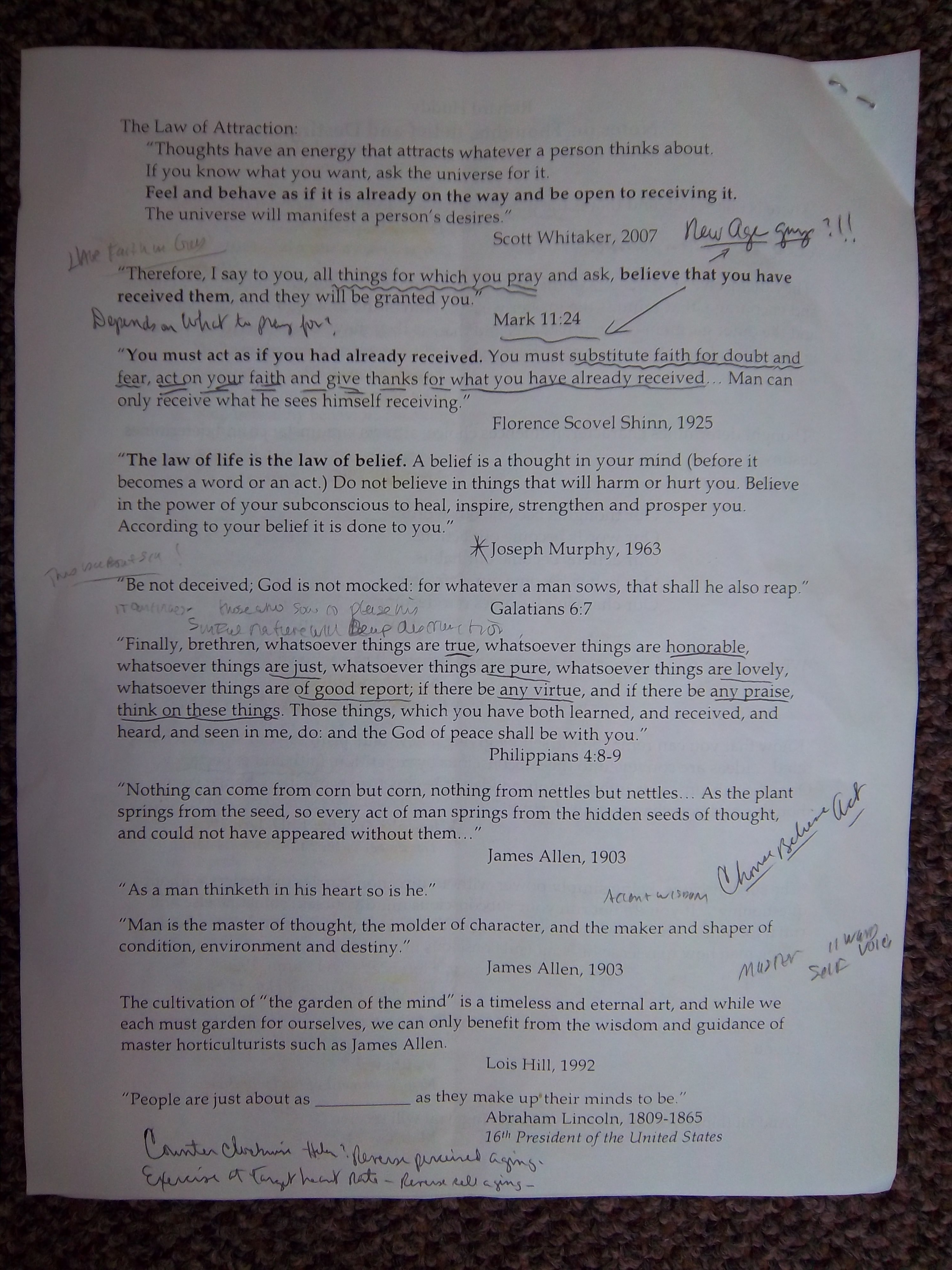
The director has taken it upon himself to further enlighten the participants of this program. I was given one of the handouts circulated at a June 23, 2011 meeting. It is titled, “Healthy Thinking & Positive Self-Talk.”
There are many great suggestions on the front and back of page one regarding healthy thinking in relation to stress, healthy diet, exercise, etc. The areas I disagree with here are the recommendations of meditation 15 minutes a day and hypnosis to “reprogram your attitudes, beliefs and thoughts”, as “methods of reprogramming the subconscious.”
Page two further develops how such things may be accomplished. It is titled “Notes on Thoughts, Belief and Destiny.” My first reaction was to ask, ” Why is an exercise program delving into spiritual issues? As a Christian I can tell you that my discernment alarms clanged loudly at the following list of quotes.
“There is one secret, and that is the power we have in forming our own destinies.” Dolley Madison 1833
This goes against biblical thinking. There is no secret. God’s plan is laid out openly in the Holy Bible. Consider these verses in Isaiah 45:19, “I have not spoken in secret, in a dark place of the earth…I, the Lord speak righteousness, I declare things that are right”, and 48:16. “Come near to me, hear this: I have not spoken in secret from the beginning.” In Luke 8:17 we read, “For nothing is hidden that shall not become evident, nor anything secret that shall not be known and come to light.”
The buzz from the book The Secret teaches otherwise. In his review of The Secret, Donald Whitney says, “It is not exaggeration to say that this book implicitly ( and sometimes explicitly) denies virtually every major doctrine in the Bible.” [1]
“Whatever the mind of man can conceive and believe, it can achieve.” Napoleon Hill, 1937, Think and Grow Rich
Here again we have positive thinking on steroids. False teacher Robert Schuller based his ministry on these concepts and now faces bankruptcy for his ice palace of a church. All the visualizations of money rolling in from the visualized fat wallets of the congregation seems to have fizzled out.
What is behind the man, Napoleon Hill and how was his philosophy created. The answer may surprise you. This is from Mike Oppenheimer of Let us Reason Ministries.
Napoleon Hill wrote about imagery and visualization in his book, Think and Grow Rich. He writes, “The THIRTEENTH principle is known as the sixth sense, through which Infinite Intelligence may and will communicate voluntarily, without any effort from, or demands by, the individual…. Step by step, through the preceding chapters, you have been led to this, the last principle. If you have mastered each of the preceding principles, you are now prepared to accept, without being skeptical, the stupendous claims made here….”Just before going to sleep at night. I would shut my eyes, and see, in my imagination, this group of men seated with me around my council table…. After some months of this nightly procedure, I was astounded by the discovery that these imaginary figures became apparently real.” “Each of these nine men developed individual characteristics, which surprised me…. “These meetings became so realistic that I became fearful of their consequences, and discontinued them for several months. The experiences were so uncanny, I was afraid if I continued them I would lose sight of the fact that the meetings were purely experiences ofmy imagination. …. Whatever you believe that the adviser is a spirit, a guardian angel, a messenger from God, a hallucination, a communication from your right brain to your left, or a symbolic representation of inner wisdom is all right. The fact is, no one knows what it is with any certainty. We can each decide for ourselves….
Sometimes people will encounter religious figures like Jesus, Moses, or Buddha, while others will find an angel, fairy, or leprechaun. People sometimes encounter the adviser as a light or a translucent spirit…. The best way to work with this and any other imagery experience is just to let the figures be whatever they are. Welcome the adviser that comes and get to know it as it is.
Also from Dave Hunt
Though he clung to the idea that it was all imagination, from what Hill wrote it is clear that visualization had opened the door to the world of the occult:
Ah…so Napoleon Hill had spirit guides. The bible is clear on divination, we are not to contact spirits from the other side, because we will indeed be deceived by them.
There are other quotes from James Allen, As A Man Thinketh, and Florence Scovel Shinn. Mixed in we have some scripture about prayer. The Bible verses just don’t fit in the New Age mix, and of course this is intentional for the new thinking involves finding your own truth. The thinking is that you can pick and choose whatever you happen to like at the moment and create your own religion and your very own God..which of course is…youself, because some entity has made you feel divine.
New Age ideas and thought do not mix with Bible teachings because they are completely opposed to each other.
In the new age, truth is found within, but the Bible teaches that we are not to trust our hearts. Jeremiah 17:9 says that “The heart is deceitful above all things and beyond cure. Who can understand it.” Yet James Allen tells us to seek Ancient Wisdom and that the master is the inner voice which is self. Shinn instructs that the Bible is “a book dealing with science of the mind…telling man how to release his soul from bondage.” This person could not be more wrong about the Bible.
Jesus Christ came to release o free us from our SIN. This is bondage we face daily. The way to everlasting life is to put your faith in Jesus as Savior, who died on the cross, taking our sin upon His sinless self. He rose again from the dead, showing us His power and glory, as the Son of the true and living God.
John Ankerberg wrote this in his book, Encyclopedia of New Age Beliefs. It was difficult to find a summary passage in this large book. This section tells how children are being indoctrinated at an early age into hypnosis, guided imagery, visualization, and meditation.
In November of 1988 we received a letter from a couple involved in researching a program used in elementary schools in Florida and other states. This program used tapes called “Quieting Reflex and Success Imagery.” A mother had told this couple that her little girl had contacted an inner guide through the hypnotic techniques used in this program. The daughter, commented, “My wise person told me not to pray in the name of Jesus anymore.” Furthermore this wise person was not the guide that the little girl has chosen for herself but rather someone that had appeared unexpectedly and spontaneously in her consciousness. It claimed that it resided in the corner of a “safe place” in her mind. But it proceeded to command her to do mean and nasty things. The mother was distraught and had no idea what to do. [2]
The guidance counselor comes into the second grade class and the regular teacher leaves….The counselor turns off the lights and begins to play the audio tape. The counselor is there to enhance the children’s self-esteem…after the meditation and relaxation exercises they are instructed to picture a rabbit as a friend in the secret place. And they are told that there is a secret and that it is believing in yourself and your self-power. With it you can do anything like magic. Answers to many things come up from a bubbling spring after watching for a white light. The answers come from the deep springs. Sometimes you will hear the words in answer to your question and sometimes you will feel it.
What you have read above is a brief induction method for meditation and hypnosis. In fact, meditation, hypnosis, progressive relaxation and guided imagery or visualization have more commonalities than many people realize.
However these techniques are also taught by the spirit world as a means to become channelers, i.e., one who is possessed by spirits in order to allow the spirits to channel information out of them…..What these spirits encourage is no different than what New Age educators are now teaching children. [2]
Apparently these techniques and beliefs are also being taught in pulmonary programs. I was told by the director at Capri:
Our educational session on healthy thinking and positive self-talk draws upon the teachings contained in several highly-respected books including the Bible. Some of the material is science-based, some of it is belief-based from a variety of beliefs, and some of it is opinion. CAPRI does not subscribe to a particular religious belief, nor do we promote any particular religious beliefs. We provide material from a wide variety of sources because people approach these matters from a wide variety of beliefs and perspectives. As part of our cardiac and pulmonary rehabilitation programs, we encourage people to adopt a positive mental attitude. We trust that they will do that in a manner that is consistent with their core values and religious beliefs. We are not trying to change anyone’s religious beliefs, nor are we trying to conform to any particular religious beliefs.
Thing is….new age teachings are incompatible with Christianity and do not belong on the same page and cannot be lumped together. Jesus said He is the only way to the Father. In John 14:6 it says “I am the way and the truth and the life. No one comes to the Father except through me.” This totally goes against what James Allen taught who said the master is the inward voice. You can’t have it both ways. Is this narrow and intolerant?. Yes it is but this is what the Bible teaches.
Using techniques meant to relax the body actually can open one up for demonic deception. New agers always look for the light, but God gives a warning.
2 Corinthians 11:14 And no wonder, for Satan himself masquerades as an angel of light.
As eastern spirituality grows leaps and bounds, those who cling to biblical faith will be ridiculed and mocked. You will be called intolerant and hateful for your faith. But take heart, beloved, Jesus said, in John 15:21, “They will treat you this way because of my name, for they do not know the One who sent me.” Pray for those who persecute you.
So stay in the Word of God. When you hear such things as the law of attraction, or that the universe will fulfill your desires if only you ask, you can compare such teachings against the Word of God and immediately recognize it as a false teaching.
Believer, ask that the power of the Holy Spirit will teach and guide you into all truth and that God’s written Word is absolute truth for all times.
1. Donald S. Whitney, “A Review of The Secret by Rhonda Byrne.
2. John Ankerberg, Encyclopedia of New Age Beliefs, pgs. 412-413

This video was interesting to watch after a study of two parables in Matthew 13. The parable of the Hidden Treasure and the Pearl. Two men find treasure. One it seems is just in a field and discovers the treasure. The second man is a merchant truly looking for the treasure. The treasure is of course the Gospel.
I thought of the man in the first parable when Kirk Cameron was saying that he wasn’t seeking God at the time. The second man in the parable finds the treasure after seeking and searching for it.
Boice says on the subject of the two men:
“They had never really seen it before. They were not seeking it. (The Gospel). But there it was; and at once, with that insight granted by God’s internal work of regeneration, they saw that this was a prize of far greater value than anything that had ever come into their lives previously. They saw themselves as sinners in need of a Savior.”
God may present truth to you in an unexpected manner. Perhaps after seeking God in all the wrong places, suddenly your search is rewarded. Lay aside all worthless aspects of your life. What both men did after their discovery were the same. They knew the value, and were determined to keep it. They sold everything they had to acquire the treasure.
“In the exchange described by these parables the men who made the purchase received a bagain. They make the deal of their lives, their fortune. From now on they will be the happiest of men. So it will be for you. You are not called to poverty in Christ but to the greatest of spiritual wealth…How could it be otherwise when the treasure is the only Son of God? How can the outcome be bad when it means salvation?” *
*James Boice “The Parables of Jesus”
“Now my friend, that old moth-eaten righteousness of yours that you are so proud of you must sell off and get rid of it, for no man can be saved by righteousness of Christ while he puts any trust in his own. Sell it all off, every rag of it.” **
**Spurgeon, “The Great Bargain”
This article just posted by Bud Press simply amazed me because of its timing.
We have been studying the Book of John and I have been focused and fascinated on the various ways that Jesus delivers truth to those He speaks with.
Jesus turned to two disciples who were trailing Him in John 1:37,”What do you want?’ What a loaded question! They spent the entire day with Him. Can you imagine the joy?
Nicodemus was probably shocked when he heard that he had to be born again. He must have been first perplexed because he was a respected teacher of the law, and he was born Jewish. He slowly left Jesus that night, but we come to learn later in the Book of John that he did later believe. Here was an esteemed teacher but there is no evidence that as a teacher he converted anyone.
Contrast Nicodemus, with the Samaritan woman who was despised by the Jews. Upon believing she ran back into town and spread the news and many were saved.
But I wanted to point out HOW Jesus approached the Samaritan woman. He asked her a question, “Will you give me a drink?” John 4:7 Isn’t this rather odd, because Jesus is the one who gives out living water. But He approached her with a humble attitude. He asked her for a service,which quickly took away any barrier that may have existed between them.
When we witness truth to others, the Holy Spirit will guide us. Every situation may be a bit different and the Lord will give us the words to speak. Whether we ask those who seek God, “What do you want?”, “Are you born again?” or “Will you help me?”, the truth must be eventually given out. The gospel message never changes, but the method and circumstances in which we give it out can. Please pray that the Lord will give discernment to recognize opportunities to boldly share the Word with others.
Please read.
Frustrated with False Teachers?
by Bud Press, Director
Christian Research Service
October 28, 2009
Two Scriptures in 1st and 2nd Timothy speak with great force concerning what Christians are to expect before Jesus Christ returns:
•people will fall away from the faith, pay attention to demonic spirits, and choose to rely on false teachings instead of God’s written word (1 Timothy 4:1).
•people will turn away from sound doctrine and truth, develop their own faulty interpretations of Scripture, seek and find those who agree with them, and rely on lies to feed their corrupt spirituality (2 Timothy 4:3-4).
Remember that 1st and 2nd Timothy were written about 2,000 years ago by the Apostle Paul, inspired of the Holy Spirit. Notice the words shall and will in both passages (NASB and KJV). Fast-forward to 2009 and know that one of the warning signs of the end times is a dizzying array of heretics, and their dizzy minds full of charms, whistles, and gimmicks.
Indeed, the shall and will is here and now, and “Christian” bookstores lead the pack in the promotion and sale of doctrines of demons, authored by heretical wigglers who have turned their backs on God to seek fortune and fame.
An ‘unusual’ approach
During a visit to a Christian bookstore years ago, I came upon a shelf filled with books written by Benny Hinn. While thumbing through one of the books, the store manager walked by and asked if I needed assistance.
Read Full Article HERE

People always remember the story about the talking donkey. Balaam’s part in this story is often forgotten and overlooked. It is Balaam who is made a fool of, by the spiritual awareness of the ass, who could see what the “seer” could not see. The donkey was more spiritually discerning than the prophet.
Israel was finally beginning to conquer her enemies before they were to enter and take possession of Canaan. After wandering for so long in the desert, the time was quickly approaching. Balak, the king Moab, was afraid, because the Israelites had just taken the land of the Amorites. They left no survivors. So the king resorted to magic or witchcraft to solve his problem of the Israelites who were beginning to the conquer the adjoining lands around him. He wanted the Israelites cursed.
Balak hired Balaam, knowing full well that he was a diviner. Some commentaries make Balaam out to be a good guy gone bad, but I can’t see how this could have been true. We know Balak knew of Balaam’s powers of divination because messengers were sent with a “divination” fee to hire him to make the trip. Divination was his profession and he was hired to curse the Israelites.
So what is a diviner? It is someone who uses hidden powers to gain secret knowledge about the future. This information does not come from God. It usually comes from Satan. If a method is used to attain the information from the spirit world, then it is occult.
Here is a definition from Dictionary.com
DIVINATION, n. L., to foretell1. The act of divining; a foretelling future events, or discovering things secret or obscure, by the aid of superior beings, or by other than human means.
And from Strong’s Concordance
Strong’s H7081
1) divination, withcraft
a) of the nations, Balaam
b) of false prophets
c) in a good sense (king’s lips as oracles)
Balaam’s words are interesting to the messengers when they arrived. Listen to the phrases he used.
Numbers 22:8 “and I will bring you back the answer the Lord gives me.”
Numbers 22:13 “Go back to your own country, for the Lord has refused to let me go with you.”
Numbers 22:19 “I will find out what else the Lord will tell me.”
If you heard someone speak these phrases, would you think him a follower of the true God?
It seems that when Balaam set out on his journey, something was wrong. God had said to go and only tell the men “the word which I shall say unto thee.” But when he left, God opposed him because the angel obstructed his path three times, but this did not stop him. He even acknowledged he had sinned, but he did not turn back.
So now we get to ask, was Balaam doing God’s will or his own? His words sounded so mighty earlier. What do his actions say about him? Do you follow leaders who are obstructed in their ministries? Do you follow them because of their righteous sounding words and because they say they hear from the Lord?
Have you ever gone ahead with your own plans even though God opposes them? Have you taken your own pathway only to find continuous obstacles? It was as though God said, “Okay… you go Balaam and I will let you make a fool of yourself.” Have you ever asked God over and over again for the same thing? He may allow you to have this thing you so desire but there will be consequences to pay later.
An interesting verse is Numbers 22:28-29 Then the Lord opened the donkey’s mouth, and she said to Balaam, “What have I done to you to make you beat me these times?” Balaam answered the donkey, “You have made a fool of me of me! If I had a sword in my hand, I would kill you right now.”
Balaam could not see the sword in the angels hand, when the donkey could, and God spared the donkey. Balaam himself died by the sword but could not “see” this part of his future.
We do learn that God would not let Balaam curse the Israelites and would let the diviner speak the words that He, the Lord, gave him, much to Balak’s distress.
Because the diviner would not curse Israel as he was hired to do, Balak took him to three different locations. Different oracles were offered by Balaam but none of them were curses against the people of Israel. God would not allow His people to be cursed. Israel is His chosen and He had a covenant with them. God keeps His promises. Do you keep all of your promises?
Interestingly, Balak was hoping that the three different perspectives or locations would influence Balaam into changing his mind, so he would curse the people. Do you go to different people to find the answer you are looking for? If you do not like one answer, do you go to another, and another, and another person till you find an answer that suits you?
Now Balaam blessed Israel in his oracles, so God amazingly used this diviner, but the story does not end here. This is why we are to read the entire Bible. If one stops here, one may think that indeed Balaam turned out to be a pretty good guy. But this was not the case.
In Numbers 25 we find out that “the men began to indulge in sexually immorality with Moabite women, who invited them to the sacrifices to their gods. The people ate and bowed down before these gods. So Israel joined in worshiping the Baal of Peor. And the Lord’s anger burned against them.”
So what does this have to do with Balaam? We find out in Numbers 31:15-16. Moses asked why the women were not killed in the war on the Midianites as the Lord commanded.
“Have you allowed all the women to live?” he asked them. “They were the ones who followed Balaam’s advice and were the means of turning the Israelites away from the Lord in what happened at Peor, so that a plague struck the Lord’s people.”
It was Balaam that enticed and led the people away from God. If he could not curse them, he would find a way to go against God’s will. In verse 8 Balaam is killed by the sword.
What lessons can we pull for us today from this story of the diviner. For one thing it is evident that the people were eventually deceived by him. He introduced heresies which led the people astray.
I hear many leaders in the church say today, “The Lord told me.” But we have to examine all teachings today. And the teachers. God has sent us many good preachers and teachers who prophesy God’s Word, and I praise Him mightily for this, but also there are those who are not really followers of Christ. Like Balaam. He was actually used by the Lord but truly, he was not a true believer.
In the end, those who listened to Balaam bowed down to other gods and worshiped Baal.
Soon…
A study of divination and how it has infiltrated the church.
 DiscernIt
Recent Comments