Transcript:  From The Berean Call 


TBC Logo

Gary: Welcome to Search the Scriptures 24/7, a radio ministry of The Berean Call with T.A. McMahon.  I’m Gary Carmichael. Thanks for tuning in. In today’s program, Tom addresses the question: “Is the History Channel’s Mini-series, The Bible, Biblical?  Joining Tom is TBC staff member, Edwin Newby.  Now, along with his guest, here’s TBC Executive Director, Tom McMahon.

Tom: Thanks, Gary. Today, as Gary mentioned, we’re going to address the Bible as interpreted by Hollywood, in particular the History Channel’s five-week mini-series titled The Bible. And it started off, in terms of interest in it-well, it broke records for the History Channel.

But here in the studios is my associate, Ed Newby. He’s a staff member, and Ed is our resident Q&A correspondent, producer of our online updates, and a contributor to TBC’s newsletter.

Ed, thanks for joining me today on Search the Scriptures 24/7.


Ed: Thank you, Tom, for the invite.

Tom: I want to start with some background on the production of The Bible. For example…well, let’s start with the producers. What can you tell me about them?

Ed: Well, this is produced by Roma Downey and her husband, Mark Burnett. Mark Burnett, of course, he’s a very successful Hollywood director, primarily television, directing such high-rated programs as SurvivorAre You Smarter Than a Fifth-Grader?, and other reality shows of that nature.

Roma Downey’s background is far more easy to determine. She is clearly identified with Mind Science teaching. She was with the successful program, Touched by an Angel.

 
Her costar, of course, was Della Reese, who pastors her own religious science church that she founded. And everything we’ve seen about her indicates that she’s fully lodged in the New Age, Mind Science-however you want to categorize her. As a matter of fact, I read one of the Hollywood blogs talking about her, and she talks about “as someone who’s been on a spiritual journey for many years.”

Roma Downey attends the University of Santa Monica private graduate school founded by New Age spiritual and self-help guru, John Roger, and will graduate with a master’s degree in Spiritual Psychology.

Tom: Wow. Well, the production–again, it’s a 10-hour series, so as I understand it, they’ve been working on this for three years. It was shot in Morocco. What can you tell me about the lead character who plays Jesus?


Ed: Well, he’s a Portuguese actor. He was specifically chosen by Roma Downey. By the way, everything that they have done, they have attributed to being directly guided by the Lord in all of these things. They’re very open with saying that, and they specifically say the actor who portrays Jesus–and, also, he’s not identified earlier in the series, but he plays the role of the Lord as one of the three men that appears to Abraham in the plains of Mamre.

So, this man was seen by Downey in a production. She felt a “spiritual rapport” with him, and of course, all the way through this production, they talk about all of these spiritual things that they attribute to the Lord-guiding and directing and ultimately producing this program.

Tom: Yeah. Ed, going back to Downey and Burnett, I remember you earlier in the week telling me about an interview they had with Bill Reilly?


Ed: Bill O’Reilly, yes.

Tom: Bill O’Reilly. Tell me about that.

Ed: Well, O’Reilly, of course, came off as the worse–you know, he’s a Catholic, he says…or, no, he was raised a Catholic, but he was asking them questions, specific, like “You actually believe these things?” And they said, “Yes, we believe the Bible.”

“Do you believe these things, particularly the account of creation? Are these accurate?”

And they sort of dodged that question and fell back on “We believe the Bible.” That was the line that they gave.

Tom: Mm-hmm. But I also remember you telling me that in the conversation, as they were sort of backpedaling about the issue, didn’t he challenge them about whether this was accurate in every case? What was the response to that?

Ed: They didn’t really answer that, other than “We believe the Bible to be true. It’s truth.”

Tom: So they just hung out there.

Ed: Basically.

Tom: Well, you know, that would be an attitude that we would take, so we would applaud them on that. But again, you can believe the Bible to be true–but tell me your impression of Part 1 of the program.

Ed: The program, of course, is probably one of the most lavishly produced Bible-themed movies or productions ever made. Top-flight production, video, visuals, they have a huge number of British actors that are very good in their craft. So if you look at it strictly as a production, it’s very good. However, that’s not the job that the Lord has called us to. They’re going to go through the entire Bible from Genesis to Revelation, and they’re going to accomplish that in ten hours. As a consequence, they have cut out much of the Bible, and much that they have retained is very hurriedly paced through. They have dropped a number of very important points that the Scriptures raise, particularly concerning the faith of Abraham.

And it’s interesting that in an interview with Focus on the Family, Mark Burnett specifically said that his goal was to “hit the emotional highs.” He wanted to be able to stir the emotions of the viewers. And I have to admit, watching it–it’s very well acted. They’re dealing with a lot of very traumatic situations in the lives of these biblical characters, and it’s emotionally stirring. And there are things that they get right.

Tom: Ed, I’m looking at an article in Charisma magazine on “The Bible Made for TV”-that’s the title of it–and there are actually some comments in here that are kind of stunning. In one sense, he says that because…”Look, you can’t do the Bible in ten hours.”

Ed: Absolutely, yeah.

Tom: Well, first of all, I would say you can’t do the Bible–you can’t bring it to the screen, but that’s…we’ll save that for part 2 of our series here. Nevertheless, I’m looking again at an article in

Charisma magazine, and this is March 2013, obviously, and here’s what they say: Well, first of all, they admit that the Bible is not very descriptive–doesn’t give you details.

Ed: No…

Tom: Mel Gibson had the same problem with The Passion of the Christ, which we’ll talk about in the second part. But this is what they say: “So when Mark Burnett and his wife, Roma Downey, producers of the forthcoming History Channel mini-series The Bible, worked with directors and set designers to create a dramatic retelling of the story, they had a measure of creative license available to them.”

Now, is that a problem or not?

Ed: Granted by whom? (laughing)

Tom: Exactly. So, give us some examples of the creative license that you saw, at least in the first part.

Ed: Well, as I said earlier, Burnett wanted to hit the emotional highs. He wanted to draw people in through touching their emotions.

So they added things: Noah and the ark-children on board. The Bible very distinctly says, “Whereas eight souls were saved”: Noah, his wife, three sons, and their wives. No children on the ark.

Secondly, Noah is walking around on the deck of the ark after the Lord specifically shuts the door to keep them inside. How did he get up there?

Tom: Somebody’s not paying attention to even the detail that’s in the Scriptures. But this is creative license, remember. Keep going.

Ed: Creative license–there’s one thing I want to touch on later that’s really critical, that they removed a very specific Messianic marker from the text, but in the occasion when the Lord asked Abraham to sacrifice his son, Isaac, that is totally whacko. Mainly because the Bible specifically says it was three-days journey to Mount Moriah; he took some servants with him and pack animals. In Downey and Burnett’s version, the mount they’re going to is just a hop, skip, and a jump–you can see it from their tent–and so, Abraham takes his son, Isaac, and they go climbing up the hill. The dramatic license they use there is to stir your emotions, because Sarah looks up, sees them silhouetted against the top of the ridge of this hill, realizes they don’t have an animal to sacrifice, so she literally freaks out and runs and begins frantically clawing her way up the mountainside in the utmost anguish. There’s that.

The angels that went into Sodom. License? Now an angel–other commentators have referred to this as the “Ninja scene” in Sodom. So these two angels–one is an individual of African descent, the other one is an Asian fellow–and they’re going into Sodom. Talk about license…

Tom: Now, wouldn’t that be license right there? Do you know of any angels that are ever described as being…


Ed: Particular racial types?

Tom: Exactly. Okay, well, let’s keep going.

Ed: And in the biblical account, Lot–he’s apparently a prominent citizen in Sodom because he’s sitting in the gate, where all the business, the judicial things, are transacted, and when he sees these two men coming, he recognizes who they are. He’s at least that spiritual, he can pick up who they are, and he immediately invites them to his house “that you don’t spend your night in the streets.”

In the production, they come into this town, and…oh, by the way, while this is happening, you’re thinking, Well, what about the sin of Sodom? What about the homosexuality?
 
So, the narrator is saying, “Sodom had corrupted itself greatly and was deeply in sin.” And so they’re showing all these heterosexual couples that are caressing each other, kissing each other, in the streets, and the only reference they make to the other thing is one very effeminate-looking guy standing there all by himself, smiling. That’s it.

And so, when the…

Tom: Well, it did have one sodomite in Sodom.

Ed: Yeah.

Tom: Wow.

Ed: The token sodomite. So as these angels are going into the town, these men start following them, obviously with intent to do them harm or something. And they end up running to Lot’s house, banging on the door frantically. Lot opens the door, and they say, “Please! Please! Help us! Hide us from these…” These are the angels!

And so, Lot is reluctant at first. His wife doesn’t want them in there at all, but eventually they go in. Then Lot goes out to calm down the crowd, which somewhat follows the plot in the Bible. Well, the angels, you know, the crowd starts to go wild, and then the angels reach out, pull Lot in, and then they strike these people with blindness, as the scriptural account goes, which apparently lasts only a few seconds, because pretty soon these guys are drawing their swords. So one of the angels takes charge, getting Lot and his family ready to flee. The other one goes out and…I forgot to mention, their attire-they look like Jedi knights straight out of a George Lucas production. They’re wearing the cowls, the cassocks, or whatever you want to call them…

Tom: From the first Star Wars…

Ed: Yes. You know how the Jedi knights dressed. And so, he walks–this one angel walks out of Lot’s house, throws off his robe, and he’s wearing this shiny Roman-style armor, then he reaches over his shoulders and pulls out two swords, just like a Ninja, and then he starts hacking these people. The other angel gets Lot and his family out of the house, takes them out and tells them to run for the gate, they’ll be with them in a minute. He draws his sword and they spend the next few minutes hacking all these Sodomites to death.

Tom: What does the Bible tell us took place at that point?

Ed: The Bible says that they struck them with blindness so that these individuals, it said, “wearied themselves to find the door.” They were blinded but they were still following their lust to do something. And then the angels tool Lot and his family out of the city.

Tom: Now, for our listeners that say, “Oh, well, come on. You guys, you’re nitpicking.” Folks, no. We’re not nitpicking. This is a representation of the Bible. That’s the name of the series: The Bible. The title of this program is Search the Scriptures 24/7. So, what we’re doing is we’re comparing what is being presented, again, out of Hollywood, what is presented as being biblically accurate–true to the Bible.
You know, as I said, earlier–well, I referred to earlier–Mel Gibson tried to do the same thing in

The Passion of the Christ. And the problem here is–yes, the Bible is a huge book, and you can only select certain things to present or a program like that would be on 24/7-it would be on all the time.

But they did select parts of the Bible to present. Question is, is this accurate with regard to what the Bible says very clearly?

So, Ed, I mean, this is…you probably already answered this question, but on a scale of 1-10, what number would you give the production in terms of being true to the Bible?

Ed: Well, Tom, you know, I…I try to be a fair person, and…

Tom: Well, it’s just going to be your opinion, but, you know, with what you articulated-give us your opinion.

Ed: I’m going to say no higher than 2. I would really tend to say, “Can we give it a zero?”

Tom: Yeah, well, you’ve got all the numbers before you. And, again, here is our problem. For some people who’ve never read the Bible, even those who profess to be Christians, and they’ve never really taken the time to read through the Scriptures, this is all they know.

And for others who are not Christians but are viewing this, whatever religious background they come out of, or they’re in right now, this is what they think the Bible is about.

Ed: Yeah.

Tom: I spent a number of years as a screenwriter in Hollywood. You know that, Ed, just for our audience’s sake. So when I see a presentation–you know, I’ve been a believer for about 35 years, and I’ve studied the Word of God every year of that. I’m more excited about it today than at the beginning because I know it better and better. But this is an abuse. This is a distortion. This is a corruption.

Now, I know a lot of people are excited about it because, well, you mentioned Focus on the Family–I’ve got Charisma, this is a magazine right in front of me. They’re giving it not just two thumbs up but they’re tremendously enthusiastic about this. But it’s the Bible. It’s the Word of God. “Man shall not live by bread alone but by every word that proceeds from the mouth of God.”

Now, as I mentioned, you know, in our next session, we’re going to talk about can the Bible–should it be–is it legitimate to translate it visually? But we’ll hold onto that for a second.

I want to go back to Downey and Burnett, the producers. In what you have researched here, what was their goal, their objective, in presenting the Bible visually, whether it’s a valid thing to do or not–we’ll talk about that later–but where was their head, their heart in this? What did they have in mind?

Ed: Well, Mark Burnett stated very specifically, “By telling these emotionally connected big stories, hopefully millions of people will reopen their Bibles.”

Tom: Yeah.

Ed: And they repeated that several times.

Tom: And how could you argue with that? That’s something that we all want. Especially in this day, as we move more into apostasy, more into deception, delusion, not just in the world, but certainly in the church. That’s what you want, you know, the solution: “The B-I-B-L-E, that’s the book for me.” That’s where we want people to be. But now the problem is how do you go about that? Do you present the Bible as man sees it? With drama, with creative license, all of these things? Do you create something–I mean, this is marketing more than it is the heart to present the Bible and to encourage people to get into the Bible.

I mean, what are they going to do? Let’s say young people. They see these two angels, so-called…

Ed: Right.

Tom: …coming off like–somebody said, “Well, they’re like gladiators.” I don’t care if you call them gladiators or Ninjas or whatever, you get somebody excited about this highly dramatic thing, and then all of a sudden they go and read the text, and they say, “Wait a minute! I don’t find any of that there.” In other words, they’re being misled by creating a distortion–a representation of the Bible that is just not there.

So, my point here is it’s counterproductive to what he said. Yeah! You’ve love The Bible to motivate people to get into the Bible, but when mankind is creating artificial things, or dramatic issues that are not there, it’s just not going to work, even if it was the right thing to do, which it’s not. It’s not the right thing to do from the scriptural standpoint.

Ed: Absolutely. And, as I mentioned earlier, one of the things that I specifically thought were–well, let’s be frank–it was terrible. The omissions! They missed Abraham–when the Lord appeared to him and took him outside the tent at night and said, “Look up at the sky. Count the stars if you’re able to do that. So shall thy seed be.” Don’t have that at all. They have, afterwards, he’s sitting outside the tent, he’s kind of rocking back and forth a little bit, and he’s repeating, “The stars, all the stars! Our seed! Our children!”

And Sarah comes out and says, “What’s wrong? What’s wrong?”

And he says, “Our children! The Lord showed me our children will be as the stars of heaven-our descendants.”

And Sarah goes, “It’s too late for me.”

Well, what they omitted was Abraham’s belief–Genesis 15:6: The Lord told him, “Count the stars. Your seed’s going to be just as numerous as that.” And it says in verse 6: “…and Abraham believed God, and it was counted to him for righteousness.” That’s all left out. They leave out several of those, we call them Messianic markers, or whatever you want to call them.

Tom: Well, again, what we find in the Tenakh, the Old Testament, is these are types of Christ. All of these things pointed to Christ and what He would…how He would be born of a virgin, and how He would–God would become a man, and go to the cross and pay the full penalty for our sins, and we have, throughout the Old Testament, types of this that point to it. We know this early on in our walk with the Lord, Ed, that those in the Old Testament–how were they saved? Well, you just mentioned it. Abraham was saved by faith, the same way every believer is saved–by faith, and faith alone. How did this happen by faith? Because, as you said, quoted the scriptures, “he believed God and it was appointed to him as righteousness.”

But what was he doing? He was looking ahead to the cross.

Ed: Amen.

Tom: We, today, as believers–we look back to the cross as what Christ accomplished for us, and we put our faith in that. That’s what being born again is all about. That’s…you, we’re, born again of the Spirit of God, and because we believe that He, Jesus, God became a man, went to the cross, paid the full penalty for our sins–that’s the only way anyone can be saved, according to the Scriptures.

Now, we’re still dealing with the first part of the series, okay. They’re not there yet, but the point is that these things that took place and were presented is a distortion of what the Bible says. So, consequently, what value is it?

Now, Ed, 15 million viewers, according to the results of this presentation.

Ed: And the demographic: age 20-39.

Tom: Unbelievable in terms of, hey, that’s what we want. We want people to respond to the Bible, to the Word of God. It’s not that the Lord won’t prick a heart or use this. But this is not God’s way. You don’t encourage people, you don’t try to bring them to Christ, you don’t try to bring them to the Word of God by distorting it, by abusing it, by corrupting it. And all of that, nevertheless, I’m looking at this Charisma article–They believed “it was clear that something supernatural” (I’m quoting) “and wonderful had just arrived and shown up,” and they believed that “there was an encounter with the Holy Spirit.” That this thing-all the terms that are used in this Charisma
article, which you’d expect, all the terms have to do with God being behind this, and people praying for it, and so on.

But let’s have a little–folks, let’s have a little discernment here if you’re enamored with this production. This is not the Bible. This is the creation of men to the distortion of the Word of God.

Ed: Along with your comment about “by faith alone,” the narrator says, and it has to do with the time that he’s asked…Abraham is asked to sacrifice his son: “To Abraham being chosen by God is both a blessing and a test. He must prove his faith again and again.” That’s works.

Tom: Yes, absolutely. Works-salvation. It boils down to this: There is either putting your faith in Christ and what He’s accomplished or there’s works-salvation. There’s working it out on your own, which is an impossibility.

Ed, the Lord willing, next week we’re going to cover, really the bottom line in all of this. Should, could, is it valid? Is it legitimate? Is it true that the Bible can be translated, interpreted visually? And that’s an important issue in here, because it really applies not just to the Bible, this History series, but to all the other productions, whether out of Hollywood or not, whether or not it is a legitimate application of presenting the Bible.

Well, next week we’ll talk about it.

Ed: Very good.
Gary: You’ve been listening to Search the Scriptures 24/7 with T.A. McMahon. We offer a wide variety of materials to help you in your study of God’s Word. For a complete list of materials and a free subscription to our monthly newsletter, contact us at PO Box 7019 Bend, Oregon 97708. Call us at 800.937.6638; or visit our website at the bereancall.org. I’m Gary Carmichael, join us again next time as Tom continues his discussion with Edwin Newby about the TV mini-series The Bible. Thanks for tuning in and we encourage you to search the Scriptures 24/7.

From – Do Not Be Suprised

EBenzBlog

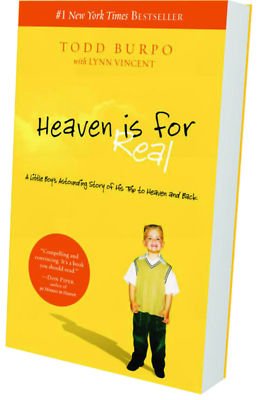
Film Adaptation of ‘Heaven Is for Real’ Being Planned; T.D. Jakes to Produce

Heaven Is for Real, the story of four-year-old Colton Burpo, who allegedly traveled to Heaven and back, has mesmerized professing Christians since its publication in 2010. In two years it has sold 8 million copies and been translated into 30 different languages. Those who could not find satisfaction in what God’s Word shares about the life to come flocked to the young boy’s story in spite of the fact that Burpo’s claims about Heaven flatly contradicted the biblical text. The popularity of the book was an overt demonstration of how many Christians today allow experience to trump objective, biblical truth.

Like every good story, whether fiction or nonfiction, Heaven Is for Real now is slated to be made into a movie. The Christian Retailing website notes that not only is Greg Kinnear in negotiations to play the role of Colton Burpo’s father, Todd, but that the film will be co-produced by Joe Roth (Oz the Great and Powerful) and famed prosperity preacher T.D. Jakes.

Finish HERE 

DOES JESUS CARE WHETHER I ATTEND CHURCH? [Excerpts]

If you identify yourself as a Christian, then I assume it really matters to you whether or not Jesus wants you to attend church. After all, He is your King….not just your advisor….or your buddy….but your Lord….and your God. Right?
We live in a day where many professing believers are being tempted to ditch the whole “church thing.” In some cases, it’s because they had a bad experience in a church. That is understandable….because it happens. Just as divorce takes place in marriages, pain is also experienced in certain church situations. So what’s the solution? Should you dump church…or instead, get connected to one where you will grow?
Here is what the New Testament church did from its very inception. “They devoted themselves to the apostles’ teaching and to the fellowship, to the breaking of bread and to prayer.” (Acts 2:42) If you don’t realize how badly you need each one of those things, then you don’t understand the New Testament….and you don’t understand spiritual growth.
Some people who leave a church never end up in another church….they remain spiritually homeless. And many of them quickly begin to lose whatever spiritual vitality they had been experiencing.

We can all tell ourselves “it won’t happen to me,” but that is often not how it plays out. When Christians attempt to remain strong in the Lord outside of His family gatherings, it usually doesn’t work. That’s because Jesus instituted His church for many important reasons, and not one of us is smarter than Jesus.

And so “yes,” Jesus cares deeply about whether or not His followers attend church. But it’s not just a matter of “attending church.” It’s really about belonging to a fellowship of believers….where you are fed….and you grow….and you serve….and you are encouraged….and you encourage others….and you pray with each other….and celebrate the Lord’s Supper together….and you experience God’s power and grace.
What’s that? You thought the church was there primarily to meet your needs? Well who did you think was going to help do that? It takes people to care for other people. It takes you to be a blessing to others. Have you come to understand yet how important your place is in the family?
Some Christians “young in the Lord” still have a “consumer mentality” about church, “What’s in it for me?” But just watch…as you grow in the Lord, you will begin to concentrate on…”Who can I bless? Who can I serve? What gifts has the Lord given me to help others know Him and grow in Him?”

Have you reached that point yet in your walk with Christ, or do you still just tend to think that the church is primarily there to meet your needs? That’s the life of a child…and while we thank the Lord for children, we also recognize that children need to grow into mature adults. It’s that way in the family….and it’s that way in the Lord’s church.

Source

http://www.christianpost.com/news/does-jesus-care-whether-i-attend-church-89527/

Letter From a Watchman: “Ode to the Watchers on the Wall…”.

[TBC: Last week we presented part 1 of a discussion regarding evangelicals such as “Tom Horn, Joseph Lumpkin, and Chuck Missler, [needing] other books of antiquity and mythologies to integrate paranormal activity with the end-times scenario that they are seeking to create.” The writer continues his discussion of Rob Skiba’s rationale for regarding apocryphal books as “Scripture.”]

“BABYLON RISING” AND CANON IN CRISIS APOCRYPHA, PSEUDEPIGRAPHA, FRESH REVELATIONS, AND AN “OPEN” CANON [Excerpts]

During His life and ministry, Jesus often quoted from the Law (His favorite book being Deuteronomy), the prophets and the writings. He told the Emmaus disciples “that all things which are written about [Him] in the Law of Moses and the Prophets and

the Psalms [writings] must be fulfilled” (Luke 24:44).Not once in the Gospel record does Jesus quote from an apocryphal or pseudepigraphal writing. Though He could have, He did not. Skiba says Jesus valued those books, but ironically he never quoted from or alluded to them. [9]


How then do we know He valued them? We do not. In short, Jesus recognized the extent of the Jewish canon to be that of traditional Judaism.
Apocrypha means “hidden” or “concealed.” On the whole, the writings conceal more than they reveal. [11]
 
This fits into the cultural/spiritual milieu of that ancient era. Old Testament scholar R.K. Harrison (1920-1993) wrote that, “Hidden or esoteric teachings [like the Apocrypha or Pseudepigrapha] were not part of the Hebrew tradition, which based its spirituality on the first five books of the Hebrew canon. Insofar as mysterious doctrines came into Hebrew life, they did so from pagan sources and generally involved magical practices which were forbidden to Israel” [See Deuteronomy 18:9-15.]. [12]
 
So Dr. René Pache summarized the value of ancient apocryphal texts: “Except for certain interesting historical information (especially in I Maccabees) and a few beautiful moral thoughts (e.g., Wisdom of Solomon), these books contain absurd legends and platitudes, and historical, geographical and chronological errors, as well as manifestly heretical doctrines; they even recommend immoral acts (Judith 9:10, 13). [13] 
 
I Enoch  (Circa 200 B.C. to A.D. 100): Skiba tells readers of Babylon Rising
(BR) that the Jews seemed to consider the pseudepigraphal book of I Enoch  to be Scripture, and makes the grandiose claim that “Jesus, Peter, Paul and Jude all made references to it.” In fact,” he goes on to state, “there are more than a hundred statements in the New Testament alone that find precedence nowhere else but in that book.” (BRChapter 1, 3) Upon investigation, this statement proves to be patently false. [14]
 
Genesis records that after living three-hundred and sixty-five years during which he “walked with God,” that suddenly Enoch “was not; for God took him” (Genesis 5:23). Any concordance study of the Bible will find references to this historical man. In addition to the mention of him in Genesis (Genesis 4:17-18; 5:18-24), the chronicler refers to him in his genealogy (1 Chronicles 1:3). Luke too mentions him in his genealogy (Luke 3:37). The author of Hebrews refers to him as a man of faith (Hebrews 11:5). In all these references it is important to note that the mentions of Enoch are to the historical person named Enoch and NOT to the books that bear his name. This brings us to Jude’s solitary New Testament quotation from the book of
I Enoch  (Jude 14-15). Does Jude’s mention of the book endow the whole of it to have been inspired of God? No, it does not, and here’s why.
Genesis tells us that one day, after Enoch walked with God for 365 years, “he was not, for God took him” (Genesis 5:24). What happened to Enoch? Where did he go after God “took him”? After he went missing, did he leave any report of what he might have encountered? To some persons (the pseudepigraphal books had multiple authors) many centuries later, the gaps in the Genesis narrative proved too tantalizing to be left blank, so they (the pseudepigraphal authors of the books of Enoch) over time composed and edited the books of Enoch to fill in the blank.
So as an extant Jewish writing, Jude knew of I Enoch. In verses 14-15 of his little letter, Jude or Judas (Matthew 13:55), the brother of James and Jesus, quoted from it.Because of the quotation, some evangelicals jump to the conclusion that the books of Enoch are divinely inspired and assign a spurious canonicity to them, and this to establish credibility for the fantastic apocalyptic scenarios they create. [15]
 
But it should be noted that Jude’s quotation of I Enoch no more endows the book to be divinely inspired than Paul’s Mars Hill citation of a pagan poet/philosopher or his quotation of one “unruly and vain” talker who racially stereotyped Cretans to be “always liars, evil beasts, lazy gluttons” endowed those words to have been God-breathed (Acts 17:28; Titus 1:12; 2 Timothy 3:16). [16]
 
They are quotations and that’s all.
Jude (Jude 14-15) does quote I Enoch 1:9.[17]  But in his citation of the pseudepigraphal book, it should be noted that Jude neither called Enoch  “scripture” nor prefaced his quotation of it with, “it is written.” Clearly, Jude did not view I Enoch
to be Scripture, to be an inspired and sacred text on a par with Scripture, but merely cited a known and surviving prophecy, authentic to Enoch, the seventh generation from Adam, of future judgment. Such a judgment was canonically predicted by the prophets (“the LORD my God shall come, and all the saints with him” (Zechariah 14:5), NASB. Compare Deuteronomy 33:2.), confirmed by Jesus (“For the Son of man shall come in the glory of his Father with his angels; and then he shall reward every man according to his works,” Matthew 16:27; Compare also Matthew 25:31, Mark 8:38 and Luke 9:26.), and affirmed  by the Apostle Paul (“the Lord Jesus shall be revealed from heaven with his mighty angels, In flaming fire taking vengeance on them that know not God, and that obey not the gospel of our Lord Jesus Christ,” 2 Thessalonians 1:7-8: Compare 1 Thessalonians 3:13).

END NOTES

[9] Skiba writes: “For Jesus and the Disciples clearly thought some of the books not found in our current Bible worthy of study and quotation.” (BRChapter 1, 2) The question to be asked is, “Where?” Give chapter and verse. The evidence is that with the exception of Jude, who referenced the book of I Enoch, neither Jesus nor any of the biblical prophet-apostles quoted from a book not found in our current Bible. Frequently and abundantly, they quoted from the Old Testament canon, and in a few instances from the words of Jesus (1 Timothy 5:18), but not from a book outside the Bible. While they could have, they did not. The burden of proof is upon those who say they did.
[11]  I am aware that the “concealed” aspect of the meaning of apocrypha had to do with churches wanting the books not to be read in their public assembly. [12] R.K. Harrison, “Old Testament and New Testament Apocrypha, “The Origin of the Bible, Philip Wesley Comfort, Editor (Wheaton, IL: Tyndale House Publishers, Inc., 1992): 83.
[13]  René Pache, The Inspiration and Authority of Scripture , Translated by Helen I. Needham (Chicago, IL: Moody Press, 1969): 172.
[14] From Enoch, there is one quotation in the New Testament and thirteen parallels, not hundreds. Admittedly, there exist in the New Testament “allusions” and “verbal parallels” to apocryphal writings outside the Jewish canon, but that is all they are. It is a delusion to transfer divine inspiration to an ancient text for reason of a biblical allusion to it. There are parallels with other ancient writings in the New Testament, but it ends at that. For a list of the allusions and parallels, see The Greek New Testament, Fourth Revised Edition, Barbara Aland, et al., Editors (Stuttgart, Germany: The United Bible Societies, 1993): 900-901.
[15]  Evidently, to demonstrate his “seed thesis” Skiba would not be against citing “the many characters of Greek mythology and the mythologies of other cultures that all speak of demigod heroes and giants.” (BR Chapter 1 , 1) Since when should mythology inform theology? In fact, Paul tells Timothy not “to pay attention to myths,” presumably including not only those of Jewish origin, but also of Greek and Roman (Emphasis added, 1 Timothy 1:4.).

[16] Paul’s quotation reads: “One of themselves [one of the “many unruly and vain talkers and deceivers . . . of the circumcision”], even a prophet of their own [evidently claiming to be inspired of God], said, The Cretians are always liars, evil beasts, slow belliesThis witness is true. Wherefore rebuke them sharply, that they may be sound in the faith; Not giving heed to Jewish fables, and commandments of men, that turn from the truth” (Emphasis added, Titus 1:12-14). When Paul states, This witness is true, he’s not validating the contents of what was said, but only that a false prophet, likely a Jew, “really” uttered the false prophecy as witnesses confirmed to him.

[17] The exact citation from I Enoch reads: “Behold, he [God] will arrive with ten million of the holy ones in order to execute judgment on all. He will destroy the wicked ones and censure all flesh on account of everything that they have done, that which the sinners and the wicked ones committed against him.” See “The Book of Enoch,” The Old Testament Pseudepigrapha, Volume 1, James H. Charlesworth, Editor (New York, NY: Doubleday, 1983): 13-14.

Part one HERE 

Pope NOT Named after Francis of Assisi: Jesuit Priest admits on Catholic radio, “New Jesuit Pope Francis was not really named after St. Francis of Assisi, but after Jesuit General Francis Borgia”

 File:Papa Francisco con periodistas 2013-03-16.jpg
Pope Francis (formerly Cardinal Jorge
Mario Bergoglio of Argentina)

by Shannon R. Haas

srh4christ.blogspot.com
03/17/13

          Coming from a background as a former Catholic, it is of great interest to me that we have the first Jesuit Pope.  I have been listening to much talk radio in the last few days from both Christian and Catholic networks.  I normally do not tune into Catholic news radio; however, last week was of interest to me to hear what Catholics were saying about the new Pope Francis.  What has surprisingly stood out among the priests and other Catholic figures interviewed has been a lot of talk about how the new Pope is of the Jesuit Order.
          The Jesuit Order (also known as the Society of Jesus) was established around 1537-1540 by Ignatius Loyola of Spain under Pope Paul III for the expressed purpose of undoing the Protest Reformation (by the Protestant Reformers: Martin Luther, John Hus, John Calvin, etc.).  After Loyola gained papal approval, he, along with 6 most trusted associates, continued to recruit Jesuits throughout Europe (and eventually the world), building schools, colleges, and seminaries.
It has been said by a few experts on the Jesuits that the Society of Jesus is more of a military order within the Catholic Church that answers to no one but the Order itself.  Some would sum up the Jesuit Order’s agenda like this: “to stamp out biblical Christianity (through the Counter-Reformation) and subdue the world to the Pope and the Roman Catholic Church.” The Jesuits have become so powerful that many within Catholicism have come to greatly fear and respect the Order (some would testify on record that the Order has even assassinated popes for the Jesuit agenda). The rather chilling Jesuit Oath can be read here.
Finish article HERE 

Pope Francis: Visions, Prophecies and the Bible

adoring the new pope

Fatal Attraction of the Man of Sin

The Man of Sin [2 Thess 2:3] (or Antichrist as he’s become known) is often portrayed in movies as devilishly evil, vile, bloodthirsty, murderous, totally depraved and abhorrent.

In other words, all that people imagine the devil to be. Yet this isn’t the biblical appearance of the False Christ.

Movies set out to deceive. This portrayal of the antichrist is incorrect, persuading people that the coming master of the world is like a figure from a medieval painting, with glowing red eyes, pitchfork and horns.

Instead, the devil comes as an “angel of light”. [2 Cor 11:14]

Many think that love can only come from God. Yet there are some forms of love that are demonic, and appeal strongly to the worldly and soulish, those who are moved mostly by their needs and drives and emotions.

We’ve already seen thousands falling over themselves (literally) to “receive the spirit” at church meetings, a spirit that makes them feel blissfully happy and loved.

This is but a softening-up process, and a drop in the ocean compared to the feelings this angelic god-man will arouse.

When he comes, his power to deceive, his supposed goodness, lovingkindness and wisdom, will be so very appealing that men will fall down and worship at his feet!

Finish article HERE 

M'Kayla's avatarm'kayla's korner

I guess news reporting is not what it used to be. We get only a glimpse of the happening, hardly a mention of serious matters, with lots of time spent on things that do not matter, and lots of opinions. The fact that everyone has got one has gone a bit too real. But oh, well, it brings in ratings, pays the bills and someone up there gets rich. So, who cares if its the truth, right? Opinions also build blogs, don’t they?

If I wouldn’t have watched it with my own eyes I probably wouldn’t have believed it. You may not believe it either because I am not going to put up a bunch of links to prove what I am saying is true. I’m not going to go into long explanations of why this is all so strange, scary and wonderful at the same time. I am going…

View original post 956 more words

Helping Those Who Are Hurting.

September 2026
S M T W T F S
 12345
6789101112
13141516171819
20212223242526
27282930  

Archives

a

Blog Stats

  • 1,805,597 hits

Donations

I do not ask or want donations for this blog. God supplies all I need to share His Word and His Way of Salvation. Revelation 21:6 says, “..I will give unto him that is athirst of the fountain of the water of life freely. “