
You are currently browsing the category archive for the ‘Emergent Church’ category.
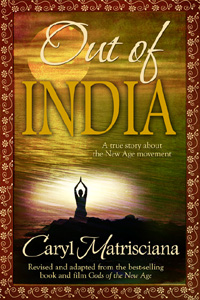 Book Review – Out of India by Caryl Matrisciana- A true story about the New Age movement Upon ordering this book, I eagerly anticipated its arrival. I had already viewed Caryl’s extremely important and informative DVD, “Yoga Uncoiled.” I was not disappointed. Anyone growing up in the 60’s will be able to identify with this true story about Caryl Mastrisciana. She was born and raised in India, which gives her views about what she witnessed about the customs and religious aspects of the Hindu life authority. After living a privileged life in India she went on to England when she was twenty to witness some of same practices she had just left behind. In “swinging London” she was about to experience a new exciting blockbuster, “Hair.” She relates:
The show moved along captivatingly. In the same way that the Hare Krishna sect was glorified, suddenly so was Yoga. Yoga! Alarm bells rang in my mind. The Yoga I had seen in India was intense, arduous and serious — a discipline taught by avowed spiritual masters who prepared their disciples for death. So why did Hair’s hero in the song “Donna” go to India to see the Yoga light? Why was it associated with drugs and reincarnation and presented as such a sweet, new spiritual experience?
Why could I only remember the tragedy, the poverty, the disease, the cruelty, and the apathy? Surely all these people here tonight couldn’t be wrong. (1)
Caryl had been introduced into the New Age, the spiritual enlightenment, the Age of Aquarius. She then moved on from a stint in the Bahamas and took refuge from a failed marriage. But also she had already developed a drug habit. Then it was on to America where life was a maze of football games, rock concerts, The Moody Blues, and more drugs.
In search of the Lost Chord
–had a colorful cover depicting reincarnation and elevation to god-consciousness through meditation. The songs reflect the use of drugs and meditation and belief in Hinduism, UFO’s, and astral projection. With the sound of sitars and hypnotic music, I was led to a knowledge of the power of the mantra (the repetitious chanting of the names of the Hindu deities, vibrations, and other mysterious code words). Such albums tantalized the rightness of my drug experiences and my new sense of universal consciousness. (2)
Even though she had alarm bells go off in the past, Caryl found herself practicing Yoga anyway. Here is a sampling of what she has to say:
I believed I was raising my psychic energy (said to be dormant) nestled in the lower extremities of the groin. Through imagination, I pushed the energies upward through my chakras, which I felt gave me maximum powers. Ultimately I trained these energies to fuse above, where I imagined my third eye to be, and created the most “peaceful” and “blissful” experiences.
I sensed these were the results of a deep spiritual union between me and a cosmic consciousness or divine essence.
…I began to realize I was experiencing the same thrills in Yoga as I attained on my drug-induced travels into altered states of awareness. (3)
but……
As my needs drew me into deeper dependency of these habits, I found I could no longer be sure of encountering pleasurable marvels. Instead, with more frequency, I had erratic hallucinations. (4)
I had erroneously become convinced that I had the power to alter my reality, when in fact it was demonic spirits that were at work in my life. (5)
Sometimes a whole day went by before I realized I had spent it meditating in my own “stoned” fantasy world….Unconsciously I was absorbing the basis of Hindu thought, that reality is maya, an illusion, and that illusion or imagination can be conjured into reality. (6)
This last excerpt is very important because it shows why many no longer today are able to accept the concept of absolute truth. The information, concepts or feelings that they download from the spirit world indoctrinates the mind. Everything is illusion and life is not a reality. Also the notion that that one’s desires can be transformed into reality gives us the basis of Word of Faith, or positive confession teachings. The source is revealed.
There is a later chapter devoted just to Yoga and I will only give one quote from this section:
It is important to understand that the results of Yoga are real: the exercises and breathing techniques actually do release an energy and bring a change in consciousness…..The goal of both drug abuse and Yoga meditation is to shut down from life’s reality….Yoga, however, is endorsed as a beneficial mind-body exercise. (7)
Next Caryl tells some fascinating stories of her spiritual journeys which led her to “eat no meat”, with holistic reasoning see “the created as the Creator”, become tolerant of Eastern religions, and welcomed the idea that “all paths led to the same God.” These themes are repeated over and over again in New Age belief.
You will need to order the book to read her story of how she actually come to the Lord. But I would like to excerpt this part of a conversation she had:
“But Richard, I had such wonderful experiences of being in the presence of God. I saw him and touched him. I talked to him and he talked to me!”
Richard smiled knowingly. I was to learn week later that he had had the same encounters on drug trips and the same occultic experiences as I’d had. “It is all a counterfeit,” he said……..[8]
As with many who become “undeceived” Caryl wanted to alert Christians of the deceptions “that were leading even God’s flock away from the truth.”
Along with a burning desire to inform and warn, I had an almost insatiable hunger for information. How do the cults really compare with true Christianity? I immersed myself in Bible study day and night…..God is putting me through His own kind of schooling, I remember thinking. (9)
And so because of this above resolve, Caryl Matrisciana has served the Lord by founding Caryl Productions, which “produces cutting edge video journalism and information to help discern the times in which we live.”
This book clearly describes how the deception entering the church can be directly traced back to Hindu Eastern principles.
Also look for interesting information on the emerging church, the Hindu Swastika and Hitler.
This is an important Christian book to have in one’s personal library.
http://www.lighthousetrails.com
1. pg. 19
2. pg. 71
3. pg. 73
4. pg. 74
5. pg. 75
6. p.p. 76-77 7. pg. 187 8. pg. 96 9. pg. 119
A Biblically based commentary on current issues that impact you
Unbiblical Teachings on Prayer and Experiencing God
How Mysticism Misleads Christians
by Bob DeWaay
To a Christian, praying to God is privilege, a blessing, and a Biblically defined responsibility. We are called to pray. But a genre of literature exists that I call “prayer secrets.” Practitioners claim to have discovered new avenues of prayer that can create power, excitement, success, and even new revelations from God. These “prayer secrets” add unbiblical practices and claims to prayer in the hope of spicing up the topic to make it more interesting. And this is not a new development; mystical practices have been brought into the church under the guise of prayer since medieval times.
However, since these teachings change in form and packaging, I will review three books about prayer and “experiencing God” subjectively. What they have in common is a form of pietism that promises better things than to go before the throne of grace to find help in time of need, as well as other basic Biblical teachings on prayer.
Experiencing God by Henry T. Blackaby
Blackaby’s book, co-authored by Claude King, promises readers that they can come to know God by experience and come to know God’s will beyond what is revealed in Scripture, thereby living out a life full of adventure.1 Blackaby promises his readers that they will, among other things, learn to hear God speaking to them and learn to identify God’s activities.2 He promises to alleviate their problem of being frustrated with their Christian experience.
Experiencing God does start out with some basic facts about the gospel and has a place for people to check to indicate that they have made a “decision for Jesus.” I am glad he told his readers about such things as sin and repentance but am disappointed in the “make a decision for Jesus” approach. We have addressed that elsewhere.3 But having checked the appropriate box, the reader is quickly ushered into the realm of subjectivity that permeates Blackaby’s approach from beginning to end. For example, we are urged to evaluate our “present experience with God.”4 However, I have known people who are totally deceived and in bondage to false doctrine who are very excited about their experience with God, so such evaluation doesn’t do much good. For example, I once met a pastor who just returned from the Toronto laughing revival and was so very excited because he had seen “God” cause people to bark like dogs and quack like ducks. That is just one example why what one thinks about his own “experience with God” is immaterial. What we need to know are the terms God has laid down for knowing Him and walking faithfully with Him.
In Blackaby’s theology, the importance of God’s self-revelation through the Scriptures is de-emphasized while personal experience is given priority. He writes, “We come to know God as we experience Him. God reveals Himself through our experience of Him at work in our lives.”5 I am not disputing that God is at work in our lives if we have truly been converted. But, like other subjectivists, Blackaby de-emphasizes specific revelation (Scripture) and puts unwarranted emphasis on general revelation (what can be observed in the created order). Our personal, spiritual experiences are unreliable. People observing general revelation and interpreting their own spiritual experiences in light of it have created the host of the world’s false religions.
For example, Blackaby writes, “Find out what the Master is doing—then that is what you need to be doing.”6 Here he suggests that by observing what is around us and studying human history we can determine God’s will. He further suggests that God reveals His will by some process in history—that He hasn’t revealed it once for all. But this subjective approach cannot reveal God’s moral law which is His revealed will. Someone’s estimate of “what God is doing” is likely to be based on their own prejudices and inclinations. Let’s look at another example. Consider a person who believes the social gospel. If they see a situation where social services are being provided, they will conclude that they are witnessing “what God is doing.” In the previous example of the laughing revival, that pastor was a charismatic. His thinking led him to believe that anything that appears to have a supernatural cause done in the context of a Christian meeting must be “what God is doing.” So he saw people behaving oddly in such a context and joined it so as to participate in God’s activities. Subjective evaluations can lead to falsely attributing things to God that in fact are not from God.
God’s providence unfolding in history is what we actually observe. But providence contains good and evil. We cannot know what God’s revealed will is by observing providence. We can only know His will through inerrant, infallible, special revelation—Scripture. Even our dreams and inner impressions are part of providence and they too are a mixture of good and evil (and indifferent). They do not reveal what God is doing or His will for our lives.
Blackaby fails to distinguish these categories, and thus uses stories of God revealing things to prophets and apostles in the Bible to suggest that these experiences should be normative for us. For example he includes a section about Moses, not to prove that Moses was an authoritative spokesperson for God, but to prove that God expects all of us to gain revelation like Moses did. This is false, and we have shown it to be false in a recent article. In the Moses section of his book Blackaby writes, “His desire is to get us from where we are to where He is working. When God reveals to you where He is working, that becomes His invitation to join Him.”8
Such a search for “where God is working” makes no sense. God is working always everywhere as He holds all things together by “the word of His power” (Hebrews 1:3). Blackaby’s concept “where God is working” is vague. Is he talking about geography? God’s revealed will is to preach the gospel to all people everywhere. God works through the gospel to convict the world of sin, righteousness and judgment and to convert those who will be saved. There is no place off-limits, and this great work of God is not limited by geography. Blackaby’s kind of thinking causes people get on airplanes scurrying to the latest hot “revival.” But how do they know God wants them in Pensacola, for example, chasing a spiritual experience rather than preaching the gospel where they live? The simple answer: they don’t.
Blackaby’s book is filled with claims that we all need personal revelations from God, that these are binding upon us, and that if we do not gain these “words from God” we are going to fail God and live frustrated and empty lives. He claims that we are to obey these words seemingly without question: “When you do what He tells you, no matter how insensible it may seem, God accomplishes what He purposed through you. Not only do you experience God’s power and presence, but so do those who observe what you are doing.”9 This is simply wrong and is a version of works righteousness.
All that I can possibly know as God’s binding, authoritative will is what God TOLD me (Scripture) not what God “tells” me (subjective ideas that may or may not be from God). It is abusive to bind people to non-authoritative, fallible words (even insensible ones) and tell them that obeying such words is the key to God’s presence in their lives. This, in my opinion, is an attack against the gospel. We have the promise of God’s presence because of what He did for us through the cross, not because we have become mystics following ideas that enter our minds which we decided might be from Him. But Blackaby reiterates, “Obey whatever God tells you to do.”10 So, on that point I think I’ll choose to follow his advice based on what I know God has told me in the Scriptures. I know God told me not to listen to people who teach false doctrine; I am going to obey that and not listen to Blackaby.
Beyond promoting these personal revelations as laws to be obeyed (as if they were God’s revealed moral law), he further claims they are also infallible: “When we come to God to know what He is about to do where we are, we also come with the assurance that what God indicates He is about to do is certain to come to pass.”11 This is another problem, because the only things certain to come to pass are those God has predicted in Scripture. Personal revelations that we think might be from God are not certainly from God [we can’t be sure they are] and they will not “certainly come to pass.” Blackaby calls this type of word “revelation”: “When He opens your spiritual eyes to see where He as at work, that revelation is your invitation to join Him.”12 Subjective impressions are now to be considered revelation? This approach could lead to every imaginable error.
Blackaby makes personal revelations not only binding (they must be obeyed) and infallible (certain), but he also declares that they are necessary for everyone’s spiritual well-being: “If the Christian does not know when God is speaking, he is in trouble at the heart of his Christian life!” Furthermore, he says, “If you have been given a word from God, you must continue in that direction until it comes to pass (even twenty f13ive years like Abraham).” That means that if someone should get one of these “words from God” and if it actually was not from God, he would be obligated to follow whatever foolhardy, insensible path the “word” led him down. Such teaching, in my opinion, is foolish and abusive to the flock.
God physically appeared to Abraham many times as “the angel of the Lord.” Abraham received special revelations. We don’t. We do not have the same certainty that our subjective impressions are “the word of the Lord.” Amazingly, Blackaby sees the problem with his approach but still presses on with it: “If you have not been given a word from God yet you say you have, you stand in judgment as a false prophet . . . [cites Deut. 18:21-22].”14 EXACTLY! That is the very claim I made in the last issue of CIC.15 If these personal words from God are taken as binding, and we speak them to ourselves and they are not totally accurate, we have become false prophets to our own selves. Blackaby evidently agrees, yet he pushes on.
The flaws of Blackaby’s subjectivism are rather obvious when you examine his claims objectively. God’s revealed will is not found by subjective experiences, but in Scripture. Looking around in the world hoping to discover “where God is working” is impossible since God is always working everywhere as He providentially brings history along toward His ultimate purposes. We will be fooled by our own prejudices because we think “God working” must look something like whatever our religious inclinations tell us it will look like. Furthermore, he has elevated fallible words that may or may not be from God to the level of infallible Scripture and elevated every believer to the status of Moses and Abraham as recipients of special revelation. Following his approach is not how we “experience God.” We cannot not know if we are experiencing God in any way other than to come to Him on His own terms, by faith. When we do, we are assured that God is with us no matter what experiences we have.
Body Prayer by Doug Pagitt
Doug Pagitt,Emergent Church leader, wrote a book (coauthored by Kathryn Prill) that claims that using various body postures can bring people closer to God and deepen one’s life of prayer.16 Here is an example of some of the claims of this book:
Engaging the body in acts of being present with God, including certain ceremonial practices, opens us up to God in new ways. People of faith in ancient times understood that such physical acts and practices as rest and worship, dietary restrictions, and mandated fabric in their wardrobes were of great value to their faith and life.17
The problem is that the Bible says that these types of practices are of NO value:
If you have died with Christ to the elementary principles of the world, why, as if you were living in the world, do you submit yourself to decrees, such as, “Do not handle, do not taste, do not touch!” (which all refer to things destined to perish with the using)– in accordance with the commandments and teachings of men? These are matters which have, to be sure, the appearance of wisdom in self-made religion and self-abasement and severe treatment of the body, but are of no value against fleshly indulgence. (Colossians 2:20-23)
Furthermore, creating dietary restrictions for religious reasons is called a “doctrine of demons” (1Timothy 4:1-5).
Pagitt claims that we can connect with God through body prayers. He calls his approach a “deeper” form of prayer: “This book is meant to be a companion and a guide into deeper forms of prayer; this book is not a specific prescription of how prayer must be done.” I appreciate that he does not claim that these postures are mandatory. But that introduces an important question—if his postures are not mandated by Scripture (and they are not) how can they be “deeper” than the sort of prayer the Bible does teach? Such claims are the problem with all the “prayer secrets” books. Why is praying to God in the manner taught in Scripture so inadequa18te that people need to discover new practices that are superior to those Jesus and His apostles taught? Would God withhold something so good and important to all but those spiritual innovators who discover the secret? The Bible says, “Seeing that His divine power has granted to us everything pertaining to life and godliness, through the true knowledge of Him who called us by His own glory and excellence” (2Peter 1:3). God did not forget to reveal to the Biblical writers key practices we need.
Pagitt teaches the same “breath prayers” that we have discussed in other articles:
As you begin to pray, close your eyes. Then inhale and exhale with deep breaths. Put your hands in a comfortable position—consider turning both hands palms up. Notice the tension in your head … and let it go as you take in a deep breath … and then exhale. Notice the tension in your shoulders and let it go, again by breathing in and then out. Notice the tension in your stomach and let it go. Move down your body doing the same.19
Concentrating on one’s breath is a way to achieve an altered state of consciousness. Jesus told us to ask the Father in His name, which we can do when fully conscious and requires no prior stress relief practice.
Some of the postures are similar in that they seem more like a technique for self awareness. One is pressing fingertips together: “There is a theory that pressing each fingertip to its corresponding fingertip activates a certain portion of our brain. Also, it is one of the gentlest ways to feel our own pulse.” Doing some of these practices is even confused with reconciliation which one comes through the finished work of Christ received by faith:
Start in a sitting position. Then use your arms to push your body up so you are standing. Inhale deeply through your mouth. Let your shoulders fall, release any stress in the top of your legs, and let your hips fall forward. Feel pressure on the bottom of your feet—and in that space alone. Keep breathing deeply. Allow the deep breaths to prepare you and arm you for the work of reconciliation.21
Reconciliation does not happen through some physical process, but through Christ’s blood atonement which we have received by faith (Romans 5:9-11).
It is not surprising, given the theology of the Emergent Church, that Pagitt’s approach is infused with theological immanence at the expense of transcendence. He writes, “So we extend to the rest of the world this hope: that good will be saved and increased and that God’s dreams will be done on earth as they are in heaven.”22 Pagitt claims that we are co-re-creators of the world: “God is never finished with creation, and God is never finished with us. We are constantly being re-created, and we are invited to join God as co-re-creators of the world.”23 There is no cataclysmic, future judgment of the cosmos in the theology of most Emergent Church leaders. Rather God is working in the world to transform it into a better place through the processes of history.
Pagitt’s terminology reflects a rather panentheistic worldview that is infused with God in some not totally explained way:
There is a rhythm to life. We find it in the ocean tides, in the rising and setting of the sun, in the beating of our hearts. And there is a rhythm of God—a rhythm that encompasses life, both the life we can readily see and the unseen life of the spirit. The rhythm of God beckons us, guide us, and dwells in us.24
This highly immanent theology implies that God is in the creation to be discovered, and not as the transcendent One who can only be known by His self-revelation in the authoritative Scriptures and in Christ who came in the flesh and ascended into heaven. Pagitt says, “As those who are created in the image of God, we are endowed with this rhythm.”25 Since all human beings are created in God’s image this is a universal statement, not limited to those who have been converted through the gospel. He continues, “We can find it [the rhythm of God] step into it, and live in it. This is the kingdom of God — to live in sync with the rhythm of God.”26
Sadly, the processes of “body prayer” described in this book reflect a theology that is gleaned not from authoritative Scripture but from creative efforts to create a version of prayer that is in keeping with the sensibilities of the postmodern culture. Key ideas that the Bible teaches about prayer (coming to God on His terms, grace for sinners, how we have access to God only because of the blood atonement, that God hears Christians who ask according to His will, etc.) are missing from this book. The techniques and teachings found in the book are not taught in the Bible. So the bigger question is whether God has spoken and revealed how we can come to Him or whether the means of access to God are discovered in the creation. Pagitt and his co-author leave us searching for the “rhythm of God” in the creation by means God has not ordained.
Prayer Quest by Dee Duke
The subtitle to this book is “Breaking through to your God-given dreams and destiny.” Duke speaks of our dreams and God’s dreams throughout his book. In the Bible God gave dreams to certain people. Those dreams, if interpreted by an infallible prophet, revealed God’s will and God plans. In the Bible, the dreams were from God, but they were not God’s dreams. They were the dreams of the people who dreamt them (for example Nebuchadnezzar’s in Daniel 2). Here we have to add a point of clarification: Only the dreams that are interpreted in the Bible by God’s prophets and spokespersons can be considered to authoritatively reveal God’s will.
The term “dream” in English can mean “hope for an ideal future,” as in, “I have a dream.” This denotes the hope for some better state of affairs that may or may not come into existence. Duke, in his book, is clearly not using the term in the Biblical sense as a dream a person has that has been interpreted by an authoritative prophet. Instead he says, “He calls us now to dream His dreams, to ask Him daily to display His power.”27 Duke is speaking of a hoped for future when he uses the term “dream”:
Welcome to the reality where dreams come true! God has a dream, and it is certain to happen just as He imagines it. He has placed the stamp of His image on our souls, so that we also dream great dreams. As we learn to passionately share and enjoy God’s dreams, we will see Him work in amazing ways . . .”28
This statement involves some serious category problems. Supposedly God’s dream is His imagination about the future. We (all humans evidently because all humans are created in God’s image) can dream like God. Either this is anthropomorphism run amok or some seriously bad theology. God is the one who says this about Himself: “Remember the former things long past, For I am God, and there is no other; I am God, and there is no one like Me, Declaring the end from the beginning And from ancient times things which have not been done, Saying, ‘My purpose will be established, And I will accomplish all My good pleasure’” (Isaiah 46:9, 10). God does not dream, He decrees. God calls things into being and works all things according to the counsel of His will (Ephesians 1:11). He doesn’t imagine a potential future that may or may not happen.
Concerning us, the only thing we know about what God “dreams” (using Duke’s terminology) is what is revealed in Scripture. Our own dreams about what we would like the future to bring are not going to make God do anything. Duke says, “This book is intended to help you learn to walk so intimately with God that you will see Him fulfill His dreams in and through you.” This brings us back to the typical “prayer secret” genre of Christian writing. Supposedly there is some key to “intimacy with God” that is not based on the once-for-all finished work of Christ, not based on availing ourselves of the means of grace by faith, but based on our own level of personal piety and the use of practices not revealed in the Bible.29
Duke asks his readers, “Do you feel as though you’ve given up on dreams you had when your faith was new?” The implication is that our “dreams” (i.e., hopes for an ideal or optimal future) somehow authoritatively reveal God’s will and that we must make these come to pass by some process. But our ideas about what we hope life will be like are nothing more than ideas and may have nothing to do with God’s purposes. Our dreams are part of providence, but providence contains good and evil. Duke is treating personal imaginations about the future as if they were infallible guidance to be nurtured and followed. But personal dreams are not God’s moral law.
Here is a further definition of what Duke means by “dream,”
A dream is a desire felt so strongly that we think and meditate on it constantly until we see it in our mind as clearly as if it were reality. A dream believes that what is desired will happen; it is accomplished by anticipation and positive expectation. People who dream tend to be upbeat and enthusiastic.30
This is a very much the type of mind over matter thinking that has enjoyed popularity in self-help circles.
He gives people some practical guidance on releasing their “imagination” in prayer: “Envision yourself embarking on a day trip into the presence of God. . . . Envision yourself approaching God in His glory.”31 This is strikingly similar to guided imagery. He gives more examples of how to manage your dream time with God, including making lists of dream notes. This is a journey into the subjective realm under the guise of “prayer.”
Much bad teaching comes into the church by route of mysticism, subjectivism, and having faulty theological categories. In previous articles I carefully defined categories to help my readers avoid these pitfalls. Risking redundancy, I must again assert that there is God’s revealed will in Scripture as well as God’s providential will (containing good and evil) that is revealed as history unfolds. Though Duke wants us to dream God’s dreams about the future, he admits that these dreams we might have come from various sources. He lists thoughts from God, your own thoughts, thoughts from the world, and thoughts from Satan. His readers are supposed to sort through their dream notes to find ones that they think are from God. But how? God’s future providen32tial will is not revealed and cannot be known until it unfolds in history. Our dreams about the future cannot be determined to be from God by any means available to us because they are not revealed in Scripture.
Duke reveals his lack of Biblical understanding when he cites the scripture, “My sheep know my voice,” as proof that we can figure out which of our dreams is God’s voice. That passage in John 10 is about those whom the Father has given to the Son and who consequently will respond to the gospel and follow Christ, not about listening to various subjective voices in our heads and trying to figure out which one sounds the most like Christ.
There is no need to belabor how bad this book is theologically. It starts from a series of faulty premises and bad theology and builds from there a concept of prayer that is not taught in the Bible. The term “dream” as he uses it is basically the idea of one’s imagination. The Bible tells us about those who speak in this manner: “Thus says the Lord of hosts, ‘Do not listen to the words of the prophets who are prophesying to you. They are leading you into futility; They speak a vision of their own imagination, Not from the mouth of the Lord’”. (Jeremiah 23:16).
That a publishing house like Navpress produced this book shows how little discernment there is in the evangelical movement these days.
Conclusion
God has not left us to fish around in the world of spirits and subjective experiences to know Him and speak to Him. God send His Son, who pre-existed as God and with God, to be born of a virgin and live in history in the flesh. The apostles heard Him, touched Him and saw Him (see 1John 1:1-3). He died for sins on the cross, shedding His blood to avert God’s wrath against our sin. He was bodily raised on the third day and He bodily ascended into heaven where He sits at the right hand of the Father. Before He left He promised His followers that they could ask the Father anything in His name. He inspired eyewitnesses to write His inerrant words so that we would know the truth from Him. The Bible promises us that He hears us. It doesn’t give us a set of techniques to hear inner voices and call these techniques “prayer.”
The mystics are confident that their extra-biblical techniques and extra-biblical experiences are certainly from God and are making more pious Christians than those of us who only have prayer as taught in the Bible and the Word of God to go by. Having discovered the secrets to increased piety and “intimacy with God,” they write books so that others can become similarly “enlightened” and be saved from their “ordinary” Christian lives. Dear readers, they are selling you a bill of goods. They are not infallible apostles and prophets, they do not speak authoritatively for God, their theology is unbiblical, and their practices are not ordained by God. I have touched on three examples of this approach but there have been literally thousands of them in church history. The simple application is this: do not listen to them. They can only deceive you; they cannot make you more holy or pleasing to God. Only the finished work of Christ and His ordained means of grace can do that.
Find more of Bob DeWaay here:
Experiencing God – Anton Bosch
I just did a search on the internet for the phrase “experience God” and came up with over 51 million references![1] Wow, that must be an important idea! “Well off course it is”, I hear you say. “We must experience God” has become such a common idea amongst Christians today that we all accept, without question, that this is God’s will for us. And of course none of us want to be so unspiritual that we don’t want to have an experience with God and so many who have not “experienced God” silently sneak away feeling embarrassed, cheated, and inferior. Then there are those special, highly spiritual ones who have experienced God and walk around feeling superior to the rest of those who have never experienced this level of spirituality.
But what is the truth about experiencing God? I did a search through the Bible and found that neither the King James nor the New King James version use the phrase “experience God” at all. The English word “experience” appears three times in the New King James[2] and three times in the King James.[3] None of these scriptures refer to experiencing God in any way.
The idea of experiencing God is simply not based on the Bible. It finds its source in ancient occultic and pagan practices, and the modern entertainment oriented world where the emphasis is on experiences to the degree that many will use any means, even narcotics and witchcraft, just to have some kind of an experience. The whole entertainment industry is built around the idea of giving people an experience. Even shopping is supposed to be a wonderful experience which, it seems, only the fairer sex are capable of enjoying.
There is just no scripture that enjoins us to experience God, or that Jesus died that we might have an experience with (or of) God. Is God like a movie or a theme park or a bungee jump that has to be experienced? Is He the ultimate thrill? I guess to some people He is just that. A denomination in South Africa used to run a full page, full color, advertisement in a trendy magazine showing the derrière of a curvaceous young girl clad in denims. The following words were embroidered on the pocket of the jeans: “You’ve tried it all, now try Jesus”. No wonder the leader and founder of the denomination was fired for multiple adulteries.
Did Abraham, Moses, Paul or anyone else in the Bible “experience” God? What was the experience like? What did they feel when the experienced Him? No, none of these men (or any others) experienced God. Some saw some aspect of Him and others heard him “speak” but none of the saints of the old or New Testaments “experienced” Him. The closest any one came to experiencing Him was John and the other disciples, who wrote “That which was from the beginning, which we have heard, which we have seen with our eyes, which we have looked upon, and our hands have handled…” (1John 1:1). But that was unique to those who saw Jesus in the flesh and even they did not “experience” Him in the mystic way which is now being promoted.
If we were to experience Him, what would that experience feel like? Is it like the goose bumps we feel when they play the national anthem or the hair standing erect on our necks on an eerie night? Or is it like the experience of hearing a live orchestra play a stirring piece of music, or for some, the bagpipes or when the pipe organ hits those low notes that makes your very soul reverberate? Well, it seems that whatever experience some may claim to have, the world is able to produce exactly the same feelings, and even greater.
How do we get to “experience God”? One writer says: “Many have never had a personal experience of God’s presence with images as the primary medium”[4]. So God’s presence is in pictures? Yea right! Others will insist we can experience God through music, worship and meditation. None of these ideas have any biblical basis. Can you see Jesus on the mountain looking at a DVD so He could “experience” His Father, or Paul attending a contemporary Christian music concert so he could “feel” God?
And what are these experiences supposed to do? They are supposed to change us. Wilson and Moore speak about “…the power of digital media to create transformative experiences of God”.[5] Well, they have that partly right. These experiences are transformative and changing. But while the scriptures want us to be transformed into the likeness of Jesus (Rom 12:2), these experiences will change us into the image of the world. And no, it is not God you experience in the concert hall, at the parade or on a dark and stormy night and it is not God you experience when looking at the beautiful (often abstract) pictures of the PowerPoint presentation; neither is He in that magnificent cathedral with the powerful pipe organ. Oh, and was there not something about not making an image of God and worshipping it? (Exodus 20:4). (Sorry, I forgot that was Old Testament – modern Christians are far to clever to be bound by such ancient rules!)
Paul had this to say “we ought not to think that the Divine Nature is like gold or silver or stone, something shaped by art and man’s devising” (Acts 17:29). This kind of idolatry, for that is what it is, is exactly what Paul had in mind when he wrote about those who, “Professing to be wise… became fools, and changed the glory of the incorruptible God into an image…” (Romans 1:22,23).
Praise God, He can be known, heard and seen but not with natural senses and not through the use of technology and techniques. “The natural man does not receive the things of the Spirit of God, for they are foolishness to him; nor can he know them, because they are spiritually discerned.” (1Cor 2:14). God is hidden from natural eyes, ears and emotions. There is only one way to the Father and that is through Jesus Christ. No service, multimedia show, picture, music or drama can bring you into His presence – it is only by the shed blood and broken body of His Son that we are able to draw near to God. (Heb 10:19-22)
——————————————————————————–
[1] Google
[2] Gen 30:27, Ecc 8:5, 1Pet 5:9.
[3] Gen 30:27, Ecc 1:16, Rom 5:4.
[4] Len Wilson and Jason Moore. Help! My Pastor Won’t Plan Ahead. Technologies for Worship. October 2005. p15. (The article deals with how to get the pastor to allow the “media minister” more freedom to manipulate people’s emotions through the use of media)
[5] Ibid
Next – Part two of four.

War on the Saints – Lying Spirits
I once read a book in which the author consistently said, “The Lord told me”. This was repeated so often I began to doubt that everything this author said was indeed from the Lord.
I have a reason to question his oft quoted assertion. I too can say “The Lord told me”, ” I heard”, “I sensed.” Come to find out, even though I was aware of lying spirits, I still listened to them, thinking that I could always tell the difference. I was wrong.
Not too long ago I read an e-book from a man who was featured on a blog, The Sign of Jonah. His story was fascinating and it was evident that he thought he truly was in the will of God, but certain aspects of his story began to reveal that he was deceived. He told of how he was always hearing from God. God was being rather specific with this man. Apparently this man went through his day, constantly being directed as to what to wear, what to eat, and when to make a left turn. He saw red dragons on all supposedly “evil” sites that needed to be “taken” for the Lord. It became apparent that this man was totally deceived and was not listening to God but had given his ear over to the lying spirits.
In the book “War of the Saints” it talks of counterfeit guidance.
“As Christ was a pattern or example for His followers, guidance or ‘leading’ in its perfect and true form is shown in His life, and believers can only expect the co-working of the Holy Spirit when they walk after the pattern of their Example. Out of line with the Pattern the cease to have the working of the Holy Spirit, and become open to the deceptive counterfeit workings of evil spirits.”
“If the believer ceases to use mind, reason, will and all his other faculties as a person, and depends upon voices, and impulses for guidance in every detail of life, he will be ‘led’ or guided by evil spirits, feigning to be God.”
“This is the time for which the deceiving spirits have been watching…he (man) is now watching for some other supernatural indication of the way to go, or the course to take….This is the moment of opportunity for a deceiving spirit to gain his faith and confidence: and so some word or words are whispered softly, that are exactly in accordance with the inward drawing that he has had….the soft whisper of the deceiving spirit is so delicate and gentle, that the believer listens to, and receives the words without question, and begins to obey this soft whisper, yielding more and more to it, without any thought of exercising mind, judgment, reason, or volition.”
“From this point deceiving spirits can increase their control, for the believer has begun the listening attitude…until he is always watching for an ‘inner voice,’ or a voice in the ear which is an exact counterfeit of the voice of God in the spirit; and thus the believer moves, and acts as a passive slave to ‘supernatural guidance.'”
ppg. 136-137
When I returned to the Lord some years back, I had a true spiritual awakening. Unfortunately, Satan was not going to give up without a fight. Every time I grew in the Lord, Satan provided opposition. I struggled to divide what was from the Lord and what was counterfeit.
God was so good to show me these things and to teach me through the Holy Spirit. All through this struggle I only wanted the truth and I prayed for answers.
Are you teachable? Do you really want the truth? This may seem like a silly question, but truly it is not, for you may say to yourself…of course I want the truth. Human nature is full of pride and what does pride do to man? It limits him. What does it limit? It limits admission.
Admission of being wrong.
Admission of being fallible.
Admission of weakness.
Admission of being deceived.
Why is this so hard? Losing face. What will others think? When we have been wrong the truth hurts. It pierces our pride, and when we are more concerned with what our fellow man thinks rather than what God thinks….we will fail every time.
It is because of this difficult admission of wrong thinking that we allow Satan to lead us into deception…no matter how many Bible verses we learn. We have to really believe and heed them. God’s Word is powerful if we actually use it and apply it to our lives. God’s Word can be poetic and inspiring but if it is left at that, using it only for its beauty we will forfeit its powerful instruction.
It is this power that keeps us teachable, humble, and open to the truth. Truth opposes lies – Satan’s lies. In these times Satan’s lies are growing more powerful because they cover-up and distort God’s written Word. When we as Christians listen to Satan’s lies, we will begin a journey into deception.
“It requires a very deep allegiance to the truth which God desires should reign in the inward parts of His children, for a believer to accept truth which cuts and humbles, as readily as he accepts that which is agreeable. The ‘undeceiving’ is painful to the feelings, and the discovery that he has been deceived is one of the keenest blows to a man who once thought that he was so ‘advanced,’ so ‘spiritual’ and so ‘infallible,’ in his certainty of obeying the Spirit of God.”
Pg. 181
So why is this deception so compelling, ever-growing, and filtering into the church? This has always been Satan’s plan. He is the deceiver of the whole earth. He is deceiving all into thinking that a new spiritual awakening is coming upon the earth. He is right, you know…there is a spiritual awakening but it has nothing to do with Jesus Christ.
“The world is now drawing nearer to the ‘time of the end,’ characterized by the deception depicted in the Apocalypse as being world-wide; when there will be deceptions of NATIONS, and individuals, on such a vast scale that the deceiver will practically have the whole earth under his control. ‘The whole world lieth in the evil one’ (1 John 19) said the Apostle, to whom was given the Revelation, describing the world as already lying deep in darkness through the deception of the evil one, and blindly led by him through vast evil spirit hosts under his control.”
Pg.10
When Satan was bombarding me with opposition and lies, I listened for awhile, but I always questioned, probed and prayed. Was I deceived? Yes, I was…but I was more interested in the truth, no matter what. If I had never acted on my doubts, who knows…I probably would be posting silly lies and prophecies that would sound just like false prophets, Kim Clement or Chuck Pierce.
I was listening to a tape this morning from a Discernment-Ministries conference I attended last year. Carolyn Schorle spoke of her deliverance from drugs prescribed to her when she was diagnosed as mentally-ill. She was taunted with the voices of demons and she battled her way out with scripture. She told us, read the Bible from Genesis to Revelation. When you are done start over.
I beg of you….pray for the truth, nothing but the truth, so help you God.
*************
“Some of the wise will stumble, so that they may be refined, purified and made spotless until the time of the end, for it will still come at the appointed time.”
Daniel 11:35

The first time i heard of Rick Warren was when that kidnapped women supposedly saved her captor. Remember this:
New York Times
September 28, 2005
Celebrated Hostage Gave Crystal Meth to Captor
By EDWARD WYATT Ashley Smith, who was held hostage in her apartment in March by the man now charged with murder in the Atlanta courthouse shootings, was hailed as a hero after she disclosed how she had persuaded her captor to surrender, partly by reading to him from the spiritual best seller “The Purpose-Driven Life.”But in a memoir released yesterday, Ms. Smith also recounts that she gave the kidnapper some of her supply of crystal methamphetamine during her captivity and that she did not tell the police for some time afterward.
***************
Almost 2 years have passed since that incident. I do not know what has happened since to that women or her kidnapper but i sure know a lot more about Rick Warren.
When i first heard of “The Purpose-Driven Life” i assumed that it was probably a good book and full of inspiration for the Christian life. But here is what i discovered instead….
http://www.inplainsite.org/html/saddleback_church.html
by David Cloud
Saddleback Church in Lake Forest, California, pastored by Rick Warren, is one of the most influential churches in the world. Warren says, “This is a world class church making a world class impact.” He is right about the impact, but sadly that impact is not encouraging strict faithfulness to God’s Word. Everything about Saddleback is shallow. Truth has been boiled down to such a low common denominator that not much is left. For example, the Saddleback Statement of Faith has six simple points.
Note the following statement on salvation, which we are quoting in full: “Salvation is a gift from God to mankind. We can never make up for our sin by self-improvement or good works. Only by trusting in Jesus Christ as God’s offer of forgiveness can we be saved from sin’s penalty. Eternal life begins the moment we receive Jesus Christ into our life by faith.”
Note that the gospel is not actually given in this statement. There is nothing about Christ’s death, burial, and resurrection, nothing about His shed blood and atonement. Sinners are exhorted to trust Christ but that is not explained in any sense whatsoever.God has commanded us not only to believe sound doctrine but also to earnestly contend for it (Jude 3).
That means we are to fight aggressively against that which is false. This is exactly what we see in the uncompromising ministry of the Lord’s apostles. Their epistles contain strong and clear warnings about false teaching. Paul often named the names of the false teachers. Such a ministry naturally causes divisions between those who are committed to the truth and those who are following error. Paul made no effort whatsoever to avoid doctrinal controversy.
Our day is described plainly in Bible prophecy: “For the time will come when they will not endure sound doctrine; but after their own lusts shall they heap to themselves teachers, having itching ears; And they shall turn away their ears from the truth, and shall be turned unto fables” (2 Timothy 4:3-4).
Rick Warren claims that he has not compromised the Word of God with his principles and methods, that he has only modernized them; but when I look into the book of Acts and the Epistles I see a different kind of Christianity, a different kind of church there, than the one that Rick Warren has devised. Thus I must reject Warren’s Purpose Driven methods and I must warn those who have an ear to hear, regardless of how small that crowd may be, that they not heed the siren call of the contemporary church growth gurus. It is fearful that this church is influencing thousands around the world.
*****************
Have you heard of Warrens Global P.E.A.C.E. Plan? What possibly could be wrong with wanting peace on this earth. Well, plenty….the way Warren is planning to achieve this peace. Wait a minute..doesn’t the Bible predicts wars and rumors of war? Does Christ ever predict peace before his return? Nope. Here is what P.E.A.C.E. actually stands for:
P – promoting reconciliation
E – equip leaders
A – assist the poor
C – care for the sick
E – educate the next generation
Sounds great doesn’t it? But let’s take a look at Matthew 24:6-11 Here is what Jesus says about the signs of His return.
Mat 24:6 “And ye shall hear of wars and rumours of wars: see that ye be not troubled: for all these things must come to pass, but the end is not yet. 7 For nation shall rise against nation, and kingdom against kingdom: and there shall be famines, and pestilences and earthquakes, in divers places. 8 All these things are the beginning of sorrows. 9 Then they shall deliver you up to be afflicted, and shall kill you: and ye shall be hated of all the nations for my name’s sake. 10 And then shall many be offended, and shall betray one another, and shall hate one another. 11 And many false prophets shall rise, and shall deceive many.”
I attended a kick-off celebration at a neighboring church who is signing on to the “40 days of Community”. The workbook i purchased from their table is subtitled, “Better Together…What on earth are we here for? A CHURCHWIDE SPIRITUAL GROWTH CAMPAIGN.” First we watched a video of Rick Warren. The ad in the New Age section* of my local paper said he was speaking at the church, but this didn’t happen. The pastor called the video a “Rick-Fix”. Here are some of the pastors quotes:
You cannot fulfill God’s purposes by yourself.
The 40 Days of Community takes us from, me and God, to we and God.
Do this as a cell group.
We are to impress others with our love of others.
We are to focus on our relationships together.
We have the longing for belonging.
The key in interdependence.
Okay, so here we have a program that is stressing the relationships that we have with one another instead of the relationship that we have with God. On our little worksheet that was handed out to us, we learned that the “Community” is God’s answer to lonliness, getting more work done, defeat, waiting, and witnessing.
Here is where i lost it….What is witnessing the pastor asked? “SPREADING THE LIFE MESSAGE” was the answer.
Life message? Hello….Excuse me? What about the Gospel? Is this what Rick Warrens main thrust is. THE LIFE MESSAGE. I am still not over this. Let’s thumb through the book.
pg. 30 ” This is your chance to choose your spiritual legacy, which will also transform your physical legacy.”
(I thought we were to do God’s will for us, that He had plan for our lives…does this mean i get to choose God’s will for me? My spiritual legacy? I have no desire for legacy. All the Glory is for God, not man…..)
pg. 44 “We is more powerful than me.”
pg. 57 “The bottom line is this: People don’t care how much you know until they know how much you care. Non-believers, like most of us, are looking for deep, true, supportive friendships.”
(Not me…i search only for Christ, He takes care of the rest)
pg 59 You’ve got to spend time with nonbelievers in order to becomes friends with them.”
( I thought we were not be friends with the world but to be separate)
There is some really good stuff in the book too. Inspirational but that’s about it…This is a book about good works. Good works…is…er…good!… but even a non-believer can do good works, so what is the difference here? This body of good-workers support and love and pray for each other….This is absolutely wonderful…but? Okay, time to move on.. let us take a look at the Missions Projects Booklet and see what this particular church has selected. Food drive, county park clean-up, Crisis Clinic, HIV/Aids Foundation, Hospice of *****County, God’s Kitchen and Closet…OK.. again all good stuff. BUT NO EVANGELIZING……There is NO training for evangelizing, no mention of evangelizing.
What is the Great Commission?
Great Commission
From Wikipedia, the free encyclopedia
In Christian tradition, the Great Commission is the instruction of the resurrected Jesus Christ to his disciples, that they spread his teachings to all the nations of the world.
************************************
Scanning this book “Better Together”, it is very easy to pick up on questionable statements. But the rule is this. I Corinthians 5:6 Your glorying is not good. Know ye not that a little leaven leaveneth the whole lump? (KJV)
This is from the King James Version. “Better Together” uses the NIV, GW, CEV, NCV, NLT, LB, Msg, TEV,GNB, NASB, NKJV, NJB, and the ESV. It must be nice to have so many versions to select from. In fact, there are thirteen versions. Then you can select the version that best matches the point you want to make.
I applaud those who want to serve Christ and do His will, and encourage those who in His will are seeking the lost and spreading the Gospel. But many professing Christians do not even know what the gospel message is. The Gospel is this…Jesus died and rose again, and He took our sins upon Himself. We need to repent of our sin and turn AWAY from it. It is our faith that leads and sustains us as our santification grows in Christ.
What is Christ asking you to do for Him today? By having a relationship with the Lord, He will reveal what His specific plan is for you. He will lead you. He will guide you. Yes, we need our brothers and sisters in Christ, but His will be done…not our will that is created by another man’s agenda.
kim

The Moses Code Movie Blasphemy and The Big Shift
Update: Since this article was published, the original movie trailer for the Moses Code was removed without explanation from both YouTube and the MosesCode.com website. They have replaced the original with a different one that does not contain the blasphemous, “I AM” statements referred to in this column. I look forward to their explanation as to why they felt they needed to remove it.
This article is from http://www.christianworldviewnetwork.com/article.php/3159/Ingrid_Schlueter
A movie will be unveiled on April 5 that should get a prize for honesty in blasphemy. Unlike the emerging church celebrity authors and speakers who shuck and jive when asked direct questions about God, salvation, and truth, The Moses Code is produced by those who will tell you right out what they believe. What they do believe is breathtaking in its Satanic audacity. In the original movie trailer, now removed mysteriously from YouTube and the MosesCode.com site, promoters of The Moses Code cheerfully announce that I AM is something all of us can say. Towards the end of the original clip, one young man looks up and into the camera and tells viewers, “I am the way, the truth, and the ‘light’.” The website says the following:
For the first time a major spiritual film release is being combined with a worldwide prayer vigil focused on shifting the planetary consciousness.
Join millions of people from every corner of the globe in learning the most powerful manifestation tool in the history of the world. Then on one momentous day we’ll use the code to promote peace and compassion for all beings through over 1000 gatherings worldwide.
This is the chance for humanity to use the Law of Attraction to create peace on the deepest level.
Coming on the heels of The Secret, the New Spirituality teachers featured in The Moses Code are in hopes that by teaching everyone about the power of declaring themselves God, they can help along the “Shift” in planetary consciousness that everyone is talking about today.
The Shift is the name of another movie under production featuring New Spirituality gurus like Deepak Chopra and Marianne Williamson, alongside leftist environmentalists like Al Gore and religious figures such as Archbishop Desmond TuTu. Their message is the same, as though it was taken from the same script.
“A massive worldwide phenomenon is in progress, offering seeds of great hope for the future…We are in the middle of the biggest social transformation in history, THE SHIFT.”
Working on the Evangelical end of things, emergent author Brian McLaren is also promoting a Big Shift, calling his nationwide tour, The Deep Shift Conference. A heretic who does not believe in hell and who rejects the penal substitutionary atonement of Jesus Christ, McLaren is taking his Shift Experience to Willow Creek Community Church in April where he will be teaching youth workers and pastors from evangelical churches across the country about how they need to change their ministries to accommodate the Big Shift in thinking.
Emergent authors Phyllis Tickle and Tony Jones are also on board promoting a big spiritual shift. They prefer to call it the “Great Emergence”. Speaking at the Zondervan sponsored National Pastor’s Convention this week, Phyllis and Tony have titled their speech, not surprisingly, “The Great Emergence.”
What is emerging is another Jesus and another gospel. The Big Shift that all of the New Spirituality gurus are buzzing about marks the advent of the worldwide apostasy that is now upon us. Just as the Lord assigns roles to fulfill in His Church, the enemy assigns roles for his purposes. Over the two decades of researching the New Spirituality teachers and the inroads they have made into evangelical churches, it is evident to me that deception comes in many forms today on many different levels. Whether it is the spiritual bubble gum from Joel Osteen that serves to deceive the shallow masses or whether it’s the quasi-intellectual postmodern poison served up to college students by men like McLaren, Rob Bell, Tony Jones, Doug Pagitt, Dan Kimball and so many others, it’s all deception working towards the same end.
It is one thing to identify the counterfeit Christ of Marianne Williamson or the latest New Age author on the Oprah Winfrey Show (Eckhart Tolle is her latest protégé ), but what happens when authors published by the big “Christian” publishers are saying the same things? What happens when our celebrity emerging church leaders are using the same language, calling for the same things, and promoting the same false doctrines that redefine Christ and the Scriptures as the New Spirituality authors?
Compare these two quotes. One is from a popular emerging author and speaker who spoke at a conference with men like Andy Stanley and Rick Warren and regularly rubs shoulders with those in the new Evangelicalism. The other quote is from one of the world’s leading New Spirituality heretics. Can you tell which is which?
Quote 1
“The first of these five untheorized observations is that New Light embodiment means to be “in connection” and ‘in-formation’ with other Christians. Deeper feeling and higher relating go together. The church is fundamentally one being, one person, a comm-union whose cells are connected to one another within the information network called the Christ consciousness. New Lights offer up themselves as the cosmions of a mind-of-Christ consciousness. As a cosmion incarnating the cells of a new body, New Lights will function as transitional vessels through which transforming energy can renew the divine image in the world, moving postmoderns from one state of embodiment to another.”
Quote 2
‘Third Jesus’ can be seen only when we move into a new human awareness that will carry us beyond tribe, prejudice and even beyond our religious systems. As a Christian, I welcome his insights into my Jesus and his provocative call to me to enter the ‘Christ Consciousness’ and thus to become more deeply and completely human.”.
The first quote is from emerging author Leonard Sweet who spoke at the Catalyst Conference in Atlanta, attended by thousands of evangelical leaders from across the nation. It’s from his book, Quantum Spirituality, in which he thanks New Agers Willis Harmon, Matthew Fox and Ken Wilbur, to name a few, for their influence on him.
The second quote is from John Shelby Spong, in a book endorsement for Deepak Chopra’s brand new book, The Third Jesus, which is a brazen introduction of the cosmic Christ of the Big Shift everyone is talking about.
Both authors are talking about the same Christ-consciousness. They are describing the same thing—one from inside of evangelicalism, one from outside. Both popular author Rob Bell and occultist/New Spirituality teacher, Barbara Marx Hubbard, speak of being co-creators with God. Bell tells us in his latest Nooma video, “Open”, that creation is unfinished and that God needs us to be fellow creators with Him to finish the job
.…we have to understand that Jesus took very seriously the creation poem Genesis, that the Bible begins with. And in this creation poem God creates, but God creates things that are capable of creating more, and so God creates trees but then gives trees the ability to create more. God creates animals and plants and fish but then empowers them to create more. And then God creates people, and gives them the ability to create more. So everything in creation is essentially unfinished, God leaves the world unfinished, and invites people to take part in the ongoing creation of the world…
Hubbard’s occult “Christ” in her channeled book, The Revelation, instructs us about our participation as co-creators of the world.
“Those of you who hear these words are to carry on the commandment given to John two thousand years ago. You are not only to prophesy the end, the tribulations, and the New Jerusalem, you are to act it out. You are to discover the blueprint and become co-creators with God. You are to see the first fruits of the NEW BEGINNING.”
Yes, there is a Big Shift underway. The two spheres that were once irreconcilably opposed to one another, (Evangelicalism and New Spirituality) are coming together. The overlap has begun. But millions of evangelical Christians in the pews are distracted. They haven’t researched these issues. They don’t know their Bibles. They accept without question whatever Zondervan or Thomas Nelson put out. They watch the DVD’s their church screens like Rob Bell’s Nooma videos and they don’t catch the language. It is slippery. It is subtle, but the enemy is getting bolder with each passing day. There is a lack of sobriety and vigilance, and now the enemy is walking boldly in the front doors of our churches and Christian colleges.
At bottom, the New Spirituality blasphemers like the producers of The Moses Code are more honest than the emergents when they state openly that they believe they are the way, the truth and the life. At its core, their message is the same as many within the emerging “conversation”. The Bible is not a product of “Divine fiat”, Rob Bell says, “it’s a human product.” (Christianity Today, 11/1/04) The end result? We become God in our own minds. We can make things up as we go. Where does it all end? Rob Bell ends up promoting doctrines of demons—that we are co-creators with God, or rejecting the existence of hell, or the atonement, like Brian McLaren. That’s where it all ends. When you abandon a high view of Holy Scripture, your rebellion will take you places you never dreamed you would go. At some point, God blinds those who willingly believe a lie. With the full counsel of God in our hands, we are without excuse if we choose to participate in the Big Shift. The Shift is here, but those who serve the risen, ascended and glorified Lord Jesus Christ will stay separate. They will reject the anti-Christ doctrine of “oneness” of the New Spirituality and they will stay faithful at all costs.
“We are discovering Christianity as an Eastern religion as a way of life.”
The Emerging Church -The Latest Heresy By Stephen Holland

Preached on: Sunday, February 10, 2008
Westhoughton Evangelical Church
King Street, Westhoughton
Lancashire, UK BL5 3AX
Online Sermons: http://www.sermonaudio.com/revholland
Now a few year ago I heard a talk given on the Emerging Church and after it went away
and thought, “I haven’t a clue what he was on about.” So I hope after this session that
you will not go away with the same opinion.
If you have not come to hear of it, the chances are you soon will. A search on the internet
search engine Google will bring up no less than 616,000 references to what has come to
be known as Emergent or Emerging Church.
A check to your local Christian bookstore and see you find such titles as A New Kind of
Christian or Vintage Christianity for New Generations or The Forgotten Ways or The
Lost Methods of Jesus or Adventures in Missing the Point, Liquid Church, A Generous
Orthodoxy: More ready than you realize, Finding Faith Post Christendom, Changing
Worlds, Changing Church, Emerging Church, Emerging Churches, emerging-
church.intro. Those were just found on one shelf in one Christian so called bookstore.
There could be added-and will be many more titles added-to the list in the coming
days. Some authors with in the Emerging Church are Brian McLaren, Ralph Bell, Dan
Kimball, Doug Paget, Leonard Sweet, Spencer Burke, Yurgin McMannis, Tommy Collolen, Jason Clock, [?], Richard Foster and Tony Jones. And we could add also to that
people like Tony Campolo and Steve Chalk.
A tour is apparently being planned in 11 states of the USA to run from February to May
of this year. That tour is called “Everything Must Change Tour.” The title, of course,
that gives almost the game away. We are told by the organizer, Brian McLaren that this
is a tour for people short on hope. This tour is named after McLaren’s latest book Everything Must Change. The subtitle of this book reads: Jesus, Global Crisis and a Revolution
of Hope. This tour is for people of all thoughts, but seems especially aimed at those who
are fed up and disillusioned with-quote-traditional church. It is for people looking for
new ways of doing church. That is the in word today, doing church.
So what, may you ask, what’s all the fuss about?
Well, the very term “Emerging Church” suggests itself that they are emerging from
something. The very titles of the books just quoted suggest the same thing. Terms like
“lost message” or “new kind of Christian” or “forgotten ways” or “finding faith” or
“missing the point” or “post-Christendom” or “changing worlds, changing church.” All
this suggests some form of revolution is taking place or is about to take place and within
branches of the professed Christian Church.
So what, again, you may be asking. After all, the Church has changed, hasn’t it, from
one generation to next and from one century to another. And, of course, our world is
every changing.
There is nothing wrong, of course, with change. None of us, I take it, came here today by
horseback like many of our forefathers would have done or are dressed like our Puritan
brethren of the 17century. We live in a very advanced age where change is happening
at an incredible pace.
Is the Church in danger of being left behind or even in danger of extinction all together
unless she adapts? These people would tell us, “Yes.”
Men can doubt that the Church of Jesus Christ is at a low point as far as man can see. We
are told that excluding deaths and transfers 1500 people are thought to be deserting
churches in Britain every week. The promised hopes of the decade of evangelism have
not materialized. In the early 1990s it was hoped that about 20,000 new churches would
be opened by the close of the century. Rather, a survey has revealed that only 1867 new
churches were opened in England while 2557 closed. We are told that the fall in church
attendance was expected to decline in Scotland from 17.1% in 1980 to 10.3% by 2005. In
Wales from 14.1% to just 6.4% while in England from 10.1% to 6.7%.
The attendance of young people in churches seems to be even more depressing. In 1979
1,000,416 under 15s attended church. In 1989 it was 1,177,000 and by 1998 it was down
to just 717,100. One has estimated that 94% of young people are not in church on a Sunday. [?] of course, in spite of all its boasts and claims has failed to stem the decline. The
situation seems bleak and desperate. The Church is being increasingly told that she is out
of date, out of touch and irrelevant to our post-modern generation.
What is the answer to our plight? Is this new phenomena, the Emerging Church, the savior of the supposed dying Church? Have we found the answer in this newest of movements? One author things to think so. Michael Moynagh in his book emerging-
church.intro he says this of his own book, “It argues that church of a different timbre is
key to Christianity’s revival, perhaps survival in the western world.” He does, though, go
on to say, “But Emerging Church is not a magic solution. Emerging Church is not a quick
pick me up for a sick body. It is a collection of new vessels for new…for all the ingredients that are essential to Church and up dimension in worship and in dimension in community, announced dimension in mission and an of dimension as individual churches see
themselves as part of the body of Christ.” End quote.
Well, how would we define the Emerging or Emergent Church? How would you define
the Church? Well, let me give you a quote from one of the leading spokesmen, Brian
McLaren, and see if you can figure it out for yourself.
On the front cover of his popular book A Generous Orthodoxy he says this. “Why I am
missional and evangelical and post Protestant and liberal conservative and mystical poetic and biblical and charismatic contemplative and fundamentalist, Calvinist and Anabaptist, Anglican and Methodist and Catholic and Green and incarnational and [?]…”
You are not surprised, “Yet hopeful and emergent and unfinished Christian.”
Well, you were beginning to thinking that here is a man who really isn’t quite too sure
what he is all about. He seems to be one who certainly hasn’t arrived at certainty. And
this really sums up the whole Emerging Church. It doesn’t quite know what it is itself or
where it is going.
Michael Moynagh says, again-quote-“Emerging Church is a mindset. We will come
to you, rather than a model. It is a direction rather than a destination. It rests on principles rather than a plan. It rises out of a culture rather than being imposed on a culture. It
is a mood scarcely yet a movement.”
The same author goes on to say-quote-“Emerging Church is more than a pragmatic
response to declining numbers. It is a theological vision, a wide eyed vision that escapes
a blinked past, challenges the status quo and calls for new forms of Christianity in which
individuals can encounter Christ authentically. Might these communities renew inherited
congregations and become the crucible of the Church in the Postmodern world?” End of
quote.
Though the Emerging Church has no leaders, official leaders or base, one widely recognized as a leading spokesman and author is Brian McLaren. He says, Brian McLaren
says, “Right now Emerging Church is a conversation, not a movement. We don’t have a
program. We don’t have a model. I think we must begin as a conversation then grow as a
friendship and see if a movement comes of it.”
Moynagh says, “The lack of a single term reflects how cutting edge it all is. Not even the
language has been defined.”
Leonard Sweet, one such Emergent pioneer, has used the acronym EPIC to describe what
Emergent is all about. E stands for experimental. You see, this is because the Postmodern man, we are told, wants to experience the spiritual. The P stands for participants because Postmodern man wants to enter into things and not just be an observer. So, you
see, we may as well do away with the sermon and have a conversation instead. The I relates to image because our Postmodern man, supposedly, in this generation is sight oriented so we might use things like images-artwork, film and video-in our presentation
and in our worship. C is for communal because Postmodern man wants essential community and belonging.
Well, these things are not necessarily wrong, of course, in and of themselves, but there is
more to it than seems to be. It is not just all innocence.
Rob Dell, who is another one of the leaders in this movement puts us in the picture when
he says, “This is not just the same old message with new methods. We are discovering
Christianity as an Eastern religion as a way of life.”
Well, having no official position as yet has caused one critic to comment, “The Emerging
Church is a rather slippery name for a rather slippery movement. By slippery I mean that
the movement is so new-originating in the late 1990s-so fragmented, so varied that
nailing it down is like nailing the proverbial Jello to the wall. There are no official leaders
or headquarters. Some have said that there are thousands of expressions yet only a few
churches have sold out to the concept. And even those claiming the name can’t agree on
what is going on. Although maybe they are not yet a force to be reckoned with, this
movement will no doubt grow, have its adherents, take its casualties and then give way to
the next heresy to attack the Church of Jesus Christ.”
We need to be very clear that what we are dealing with here in the movement Emergent
Church. We are not simply dealing with differences within evangelical theology or with
secondary issues upon which Christians must agree to disagree. We are not dealing with
what the apostle…we are dealing with what the apostle Paul would describe as “another
1
gospel.”It is another gospel which is not a gospel to begin with.
Here is another devilish attempt at muddying the waters of the pure gospel of Jesus
Christ. Well, should we be concerned? Should we be taking a few hours out on a Saturday to look at this new phenomena that is coming in to the Church and claming to be
Christian? Well, we should be as concerned as the apostle Paul was concerned in combating heresy that attacked the Church in his own day. We are called to “earnestly con
2
tend for the faith which was once delivered unto the saints.”And Paul says that we are
3
“set for the defence of the gospel.”
So the answer is a definite yes. We should be concerned about this false, heretical Emerging Church that is coming upon the scenes and you will soon see to hear about it or get to
hear about it.
One pastor on the fringes of the movement, although it is not entirely Emergent in the
heretical sense of it, Mark Driscoll, who was one of the early young pastors who got involved in this and how it all started in the United States as a group of men gathering together to meet. None of them seemed to have much theological understanding at all, but
they seemed to get together and hold conferences. And out of this grew the Emerging
Church. But he says, “I have to distance myself from one of the many streams in the
Emerging Church because of theological differences. The Emerging Church is the latest
version of Liberalism. The only difference is that the old Liberalism accommodated modernity and the new Liberalism accommodates Postmodernity.”
This really brings us to the heart of the movement. The Emerging Church is a move to
make the gospel attractive and acceptable to Postmodern man. The big challenge, we are
told, is how to tap in to the heart and mind of our Postmodern generation. In order to do
this we must start, of course, they say, with 21st century man, start with where he is at.
1
See Galatians 1:6
2
See Jude 3
3
See Philippians 1:17
How do we do that we ask. Well, we must start with experimentation. After all, as one
Emergent leader tells us, “That is exactly what God did when he created the world.”
Moynagh says this. “Experiments are one of the defining features of Emerging Church.
What is evolution if it is not a history of experimentation? One species flourishes. Another doesn’t. A third mutates.”
Of course we tell him if he read Genesis he would know there is no such thing to begin
with so his movement would flop there.
But he goes on and it gets even worse. He then goes on to say that that is exactly what
God did, experimented when he created Adam. To quote him again, “Does Genesis
two,” he asks, “contain a picture of God in experimental mode? He places Adam in the
Garden and then decides that it is not good for man to be alone. ‘I will make a helper
4
suitable for him.’He forms all the animals and brings them to Adam to see what he
would call them. But for Adam no suitable helper was found. Has God’s experiment not
succeeded? So God tries again. He creates the woman. The experiment produced the
desired result. God seems to be learning.”
He quickly, of course, see the heresy cries coming and admits that seems to go against
one of the basic attributes of God. But he says that God seems to limit himself. He goes
on to say, “It is a part of God’s perfection that he can be surprised by creation. He has
created in us, for example, with not the songs that humans compose. Each new chart
buster can amaze and perhaps delight him. There is something [?] fitting about a wonderful surprise. Is God to be denied that emotion?”
Do you see where these people are coming from? No understanding of a theology of
God.
One fellow Emergent leader, George Lings, takes great delight in what has been said.
And he adds this complement in the book, “I am glad Mike has been daring and picked
up on the open and creative relationship God has with his creatures to which the Bible
testifies,” to which I say-and this is me-it most certainly does not. And then he goes
on, “And which makes so much better sense of a world where things go wrong. I would
only add that God’s grand experiment or risk was to choose to create beings who have
genuine freedom to love him or not. All the rest flows from this audacious fact.” We are
also told, “Experimentation is part of human being. So it will be second nature for Christians to try and try again with church.”
So after 2000 years we have still not got it right and we must keep on trying and experimenting.
To say that the Emerging Church has a faulty theology of God is an understatement. Any
heresy usually has a defective view of God himself and the Emerging Church has gone
4
See Genesis 2:18
wrong on its attempts to spread the gospel because it has a wrong view of God and a
wrong view of the Bible.
Well, at the heart of the Emerging Church is the adopting of a Postmodern culture. We
are living in what has come to be termed as Postmodernism. You see, we pass through
the Premodern era, a period stretching from Medieval times up to the French Revolution
of 1789. That was the Premodern era. In such a period man had difficulty in believing
the supernatural. Spirits, demons, hell, heaven and an afterlife and even much superstition is said to have abounded in that period. You would not have had difficulty in persuading people that God or even gods existed. Such beliefs, however, began to be challenged and their sources of authority. This began the Modern era, said to have begun with
the Enlightenment period. Philosophers like Emmanuel Kant (1724-1804) began to challenge and question the dogmas of the past age. The Enlightenment would bring in the
age of Modernity.
One writer, Michael Kruger, says, “With the rise of the Enlightenment there came a new
guardian of truth to replace the Church. Science. No longer would human beings stand
for the irrational musings and archaic dogmatism of religion. Science, with reason as the
foundation, was the new god. And all intellectual theories had to bow and pay homage in
order to be seriously considered. Science viewed Christians as being naively committed
to ancient myths, unable to see past their bias and to take an objective and neutral look at
the world. So Modernity proffers the idea that mankind, armed with rationalism and science, is able to access absolute truth and make unlimited progress toward a better life for
itself. Therefore at its core Modernity is a celebration of human autonomy.”
Well, such a period, of course, was a very exciting period in the history of mankind. It
was a period of discovery, a period of development and a period of growth. It appeared
to offer mankind hope for the future. However, the discoveries being made were not too
deliver. Not only has science and learning not provided man with the satisfaction desired
and prayed for, but it has neither provided him with an answer to life’s most perplexing
questions.
In the area of religion the Modernist theologians have destroyed any belief in a supernatural God who spoke through a divinely inspired and infallible Bible. These two
worldviews, then-Premodernism and Modernism-have failed miserably. Of course,
we would expect them to do so as neither can be said to be firmly rooted in the Word of
God.
Well, we now come to our present worldview today. It is called Postmodern,
Postmodernism, a Postmodern generation. Well, it is a matter of debate among scholars
as to when this new period began, but many place it at the time of the collapse of the
Berlin wall in 1989. Some have put it somewhere in the 70s with the sexual revolution
and all the rest. But whichever we say, it is a new era that has come in, Postmodern.
With both Premodernism and Modernism failing to satisfy, man has become disillusioned. Answers to the meaning, purpose and direction of life have not been found. Man has been looking for truth and meaning. The Premodernist stores it in a revelation-albeit
the wrong one-the Church. Well, at least the Church of our day. The Modernist stores it
in science and reason. The Postmodernist now sees his worldview as one in which, for
example, that there is really no such thing as truth. So that is Postmodernism. There
really is no such thing as absolute truth. Absolute truth, he tells us, cannot be. Truth is
rather created and not found. So a culture, for example, may invent its own truth. And
yet another culture, its own version of truth even though they may be contrary to each
other. But there can be no universal truth that belongs to all and everyone. In other
words, there is no absolute truth and it must not even be sought.
Michael Kruger says, “Postmodernity, in contrast to Modernity, rejects any notion of objective truth and insists that the only absolute in the universe is that there are no absolutes. Tolerance is the supreme virtue and exclusivity, the supreme vice. Truth is not
grounded in reality or in any sort of authoritative text, but is simply constructed by the
mind of the individual or socially constructed.”
Another author says, “For the Postmodernist thinkers the very idea of truth is decayed
and disintegrated. It is no longer knowable. At the end of the day truth is simply what
we, as individuals and communities, make it to be and nothing more.”
If you think that is not yet affecting your worldview you are wrong. It is. We have so
many different paths in society, don’t we? So many religions. We are not allowed to say
that one has absolute truth, somebody else is wrong. No, no. You can’t say that. Everything is relative. If it is right for them, then it is right. If they are happy, if that is their
belief, then it is acceptable.
But for Postmodern thinking, “Well if it is…if to them, you know, it’s a flower, it’s a
flower. If to somebody else it’s a weed, it’s a weed. It is whatever you think it to be.”
And hasn’t that come in even in subtlety in things like, with so called, certain crimes,
homophobic crimes, so called, racist crimes, so called. If the person perceives it to be
such then it is. There is no real objective truth.
If such is now the culture and the world we are living in how are we to get the gospel
across?
Well, first we must…first we are to remember that the world in which we live must never
be allowed to shape the gospel that we believe. The Emerging Church has embraced-
like its forefather the Modernist-the belief of its age. It, too, denies that there is such a
thing as truth.
Take the words of Brian McLaren, one of its main architects, “Ask me of Christianity.
My version of it, yours, the pope’s, whoever’s, it is orthodox meaning true. And here is
my honest answer. A little, but not yet. Assuming by Christianity you mean the Christian’s understanding of the world and God, Christian’s opinion on soul, text and culture. I
have to say that we probably have a couple of things right, but a lot of things wrong. And
even more spreads before us unseen and unimagined. But at least our eyes are open. To
be a Christian in a genuinely orthodox way is not to claim to have truth captured, stuffed
and mounted on the wall.”
This is a man who claims to give adherence to the Word of God.
Christians for over 2000 years have believed, rejoiced and often died for the absolute
truth they find in the teachings of Christ and his Word. Yet after all these years we are
now told that there really is no such claim on truth.
Interesting that, McLaren’s latest book is called The Secret Message of Jesus. He and those who follow him are constantly telling us that they are dissatisfied with doing church the traditional way. They are tired of evangelical right they tell us. They are seeking to break free from all that they belonged to the past. Could it be, I ask, that such people have never known the truth and have never known the real Jesus of the Bible? Could it be that they are so dissatisfied because they have never known the liberating power of the gospel of Jesus
Christ? I believe that is so. Christians have traditionally and robustly rejoiced in the certainties and steadfastness of the foundation of the gospel. We have read about it,
preached it with conviction and sung about it with rejoicing. It houses the Emergent
Church, Emerging so called Christians see such.
Rob and Christine Bell, his wife, in the beginning of being interviewed said this concerning the Bible, but they have discovered the Bible as a human product. “I do the thinking,”
she says, “that we figured out the Bible, that we knew what it means.” Now she says, “I
have no idea what most of it means. And yet I feel life is big again like life used to be
black and white and now it is color.”
Brian McLaren sums it all up in the closing of his book A Generous Orthodoxy. “Consider for a minute what it would mean to get the glory of God finally and fully right in
your thinking or to get a fully formed opinion of God’s goodness or holiness. Then I
think you will feel the irony. All these years of pursuing orthodoxy ended up like this, in
front of all this glory, understanding nothing.”
So McLaren would like us to believe at the end of it all we really end up understanding
and knowing nothing. And yet the Christian can say with a certainty like Jeremiah nine
verse three, “And they bend their tongues like their bow for lies: but they are not valiant
for the truth upon the earth; for they proceed from evil to evil, and they know not me,
5
saith the LORD.”
Unbelief and uncertainty like this is found nowhere in the teaching of Christ or the New
Testament epistles. In fact, the Christian message is not only solid, but simple, too. The
message of the Bible is neither lost, uncertain, complex or difficult. It is a message that is
clear, plain and easy to understand.
5
Jeremiah 9:3
Oh, yes, there may be a few difficult passages in Daniel or Revelation to interpret, but the
overall message of the Bible is simple and plain. And for people like Christine Bell we
would say she ought to get on her knees, humble herself before the God of heaven and
submit to his authoritative, inspired, easy to understand revelation.
The message of the Bible is not complex. They seem to great delight in saying, “We can’t
understand anything. We don’t know truth. We don’t know what it is all about. And yet
life is big again.”
We say, “The god of this world hath blinded the minds of them which believe not, lest
6 the light of the glorious gospel…”
How do we share the gospel, then, in their eyes with the unchurched? Well, one of the
key words in the Emerging Church is missional. That is the big word, missional. We
want to be a missional church.
What do we understand by missional? Well, the old meaning, of course, of doing missions, going to the lost, preaching the everlasting gospel of God’s saving grace and rescuing sinners from hell and seeing them get into heaven is not quite what they mean by
missional. A clue to what being a missional Christian is all about is found in the
McLaren’s work, his most well known, although he seems to be spewing out these books
and heresies one after another. But in [?] he says this. “But what about heaven and hell
you ask. Is everybody in? My reply. Why do you consider me qualified to make this
pronouncement? Isn’t this God’s business? Isn’t it clear that I do not believe this is the
right question for a missional Christian to ask?”
Let me break in and say there what caused men like William Carey and others to leave
everything behind was the eternal soul of the people that they were to go and preach to,
but that they were concerned about the eternal destiny of man’s never dying soul.
Not so being missional within the Emerging Church. McLaren goes on, “Can’t we talk
for a while about God’s will being done here on earth as it is heaven instead of jumping
to how to escape earth and get to heaven as quickly as possible? Can’t we talk for a
while about overthrowing and undermining every hellish stronghold in our lives and in
our world?”
Doesn’t this sound very much like the old “damnable heresy” of the Modernist, Liberal
social gospel that emptied our churches and robbed the gospel of all its saving power?
He goes on to say, “Missional Christian faith asserts that Jesus did not come to make
some people saved and others condemned. Jesus did not come to help some people be
right while leaving everyone else to be wrong. Jesus did not come to create another exclusive religion, Judaism having been exclusive based on genetics and Christianity being
exclusive based on belief which can be a tougher requirement than genetics.”
6
2 Corinthians 4:4
McLaren has no understanding of the New Testament gospel at all. He himself admits
so. He says, “We must continually be aware,” and this is him speaking, “that the old, old
story may not be the true, true story.” He goes on, in other words, “We must be open to
the perpetual possibility that our received understanding of the gospel may be faulty, imbalanced, poorly [?] or downright warped and twisted.”
Here we must retain the good, Protestant, evangelical and biblical instinct to allow Scripture to critique tradition including our dominant and most recent tradition and including
our tradition’s understanding of the gospel. In this sense, Christians in missional dialogue
must continually expect to rediscover the gospel.
Note how he is prepared to us-or we would say misuse-Scripture to critique what he
says is tradition. He wants us to rediscover the gospel he says. Yet he doesn’t even know
what the gospel is himself. This really is the gospel according to Brian McLaren. It is a
gospel full of uncertainty, mystery and we say falsehood. And he wants us to join him in
his journey of rediscovery?
The gospel of McLaren and the Emerging Church is not the saving gospel from sin and
hell, but another gospel of making a better world and a better you.
But he goes on to say, “From this understanding we place less emphasis on whose lineage, rights, doctrines, structures and terminology are right and move emphasis on whose
action, service, outreach, kindness and effectiveness are good in order to help our world
get back on the road to being truly and wholly good again the way God created it to be.
“We are here on a mission to join God,” he tells us, ” in bringing blessings to our needy
world. We hope to bring God’s blessing to you,” he says, “whoever you are and whatever you believe. And if you would like to join us in this mission and the faith that creates and nourishes, you are welcome.”
I say, “No thank you.”
Note his intention is to join God in bringing blessing to a needy world. He tells us it
really doesn’t matter what you believe. Why, of course, would you when none has arrived at truth anyhow or orthodoxy anyway because he has imbibed a Postmodern age?
His gospel is not to get you into the kingdom, but to bring the kingdom to you.
Dan Kimball, another Emergent leader, says, “Our faith also includes kingdom living.
Part of which is the responsibility to fight local and global and social justice on behalf of
the poor and needy. Our example is Jesus,” he tells us, “who spent his time among the
lepers, the poor and the needy.”
Are we saying that these thing are unimportant and unnecessary? Well, by no means.
Jesus did, in fact, heal the sick, raise the dead, feed the hungry and perform other miracles. We are not saying doing good works is a bad thing. No, they follow the fruits of the gospel. Yet we must always remember that the forming of such miracles was first and
foremost to point to who he was and what he had come to do, of course, to testify that he
was the Savior of lost sinners.
Jesus, in fact, said virtually nothing about social injustice, nothing about the environment
or political tyranny or eradication of poverty or making the world a better place.
What is the true gospel itself? Whereas it has transformed the lives, that society has been
so changed for the better, this was never the priority of Christ, the apostles or the early
church. Christ did not come to bring a paradise to earth through his Church. He came to
rescue sinners from the wrath to come, to give spiritual life to the dead, to draw men back
to the Father, to be a propitiation for men’s sins, to shed his blood for the forgiveness of
those sins, to provide a mansion in heaven, to reconcile sinners to a holy God. He himself
7
has said that he had not come to bring peace on earth, but a sword.As the truth divides
and brings a different color…literal thought, of course where people fight each other. That
is not the gospel. Christians willingly lay down their lives for the gospel, but the sword is
the Word of God which cuts against truth and separates from truth and error. That can
never happen with McLaren’s gospel or the gospel of the Emerging Church because it
has imbibed a Postmodern culture that tells us there is no such thing as truth.
So he certainly can’t earnestly contend for the faith because he doesn’t know what that
faith is. This aspect of the social here and now gospel is seen in McLaren’s two questions that he asks which are these. What are the biggest problems destroying our world?
And what do the life and teaching of Jesus have to say about these global crises?
The Emerging Church is more world focused than heaven focused. The early Church
8
looked for new heavens and a new earth wherein dwelleth righteousness.The Emerging
Church is man centered. Its starting point is not with the truth as expressed in God’s
Word, but-imbibing a cultural philosophy of the day-truth cannot be established anyway.
The well being of man is the beginning. We hear things like, “We will come to you
rather than you come to us.” “We’ll do church on your terms rather than on ours or the
Bible’s terms.”
Rob Bell writes for the media in the States, but all this may be new to you, but it is big
news in the States and it will come over here. They consider him the next Billy Graham
although why I am not sure. He has neither gifts nor theology, well, as he had in his
younger day. Rob Bell says, “For Jesus the question wasn’t how do I get into heaven, but
how do I bring heaven here. The goal isn’t escaping this world, but making this world the
kind of place God can come to. And God is making us into the kind of people who can do
this task, this kind of work.”
7
See Matthew 10:34
8
See 2 Peter 3:13
One wonders which Bible are these people reading. He seems to be ignorant of the fact
that Scripture teaches, “The heavens shall pass away with a great noise, and the elements
shall melt with fervent heat, the earth also and the works that are therein shall be burned
9
up. Seeing then that all these things shall be dissolved….”What does Peter say? Not
put on a global mask to solve the world’s dilemmas and problems, but in light of this Peter says, “What manner of persons ought ye to be in all holy conversation and godliness,
looking for and hasting unto the coming of the day of God, wherein the heavens being on
10
fire shall be dissolved, and the elements shall melt with fervent heat?”There, and as we
have quoted earlier, “We look for new heavens and a new earth, wherein dwelleth right
11
eousness.”
I want to look-the time is moving on-to the mystical aspect of the Emerging Church.
Due to the fact that the Emerging Church is not truth based means it is susceptible to all
forms of error and falsehood as one might expect. As we are not moved by the truth of
God’s Word then we will seek experiences outside of that Word. And that is exactly
what we find in the Emergent movement. There is no real Jesus in the Emerging Church.
I believe it is not the Jesus we find in the Bible. Christ himself warned that, “Many will
12
come in my name.”And there appears to be as many Jesus’ in the world as there are
Jones’ in Wales. The big question is: Which Jesus do we have and which Jesus are we
following?
Peter Rollins, an Emergent Leader in Northern Ireland-so it has come over into this
country already-Icon. They all have strange names. They don’t have, you know, Emergent Evangelical Church or Emergent Church. They have stupid, silly names. And here is
one Icon. And the very name will suggest where it is going.
Icon, “We as Icon,” they say, “are developing a theology which derives from the mystics,
a theology without theology to complement our religion without religion.”
You notice all this double talk. It doesn’t make sense. And you read their books. It
doesn’t make sense. Much of the Emergent Church thinking is not based on what the Bible teaches. And they do not derive their theology from the Bible, but rather, their theology-if it can be called that-from experience.
Dan Kimball, another Emergent leader says, “The old paradigm taught that if you have
the right teaching you will experience God. The new paradigms says that if you experience God you will have the right teaching.”
Another Emergent leader [?] in England, so it has arrived on our shores near to here,
Sanctus One, you know, so it is not, you know, the Baptist Tabernacle or somewhere.
They adopt one of their silly names. Sanctus One which is actually in Manchester says,
9
2 Peter 3:10-11
10
2 Peter 3:11-12
11
2 Peter 3:13
12
See Matthew 24:5, Mark 13:6, Luke 21:8
“We believe that God is not defined by theology. Experience is vital and experience defines us.”
Now in our second talk I am going to jump to the next section because we will be all afternoon otherwise, but I want to jump on briefly and then we can close with some questions. You see, this searching for meaning and experience has not driven this movement
to the Word of God, but back into the world of Medieval Catholicism and Eastern mysticism.
Of course the Roman Catholic Church will endorse anything that furthers its own cause.
An official endorsement in 1965 by the Vatican reads this. “In Hinduism men seek release from the trials of the present life by ascetical practices, profound meditation and
recourse to God in confidence and love. Buddhism proposes a way of life by which man
can with confidence and trust attain a state of perfect liberation and reach supreme illumination either through their own efforts or by the aid of divine help.” And then they go
on to say, “The Catholic Church rejects nothing of what is true and holy in these religions.”
The Second Vatican Counsel then or some time afterwards mentioned, “It longs to set
forth the way it understands the presence and function of the Roman Catholic,” in this
context, “Church in the world today. Therefore the world which the Counsel has in mind
is the whole human family seen in the context of everything which envelopes it. This is
the reason why this sacred synod in proclaiming the noble destiny of man and affirming
an element of the divine in him offers to cooperate unreservedly with mankind in fostering a sense of brotherhood to correspond to this destiny of theirs.”
You are not surprised, then, at the Emerging Church going down the pathway not just to
Eastern mysticism, but to Romanism as well. In Soul Shaper: Exploring Spirituality and
Contemplative Practices in Youth Ministry Tony Jones advocates 16 ancient future, both,
spiritual tools or disciplines such as-quote-“the Jesus prayer, [?] diviner, silence and
solitude, stations of the cross, center in prayer, [?] and the labyrinth.”
Richard Bennett, a former Roman Catholic priest says this, “Assuming that the Roman
Catholic Evangelical split over the gospel is a thing of the past,” which we know it is not,
“Jones begins by defining his Postmodern approach to youth ministry by combing aspects
of what he sees as common spirituality and evangelicalism, Roman Catholicism and
Eastern Orthodox traditions along with Eastern religious practices gleaned from Buddhism and Hinduism.” Then it goes on, “Tony Jones’ involvement with youth ministry
and leaders of youth ministry is particularly dangerous. This is the cause of cases of obscure heretical practices from papal Rome when he then passes off on the unsuspecting as
if he has rediscovered a long hidden spiritual treasure for Postmodern Christianity. His
major goal is to make his very Roman Catholic view of the past come alive in the present,
something Bible believers should consider carefully especially regarding his very young
audience.”
This man, by the way, Tony Jones, is a foul mouthed individual who uses foul language
of the worst kind even in describing the Bible. It is for this reason that you will find some
Emergent Churches lighting candles, crosses and other ritual things being performed, all
done in seeking a deeper experience of the divine. So they light their candles. They will
have their crosses They will have their music and their lights. Of course, they will all be
different.
But what are they doing? They are seeking an encounter with the divine. They are seeking an encounter with the spiritual. For the true evangelical we say we are not seeking or
searching for the divine God out there whoever he may be. We have found him in Jesus
Christ, the Jesus alone in the pages of God’s Word.
We are never against experiences, but experiences come from the Word of God and are
based and tested by that very Word.
You will notice many of these people talk about seeking the divine and their masks that
they are having with McLaren and all this everything must change in 11 states of the
United States. They are all telling, “We are seeking something.”
I am not seeking anything. I found it. I am not seeking God or deeper experiences. He is
there in the Word in the written page.
And just in closing: Many young people will be attracted to this Emergent Church. They
will pack them out. The man we just quoted from, Tony Jones, you have seen his influence as to so many Emergent leaders among the youth. The Emergent Church targets the
young and is of particular attraction to young people. One of the reasons is that it uses an
anything goes approach in worship. You can have your bands. You can have your hip
hop, your reggae, whatever music you want. You can have it. You can bring your drums
and whatever you want into worship, whatever is appealing, whatever you want, whatever you are into. Bring it along.
And people will think, “This is great.”
But it is just like the world. You can bring anything into it. All forms of worship and
fleshiness come in. It would not amiss to say it is an almost anything goes approach. Any
form of music no matter how much it represents the debased culture around us seems to
be acceptable and even encouraged. So it will attract the young people who have no understanding of the gospel.
Another reason for why it attracts and will attract the young people is because it appeals
to their sinful nature. It has almost a no rules policy. If you are to go into an Emerging
Church you will find standard. Whatever is right for you is right. You will find one
standing, another sitting, another slouching because anything goes. Just fill out whatever
takes your fancy. We will have appeals, not appeals. There is no such thing as, “Let all
13
things be done decently and in order.”However, this pandering and [?] to the young is
sinful.
The young of our church-and they are to be those who are shown authority and leadership-they are not to be those who are considered as to what they would like to see in
church or what pleases them or what will attract them or what will keep you here. Leadership shall be done by those who are mature adults in the faith. And this pattern of lead
14
ership is seen right throughout Scripture. “Children, obey your parents in the Lord.”
“Obey them that have the rule over you, and submit yourselves: for they watch for your
15
souls.”Considering those who would be leaders there is one that ruleth his household
well having his church or household in subjection.
See, man’s heart is rebellious and will be attracted to this fleshy, false gospel of the
Emergent Church. It is a denial of the clear truth oriented certain foundation of biblical
Christianity.
And I am going to close by summing up two quotes from the Emerging Church and then
we will hand back to our chairman. Sanctus One, an Emerging Church in Manchester
says, as stated on their blog site, “Churches in the West are increasingly experimenting
with more symbolic, reflective spiritualities [?] from Orthodox and Celtic traditions and
sing digital technologies and ambient music. How far can we engage with the Eastern
spiritualities of our Sikh, Hindu and Muslim neighbors whilst retaining our Christian integrity? What might an Emergent Church look like in a multi faith context?”
Our second quote, “Does a little dose of Buddhism thrown into a belief system somehow
kill off the Christian part?”
Real Christians would say a loud, “Yes.”
“My Buddhism doesn’t, except for the unfortunate inability to embrace Jesus,” as if that
is a side issue, “is a better Christian based on Jesus’ description of what a Christian does,
but almost every Christian I know…”
It could be well, he doesn’t know any Christians.
“If they are using Matthew 26 as a guide she would be a sheep and almost every Christian I personally know would be a goat.”
And I say in the Emerging Church they are all goats and may be warned and discerning
about Emerging Church?
13
See 1 Corinthians 14:40
14
Ephesians 6:1
15
Hebrews 13:17

I have two books by Ray Yungen, “A Time Of Departing” and “For Many Shall Come In My Name”. Both of these books are packed with information regarding the universal spirituality which is “preparing the world for the end of the age”.
What caught my interest in this article is the mention of Marcus Borg. I have studied him previously because of his involvement in a seminary board which demotes Jesus to a historical spiritual man.
In September this year, a local Episcopal church about 2 miles from my home, advertised in our local newspaper, a study group based on the book “The Meaning of Jesus” by Marcus Borg. “It explains ways to relate to Jesus in a new way.” This alone made me shudder. Also they promoted “prayer and meditation in the Celtic tradition”.
I read about apostate churches all over the country but when it happens so close to home, I weep inside because of the reality of it all.
kim
Filling the Vacuum with Mysticism
Source: Ray Yungen
by Ray Yungen
Why are the mainstream denominations so open to meditative and holistic practices? David R. Griffen, professor of theology at a United Methodist college in Clairmont, California, states:
A spiritual vacuum exists in organized religion that might he filled by theologies that draw–for better or worse–from what is called parapsychology, paranormal studies, psychic phenomena and, somewhat pejoratively, the “New Age” movement.1
New Agers have become very much aware of this “spiritual vacuum” and have directed their efforts toward filling it. Metaphysical leader James Fadiman makes the following observation:
The traditional religious world is just beginning to make changes, but it’s a slow process–denomination by denomination. When religious institutions begin to lose members year after year, they eventually become aware that they’re not meeting people’s needs. Before long they’re scurrying around looking for innovative programs and improvements.2
Even atheists have observed this trend. Science-fiction writer Richard E. Geis comments in his personal journal that:
The mainstream Christians are lip-service religions in the main, convenience religions, social religions, and they are the ones most subject to erosion and defections and infiltration and subversion. A large and successful effort seems to have been made by the occultists’ New Age planners to dilute and alter the message of most of the mainstream Christian religions.3
This is made evident by a quote which appeared in a newspaper interview with the owner of a New Age bookstore. She reveals:
A lot of people come in who are very Christian. They are looking, by whatever means, to move closer to God on an individual basis.4
This shows that a great number of people who consider themselves to be Christians have a rather dull and dreary attitude toward their faith. They are looking for something to fill the void. One of the foremost individuals who has attempted to fill this void with the New Age is Marcus Borg, professor and author of many widely read books. In one of them, The God We Never Knew, he lays out very concisely how he went from being a traditional Christian to a “mature” Christian. He relates:
I learned from my professors and the readings they assigned that Jesus almost certainly was not born of a virgin, did not think of himself as the Son of God, and did not see his purpose as dying for the sins of the world…. By the time I was thirty, like Humpty Dumpty, my childhood faith had fallen into pieces. My life since has led to a quite different understanding of what the Christian tradition says about God.5
Like multitudes of liberal Christians who believe as he does, Borg turned to mysticism to fill the spiritual vacuum that his way of thinking inevitably leads to. Borg reveals:
I learned about the use of mantras as a means of giving the mind something to focus and refocus on as it sinks into silence.6
This is a recurring theme in all his books, including his very influential book, The Heart of Christianity. Even though Marcus Borg would certainly not call himself a New Ager, his practices and views on God would be in line with traditional New Age thought (i.e., God is in everything and each person is a receptacle of the Divine, which is accessed through meditation).
Borg is a key example of what I am trying to convey. He is not some Hindu guru or counter-culture type personality. He represents the mainstream for millions of people in liberal churches. But his spiritual platform is pure New Age as he makes clear when he expounds:
The sacred is not “somewhere else” spatially distant from us. Rather, we live within God … God has always been in relationship to us, journeying with us, and yearning to be known by us. Yet we commonly do not know this or experience this…. We commonly do not perceive the world of Spirit.7
This perception is, of course, as I have shown [in Yungen’s book], the outcome of mantra-induced silence.
The following is another barometer of Christian tolerance to New Age ideas. The late psychologist M. Scott Peck wrote a phenomenal best seller on psychology and spiritual growth titled The Road Less Traveled. The book contains insights and suggestions for dealing with life’s problems, which is why it has generated the interest it has. But the book also incorporates the central theme of the Ancient Wisdom:
God wants us to become himself (or Herself or Itself). We are growing toward godhood. God is the goal of evolution. It is God who is the source of the evolutionary force and God who is the destination. This is what we mean when we say that He is the Alpha and the Omega, the beginning and the end….
It is one thing to believe in a nice old God who will take good care of us from a lofty position of power which we ourselves could never begin to attain. It is quite another to believe in a God who has it in mind for us precisely that we should attain His position, His power, His wisdom, His identity.8
Madame Blavatsky and Alice Bailey [New Age occultists] could not have said it any better. Peck revealed where he was coming from when he said, “But (The Road) is a sound New Age book, not a flaky one.”9 This book, which was on the New York Times best seller list for over 400 weeks, has been incredibly popular in Christian circles for years. Peck himself said the book sells best in the Bible Belt.
What is happening to mainstream Christianity is the same thing that is happening to business, health, education, counseling, and other areas of society. Christendom is being cultivated for a role in the New Age….
This ultimately points to a global religion based on meditation and mystical experience. New Age writer David Spangler explains it the following way:
There will be several religious and spiritual disciplines as there are today, each serving different sensibilities and affinities, each enriched by and enriching the particular cultural soil in which it is rooted. However, there will also be a planetary spirituality that will celebrate the sacredness of the whole humanity in appropriate festivals, rituals, and sacraments. There will be a more widespread understanding and experience of the holistic nature of reality, resulting in a shared outlook that today would be called mystical. Mysticism has always overflowed the bounds of particular religious traditions, and in the new world this would be even more true.10
The rise of centering prayer is causing many churches to become agents of transformation. Those who practice it tend to embrace [a] one-world-religion idea. One of the main proponents of centering prayer had this revelation:
It is my sense, from having meditated with persons from many different traditions, that in the silence we experience a deep unity. When we go beyond the portals of the rational mind into the experience, there is only one God to be experienced…. I think it has been the common experience of all persons of good will that when we sit together Centering we experience a solidarity that seems to cut through all our philosophical and theological differences.11
In this context, we may compare all the world’s religions to a dairy herd. Each cow may look different on the outside, but the milk would all be the same. The different religious groups would maintain their own separate identities, but a universal spiritual practice would bind them together–not so much a one-world church as a one-world spirituality.
Episcopal priest and New Age leader Matthew Fox explains what he calls “deep ecumenism”:
Without mysticism there will be no “deep ecumenism,” no unleashing of the power of wisdom from all the world’s religious traditions. Without this I am convinced there will never be global peace or justice since the human race needs spiritual depths and disciplines, celebrations and rituals, to awaken its better selves. The promise of ecumenism, the coming together of religions, has been thwarted because world religions have not been relating at the level of mysticism.12
Fox believes that all world religions will eventually be bound together by the “Cosmic Christ”13 principle, which is another term for the higher self.
As incredible as this may sound, it appears to be happening now. The New Age is embedded in American religious culture far deeper and broader than many people imagine. If your concept of the New Age is simply astrology, tarot cards, or reincarnation, then you could easily miss the real New Age as it pulses through the religious current. If mystical prayer continues its advance, then we could one day see, perhaps sooner than we expect, many Christian churches becoming conduits of New Age thought to their membership.

This is a very interesting article about Testing the Gift of Tongues. One time my father gave me an account of listening to someone speaking in tongues and then hearing the interpretation. His eyes glowed when he told me of the simply beautiful words of praise that come from the interpretors mouth. Then again, I heard a story from my mother who attended a revival meeting many years ago in Bellevue, WA and received the gift of tongues there. On a return trip back to the meeting place she noticed that those speaking in tongues were actually worshiping a man named Ted, and calling him Lord. The hair raised on the back of her neck and she realized that the meeting was demonic. She renounced the gift she had received suspecting that it was satanic in origin. So I have two accounts from my own family, one appearing to be the true gift of tongues and then the second being a counterfeit gift.
Testing the gift of tongues, what are you afraid of if you do?
God commands believers to not forbid speaking in tongues (I Corinthians 14:39), but He also commands them not to believe every spirit but to put them to the test to see whether they are of God or not (1 John 4). The spiritual gift ‘distinguishing of spirits’ is one of the least sought after, and least preached about spiritual gifts, that is very seldom mentioned let alone practiced. However this gift is vital for any Spiritual church’s day to day life – as the Apostle John tells us many false spirits NOT of God have gone into the world. Note also that testing the spirits in the Biblical sense is completely different to ‘blaspheming against the Holy Spirit’ which is a commonly given reason for not testing spiritual gifts. However, it is one thing to accuse a person or spirit they operate by the power of Beelzebub (without scripturally testing them), and quite another to test and see if the spirit acknowledges Christ or not as per the test in 1 John 4 before one makes any accusation.
After fifty-five years of ministry, A.E. Ruark believed around 90% of all tongues manifestations that he tested were false. He believed there was a true gift of tongues so he was not against spiritual gifts. However he realized that for every spiritual gift there was an anti-gift – a false gift that is antichrist. He claimed that tongues was one of the most frequent entry points for Satan in his attack upon Christian people (as they do not know what they are saying and rarely discern it or interpret it properly) and that their fear, or reluctance, to test the spirits was a major strategy Satan used to avoid being uncovered.
The test he suggested of a tongues spirit should be made when someone is speaking in tongues. The one who does the testing should address, not the human being, but the spirit, in this manner, “Spirit, in the name of Jesus Christ, answer, is Jesus Christ come in the flesh?” A demon is most reluctant to answer this question. It will refuse to answer that question, will give an evasive answer, or say “no” in English with the person’s voice. “The tongues speaker must agree that the spirit of the tongue may answer in English, and that he himself will not give the answers, but will as it were “sit back”, and allow the spirit controlling his vocal organs to give the answers, while he simply listens. Then we are testing the spirit of the tongue directly, and will prove whether this spirit is of God or of the devil.”Gerald E. McGraw said that the Holy Spirit promptly, freely and consistently confesses Christ. A demon will give one or several answers that betray his real identity, or he will stubbornly evade the question, in itself a refusal to confess. A demon may give a number of favorable answers, for he hopes to preserve his hold on the victim, but persistence and faith will soon unveil his actual identity, name and purpose.
W.L. McLeod, the pastor in whose church the Canadian Revival began, said,‘On a number of occasions I have been asked by tongues speakers to test their gift. I have found some that were entirely a self thing, and some that had demonic overtones, but I cannot deny that some were as genuine as any Scriptural test could make them. The test I applied was simple. I would kneel with the person and ask them to exercise the gift. . . . When they go into this other tongue, I then address the spirit controlling their tongue and ask it, on the authority of 1 John 4:1-3 to confess in the English language that Jesus Christ is come in the flesh. I think of one such case where the reply was given in perfect English, loud and clear, “Yes, yes, Jesus Christ is the Son of God and He came in the flesh.” The person was so overcome afterwards by the manifestation of the power of God, that she was unable for a few moments to rise from her knees…. . . There are probably as many genuine cases as there are phony ones.’
Gerald McGraw claimed that many religious spirits would be deceptive, and call themselves ‘Jesus’ (albeit another Jesus). ’During a deliverance session, we encountered a spirit named Jesus. He hated the Lord Jesus Christ. I was suspicious because past experience had revealed that tongues demons often deceptively adopt the name Jesus. Upon my inquiry the demon admitted he was the spirit giving her, her gift of tongues, rather than the Holy Spirit.’ Some apparently even claim to be the Holy Spirit till revealed to be otherwise.Strong Christians can be invaded by a tongues demon, therefore anyone with a gift of tongues should make certain the gift was not a satanic counterfeit, since missionaries have reported hearing tongues speakers blaspheming in the language they had used on the mission field.
Tongues should be tested….At that time McGraw had never tested any tongues, nor had his colleagues. But soon someone asked for a test…. she was ‘an outstanding Christian lady – capable, talented, balanced, dependable, a soulwinner. She said she never used her tongue except in private. As she related her spiritual experience to my wife and me I just could not imagine that this fine believer could have a tongues demon. I told her so….Upon testing we found a tongue quite manifestly of the Holy Spirit. But soon another tongue appeared in the same woman- a tongue that was bitter and hateful toward Christ, toward her and toward us. The true tongue was clear evidence to me that her sanctification was genuine. Yet it was undeniable that a demonic tongues spirit inhabited her.’
‘Others who have had tongues tests are utterly sincere and deeply spiritual people. The lives of several show marked evidence of conversion, spiritual hunger and growth. I do not believe that a tongues demon can sever a person from Christ’s love. I have no doubt that many in the charismatic movement are earnest Christians, with more zeal and love than their anticharismatic critics. Yet my experiences of testing make me suspect that multitudes of tongues enthusiasts are deluded.’
There is seemingly slight ground that can admit a tongues demon, particularly where an unscriptural view is entertained…. God will never give a stone if we ask Him for the good gift of His Spirit (Luke 11:11-13), but experiences of many demonstrate that unscriptural views on tongues are frequently sufficient provocation for Satan to give an unsuspecting victim stones and scorpions of false tongues at the same time. God offers no automatic protection to the unwary. One middle-aged lady visited only one charismatic meeting. When a saintly looking elderly man there urged, “Just yield your tongue,” she did. She received nine different demonic spirits who all professed to provide her with tongues gifts.Tongues are no plaything. A properly tested tongue can provide a channel of spiritual enrichment to a Christian and to a congregation. But it appears much of the current wave of tongues-speaking is satanic delusion.’Edited excerpts from ‘Distinguishing Between True and False Utterances’ by K. Neill Foster.
Alexander Seibel of Germany was a Pentecostal of good standing. His friend was a missionary in India and on a visit in Germany. They shared missionary experiences and decided to pray. While Alexander was praying in tongues the missionary jumped up and demanded Alex to stop speaking as he was saying, in a known Indian dialect, the most horrible blasphemy words against God.
There are many other similar occurrences. Tongues must be tested. Note I do not say all tongues are false, I say some are. K. Neill Foster continues –‘Can it be claimed as certain assurance that those who insist upon a tongues experience contrary to scriptures will never get a stone or serpent? If this scripture can be used in this way, why then the manifestation of false gifts on every side?
For example, I know personally a former preacher who finally discovered his gifts were not of God. I was in the counseling room when he was converted. During his Bible college days I had occasional contact with him. He began working in what would be called a non-charismatic evangelical denomination. He left to pastor a Pentecostal church because of his speaking in tongues and also other “gifts” such as the ability to identify the sins of the people in the congregation. At the same time his marriage deteriorated. He finally left the ministry. In his case there were also frequent outbursts of obscenity and later abject backsliding. Finally in desperation he came to his former friends, so-called non-charismatic pastors. In a deliverance which lasted several hours these pastors drove out eight demons, many of them naming themselves as false gifts, several of them speaking in tongues.One brother who has tested tongues for forty years says that in his experience nine out of ten were false.
In a recently published article one of our contemporaries cites a similar statistic: Ninety percent of the tongues he and his colleagues have tested have been false. In my own experience perhaps eighty percent of the tongues manifestations that I have had to deal with have been false.
Still I doubt that the statistics tell the whole story. Because people with genuine gifts and healthy spiritual life do not come for counseling nearly so frequently. But there is no denying that the devil has been having a field day among charismatic’s. His penetration, whatever the percentage, appears to be massive.
But to face the issue of false gifts, stones and serpents, the open door to satanic penetration is in the merging of the work of the Holy Spirit which is for all with a spiritual gift that is given only to some as God wills. The resulting confusion is very often tragic.
A teenager was subjected to the overtures of a radical charismatic group, a group which in turn would certainly be rejected by mainline groups of Pentecostals. He allowed hands to be laid on him and “saw” a bright light. Later in a “Canadian revival” atmosphere, as distinct from “charismatic” atmosphere, the youth felt a bondage he could not escape until he made a verbal commitment much like this, “In the name of the Lord Jesus Christ I now refuse, repudiate and renounce completely any and all spirits of false prophecy from _____ (naming the false prophet). And I send them to the abyss in Jesus’ name.” He was instantly liberated and sensed within that the “charismatic” bondage had been broken.
On one occasion a pastor friend came to me asking for assistance. He had two young fellows preaching in his church, one of whom he knew spoke in tongues, and he was uneasy about their ministry. He wanted the test to be applied….We applied the test to both, but we were unsatisfied with the results. It appeared that the fellows spoke in tongues, switched off the manifestation to answer positively to the question, “Did Jesus Christ come in the flesh?” and then shifted back into their tongues. I realize now that we found out only if the fellows believed that Jesus Christ came in the flesh. We did not succeed in trying the spirits at all. But the experience was not wasted; we learned what not to do.
The manifestation must be allowed unhindered and uninterrupted expression while the test is being made, and no effort must be made by the person involved to supply the “right” answer.
The repetition of the question, “You spirit now manifesting, is Jesus Christ come in the flesh?” may be important. I have come to expect a spontaneous affirmative answer when the tongues manifestation is genuinely of the Holy Spirit, especially when the test question is put several times.If the enemy is involved, repetitious questioning (like repetitious commanding, Mark 5:8, Amplified New Testament) will often shake the enemy loose and provoke abrasive or antagonistic reactions – and of course clarify the case.Sometimes the spirit may respond with a positive answer that is at the same time equivocate and/or evasive. For example, a spirit might respond, “Of course I believe in Jesus.” But which Jesus is not specified. If there is any hint of subterfuge, stick to the biblical test. Repeat it. Enlarge upon it by requiring answers to such questions as these: Is Jesus Christ Lord? Is Jesus Christ anathema? Does all the fullness of the Godhead dwell bodily in Jesus Christ? This procedure is likely to clarify the issue fully.In 1 John 4:2 and 3 the verb forms used indicate that every spirit that continually and genuinely confesses that Jesus Christ is come in the flesh is of God. Therefore reluctant admissions or occasional positive declarations that Jesus Christ is come in the flesh are not sufficient.
The confession must be continual. A superficial understanding of this principle can short circuit the whole procedure of testing.
(Demons can and do lie. Thus, the words continually and genuinely in the paragraph above are of utmost importance. Also, as we have just noted, the Greek verbs used in 1 Corinthians 12:3 and 1 John 4:2 and 3 do come down strongly on the continuous idea.)
Illustrations of deceitful positive affirmations are not hard to come by. In the Dominican Republic I met a Christian woman who habitually twitched and shuddered in prayer meetings. She had a tongues manifestation which seemed to take over when she wanted to praise the Lord. But when the manifestation was confronted, the confession of Jesus Christ, though positive, was accented, even faintly humorous or mocking, and in English which the woman definitely did not know. I believe in retrospect that it was a false confession.
A friend who wrote to me during the writing of this book related an incident where invading spirits named one of their co-inhabitors, “Jesus.” So of course they all knew and loved “Jesus.” The spirits had to be confronted with “which Jesus?”
Another friend added yet another illustration. In the process of a deliverance a spirit claiming to be the Holy Spirit manifested itself in the victim. All tests were applied with positive results. When my friend returned home from a trip, he found his colleagues persuaded that the Holy Spirit indeed had taken control of the person. All he had to follow was a discerning witness that something was wrong. He initiated a confrontation and the phony “Holy Spirit” was uncovered.
Thus, as we have said elsewhere in these pages, there are four possibilities with spirit-testing: (1) a positive affirmation which is genuine and continual, (2) a positive affirmation which is not continual but is intended to deceive, (3) a denial, and (4) silence. 1 John 4:2 and 3 lays a four-sided trap for the enemy, and the Christian worker must know where the biblical lines are drawn.
If a pastor observes doubtful manifestations in his congregation, as a shepherd of the flock, I feel personally he has every right to ask to be permitted to test the manifestation. But he should be ready for the fireworks and to proceed with exorcism in the event of false manifestations. He should also be prepared to instruct the inquiring person if the manifestation proves fleshly. If the person himself is creating the “tongue” and no spiritual manifestation is involved, it may be judged fleshly.
Also, before the test is applied, one should prepare the person involved for the possibility that there has been deception. To admit that one has been deceived is a very high hurdle indeed. Terminology is important. Use the full title of the Lord Jesus Christ, because there are many antichrists in the world. At one of our conventions a sister who was in the process of being delivered was taken by a spirit which said repeatedly, “Jesus, Jesus, Jesus.” Unfortunately the “Jesus” was not the Lord Jesus Christ. The spirit was dislodged in His name.’
From ‘A Third View of Tongues’ by K. Neill Foster
I found this article Here.
Todd Friel Interviews Doug Pagitt of the Emergent Church
11/17/07 UPDATE:::: I found someone who transcribed the entire interview…Read it here http://www.robwillmann.com/blog/2008/07/10/wotm-radio-transcript-todd-friel-interviews-doug-pagitt/ A reader sent me two audio interviews of Doug Pagitt of Solomon’s Porch in Minnesota. Todd Friel is the interviewer from Way of the Master Radio. I have already posted an article about this church here: https://kimolsen.wordpress.com/2007/09/20/solomons-porch-an-emerging-church/ I do not want to clump all emergents in one defining category or imply all their theology is like Pagitt’s but all emerging churches seem to be involved in either mysticism, contemplative spirituality, a road back to Rome, universalism, ecumenism, or adding Jesus’ name to another religion. Please listen to these audios:
|
These comments are from YouTube
****************************
Doug Pagitt is fulfilling
2 Timothy 4:3-4
For the time will come when men will not put up with sound doctrine. Instead, to suit their own desires, they will gather around them a great number of teachers to say what their itching ears want to hear.
They will turn their ears away from the truth and turn aside to myths.
*************************
Revelation 21:8 But the fearful, and unbelieving, and the abominable, and murderers, and whoremongers, and sorcerers, and idolaters, and ALL LIARS, shall have their part in the lake which burneth with fire and brimstone: which is the second death.
Wow, heresy.
*************************
Systematic theology=taking your own views and imposing them on the Bible.
Biblical theology=reading the scriptures, with historical context in mind, and trying to figure out what is being said through it.
**************************
Bless his heart, Todd Friel is a radio host. He did well given the extremely combative, elusive Padgitt. It’s difficult to nail down the Emergent doctrines because they are continuing to evolve.
*************************
These comments are from the below site that also featured these two interviews:
http://reformedvoices.blogspot.com BTW i really like this site…..
Anonymous said…
- If I have to wander about in goat skins and starve half to death to preach out against this heresy I will this is a shame and is perverted enough to make me weep. Please hold fast to the bible. Thank you for exposing this garbage. Greg.
- Anonymous said…
- Paggit is just another in a long list of heretic kooks who have no understanding of the word of God, for they have not the Holy Spirit to open their blind eyes to see, yet they proclaim to be teachers of men. Unfortunately,there are too many in the church today that are not truly born again, and are willing to swallow ANY teaching that comes down the pike. They love to have their itching ears scratched. It is also unfortunate that some seem to be so complacent and gullable, that they may as well wear a sign around their neck saying, “feed me and burp me when it’s over”. In season and out of season.
- Jason L. said…
- DP didn’t surprise me one bit. One of the Po-motivators posters describes it best:”If you don’t agree with my new point of view, then it’s pretty obvious who the divisive one is”http://www.spurgeon.org/~phil/posters.htmPray for the “sheeple” of these false prophets, that God would deliver them out of those places.
- Vaughan Smith said…
- I think it was funny when he almost claimed Luther, Calvin, Whitfield, Spurgeon and Moody.
 DiscernIt

Recent Comments