
You are currently browsing the tag archive for the ‘Prayer’ tag.
A Biblically based commentary on current issues that impact you
Unbiblical Teachings on Prayer and Experiencing God
How Mysticism Misleads Christians
by Bob DeWaay
To a Christian, praying to God is privilege, a blessing, and a Biblically defined responsibility. We are called to pray. But a genre of literature exists that I call “prayer secrets.” Practitioners claim to have discovered new avenues of prayer that can create power, excitement, success, and even new revelations from God. These “prayer secrets” add unbiblical practices and claims to prayer in the hope of spicing up the topic to make it more interesting. And this is not a new development; mystical practices have been brought into the church under the guise of prayer since medieval times.
However, since these teachings change in form and packaging, I will review three books about prayer and “experiencing God” subjectively. What they have in common is a form of pietism that promises better things than to go before the throne of grace to find help in time of need, as well as other basic Biblical teachings on prayer.
Experiencing God by Henry T. Blackaby
Blackaby’s book, co-authored by Claude King, promises readers that they can come to know God by experience and come to know God’s will beyond what is revealed in Scripture, thereby living out a life full of adventure.1 Blackaby promises his readers that they will, among other things, learn to hear God speaking to them and learn to identify God’s activities.2 He promises to alleviate their problem of being frustrated with their Christian experience.
Experiencing God does start out with some basic facts about the gospel and has a place for people to check to indicate that they have made a “decision for Jesus.” I am glad he told his readers about such things as sin and repentance but am disappointed in the “make a decision for Jesus” approach. We have addressed that elsewhere.3 But having checked the appropriate box, the reader is quickly ushered into the realm of subjectivity that permeates Blackaby’s approach from beginning to end. For example, we are urged to evaluate our “present experience with God.”4 However, I have known people who are totally deceived and in bondage to false doctrine who are very excited about their experience with God, so such evaluation doesn’t do much good. For example, I once met a pastor who just returned from the Toronto laughing revival and was so very excited because he had seen “God” cause people to bark like dogs and quack like ducks. That is just one example why what one thinks about his own “experience with God” is immaterial. What we need to know are the terms God has laid down for knowing Him and walking faithfully with Him.
In Blackaby’s theology, the importance of God’s self-revelation through the Scriptures is de-emphasized while personal experience is given priority. He writes, “We come to know God as we experience Him. God reveals Himself through our experience of Him at work in our lives.”5 I am not disputing that God is at work in our lives if we have truly been converted. But, like other subjectivists, Blackaby de-emphasizes specific revelation (Scripture) and puts unwarranted emphasis on general revelation (what can be observed in the created order). Our personal, spiritual experiences are unreliable. People observing general revelation and interpreting their own spiritual experiences in light of it have created the host of the world’s false religions.
For example, Blackaby writes, “Find out what the Master is doing—then that is what you need to be doing.”6 Here he suggests that by observing what is around us and studying human history we can determine God’s will. He further suggests that God reveals His will by some process in history—that He hasn’t revealed it once for all. But this subjective approach cannot reveal God’s moral law which is His revealed will. Someone’s estimate of “what God is doing” is likely to be based on their own prejudices and inclinations. Let’s look at another example. Consider a person who believes the social gospel. If they see a situation where social services are being provided, they will conclude that they are witnessing “what God is doing.” In the previous example of the laughing revival, that pastor was a charismatic. His thinking led him to believe that anything that appears to have a supernatural cause done in the context of a Christian meeting must be “what God is doing.” So he saw people behaving oddly in such a context and joined it so as to participate in God’s activities. Subjective evaluations can lead to falsely attributing things to God that in fact are not from God.
God’s providence unfolding in history is what we actually observe. But providence contains good and evil. We cannot know what God’s revealed will is by observing providence. We can only know His will through inerrant, infallible, special revelation—Scripture. Even our dreams and inner impressions are part of providence and they too are a mixture of good and evil (and indifferent). They do not reveal what God is doing or His will for our lives.
Blackaby fails to distinguish these categories, and thus uses stories of God revealing things to prophets and apostles in the Bible to suggest that these experiences should be normative for us. For example he includes a section about Moses, not to prove that Moses was an authoritative spokesperson for God, but to prove that God expects all of us to gain revelation like Moses did. This is false, and we have shown it to be false in a recent article. In the Moses section of his book Blackaby writes, “His desire is to get us from where we are to where He is working. When God reveals to you where He is working, that becomes His invitation to join Him.”8
Such a search for “where God is working” makes no sense. God is working always everywhere as He holds all things together by “the word of His power” (Hebrews 1:3). Blackaby’s concept “where God is working” is vague. Is he talking about geography? God’s revealed will is to preach the gospel to all people everywhere. God works through the gospel to convict the world of sin, righteousness and judgment and to convert those who will be saved. There is no place off-limits, and this great work of God is not limited by geography. Blackaby’s kind of thinking causes people get on airplanes scurrying to the latest hot “revival.” But how do they know God wants them in Pensacola, for example, chasing a spiritual experience rather than preaching the gospel where they live? The simple answer: they don’t.
Blackaby’s book is filled with claims that we all need personal revelations from God, that these are binding upon us, and that if we do not gain these “words from God” we are going to fail God and live frustrated and empty lives. He claims that we are to obey these words seemingly without question: “When you do what He tells you, no matter how insensible it may seem, God accomplishes what He purposed through you. Not only do you experience God’s power and presence, but so do those who observe what you are doing.”9 This is simply wrong and is a version of works righteousness.
All that I can possibly know as God’s binding, authoritative will is what God TOLD me (Scripture) not what God “tells” me (subjective ideas that may or may not be from God). It is abusive to bind people to non-authoritative, fallible words (even insensible ones) and tell them that obeying such words is the key to God’s presence in their lives. This, in my opinion, is an attack against the gospel. We have the promise of God’s presence because of what He did for us through the cross, not because we have become mystics following ideas that enter our minds which we decided might be from Him. But Blackaby reiterates, “Obey whatever God tells you to do.”10 So, on that point I think I’ll choose to follow his advice based on what I know God has told me in the Scriptures. I know God told me not to listen to people who teach false doctrine; I am going to obey that and not listen to Blackaby.
Beyond promoting these personal revelations as laws to be obeyed (as if they were God’s revealed moral law), he further claims they are also infallible: “When we come to God to know what He is about to do where we are, we also come with the assurance that what God indicates He is about to do is certain to come to pass.”11 This is another problem, because the only things certain to come to pass are those God has predicted in Scripture. Personal revelations that we think might be from God are not certainly from God [we can’t be sure they are] and they will not “certainly come to pass.” Blackaby calls this type of word “revelation”: “When He opens your spiritual eyes to see where He as at work, that revelation is your invitation to join Him.”12 Subjective impressions are now to be considered revelation? This approach could lead to every imaginable error.
Blackaby makes personal revelations not only binding (they must be obeyed) and infallible (certain), but he also declares that they are necessary for everyone’s spiritual well-being: “If the Christian does not know when God is speaking, he is in trouble at the heart of his Christian life!” Furthermore, he says, “If you have been given a word from God, you must continue in that direction until it comes to pass (even twenty f13ive years like Abraham).” That means that if someone should get one of these “words from God” and if it actually was not from God, he would be obligated to follow whatever foolhardy, insensible path the “word” led him down. Such teaching, in my opinion, is foolish and abusive to the flock.
God physically appeared to Abraham many times as “the angel of the Lord.” Abraham received special revelations. We don’t. We do not have the same certainty that our subjective impressions are “the word of the Lord.” Amazingly, Blackaby sees the problem with his approach but still presses on with it: “If you have not been given a word from God yet you say you have, you stand in judgment as a false prophet . . . [cites Deut. 18:21-22].”14 EXACTLY! That is the very claim I made in the last issue of CIC.15 If these personal words from God are taken as binding, and we speak them to ourselves and they are not totally accurate, we have become false prophets to our own selves. Blackaby evidently agrees, yet he pushes on.
The flaws of Blackaby’s subjectivism are rather obvious when you examine his claims objectively. God’s revealed will is not found by subjective experiences, but in Scripture. Looking around in the world hoping to discover “where God is working” is impossible since God is always working everywhere as He providentially brings history along toward His ultimate purposes. We will be fooled by our own prejudices because we think “God working” must look something like whatever our religious inclinations tell us it will look like. Furthermore, he has elevated fallible words that may or may not be from God to the level of infallible Scripture and elevated every believer to the status of Moses and Abraham as recipients of special revelation. Following his approach is not how we “experience God.” We cannot not know if we are experiencing God in any way other than to come to Him on His own terms, by faith. When we do, we are assured that God is with us no matter what experiences we have.
Body Prayer by Doug Pagitt
Doug Pagitt,Emergent Church leader, wrote a book (coauthored by Kathryn Prill) that claims that using various body postures can bring people closer to God and deepen one’s life of prayer.16 Here is an example of some of the claims of this book:
Engaging the body in acts of being present with God, including certain ceremonial practices, opens us up to God in new ways. People of faith in ancient times understood that such physical acts and practices as rest and worship, dietary restrictions, and mandated fabric in their wardrobes were of great value to their faith and life.17
The problem is that the Bible says that these types of practices are of NO value:
If you have died with Christ to the elementary principles of the world, why, as if you were living in the world, do you submit yourself to decrees, such as, “Do not handle, do not taste, do not touch!” (which all refer to things destined to perish with the using)– in accordance with the commandments and teachings of men? These are matters which have, to be sure, the appearance of wisdom in self-made religion and self-abasement and severe treatment of the body, but are of no value against fleshly indulgence. (Colossians 2:20-23)
Furthermore, creating dietary restrictions for religious reasons is called a “doctrine of demons” (1Timothy 4:1-5).
Pagitt claims that we can connect with God through body prayers. He calls his approach a “deeper” form of prayer: “This book is meant to be a companion and a guide into deeper forms of prayer; this book is not a specific prescription of how prayer must be done.” I appreciate that he does not claim that these postures are mandatory. But that introduces an important question—if his postures are not mandated by Scripture (and they are not) how can they be “deeper” than the sort of prayer the Bible does teach? Such claims are the problem with all the “prayer secrets” books. Why is praying to God in the manner taught in Scripture so inadequa18te that people need to discover new practices that are superior to those Jesus and His apostles taught? Would God withhold something so good and important to all but those spiritual innovators who discover the secret? The Bible says, “Seeing that His divine power has granted to us everything pertaining to life and godliness, through the true knowledge of Him who called us by His own glory and excellence” (2Peter 1:3). God did not forget to reveal to the Biblical writers key practices we need.
Pagitt teaches the same “breath prayers” that we have discussed in other articles:
As you begin to pray, close your eyes. Then inhale and exhale with deep breaths. Put your hands in a comfortable position—consider turning both hands palms up. Notice the tension in your head … and let it go as you take in a deep breath … and then exhale. Notice the tension in your shoulders and let it go, again by breathing in and then out. Notice the tension in your stomach and let it go. Move down your body doing the same.19
Concentrating on one’s breath is a way to achieve an altered state of consciousness. Jesus told us to ask the Father in His name, which we can do when fully conscious and requires no prior stress relief practice.
Some of the postures are similar in that they seem more like a technique for self awareness. One is pressing fingertips together: “There is a theory that pressing each fingertip to its corresponding fingertip activates a certain portion of our brain. Also, it is one of the gentlest ways to feel our own pulse.” Doing some of these practices is even confused with reconciliation which one comes through the finished work of Christ received by faith:
Start in a sitting position. Then use your arms to push your body up so you are standing. Inhale deeply through your mouth. Let your shoulders fall, release any stress in the top of your legs, and let your hips fall forward. Feel pressure on the bottom of your feet—and in that space alone. Keep breathing deeply. Allow the deep breaths to prepare you and arm you for the work of reconciliation.21
Reconciliation does not happen through some physical process, but through Christ’s blood atonement which we have received by faith (Romans 5:9-11).
It is not surprising, given the theology of the Emergent Church, that Pagitt’s approach is infused with theological immanence at the expense of transcendence. He writes, “So we extend to the rest of the world this hope: that good will be saved and increased and that God’s dreams will be done on earth as they are in heaven.”22 Pagitt claims that we are co-re-creators of the world: “God is never finished with creation, and God is never finished with us. We are constantly being re-created, and we are invited to join God as co-re-creators of the world.”23 There is no cataclysmic, future judgment of the cosmos in the theology of most Emergent Church leaders. Rather God is working in the world to transform it into a better place through the processes of history.
Pagitt’s terminology reflects a rather panentheistic worldview that is infused with God in some not totally explained way:
There is a rhythm to life. We find it in the ocean tides, in the rising and setting of the sun, in the beating of our hearts. And there is a rhythm of God—a rhythm that encompasses life, both the life we can readily see and the unseen life of the spirit. The rhythm of God beckons us, guide us, and dwells in us.24
This highly immanent theology implies that God is in the creation to be discovered, and not as the transcendent One who can only be known by His self-revelation in the authoritative Scriptures and in Christ who came in the flesh and ascended into heaven. Pagitt says, “As those who are created in the image of God, we are endowed with this rhythm.”25 Since all human beings are created in God’s image this is a universal statement, not limited to those who have been converted through the gospel. He continues, “We can find it [the rhythm of God] step into it, and live in it. This is the kingdom of God — to live in sync with the rhythm of God.”26
Sadly, the processes of “body prayer” described in this book reflect a theology that is gleaned not from authoritative Scripture but from creative efforts to create a version of prayer that is in keeping with the sensibilities of the postmodern culture. Key ideas that the Bible teaches about prayer (coming to God on His terms, grace for sinners, how we have access to God only because of the blood atonement, that God hears Christians who ask according to His will, etc.) are missing from this book. The techniques and teachings found in the book are not taught in the Bible. So the bigger question is whether God has spoken and revealed how we can come to Him or whether the means of access to God are discovered in the creation. Pagitt and his co-author leave us searching for the “rhythm of God” in the creation by means God has not ordained.
Prayer Quest by Dee Duke
The subtitle to this book is “Breaking through to your God-given dreams and destiny.” Duke speaks of our dreams and God’s dreams throughout his book. In the Bible God gave dreams to certain people. Those dreams, if interpreted by an infallible prophet, revealed God’s will and God plans. In the Bible, the dreams were from God, but they were not God’s dreams. They were the dreams of the people who dreamt them (for example Nebuchadnezzar’s in Daniel 2). Here we have to add a point of clarification: Only the dreams that are interpreted in the Bible by God’s prophets and spokespersons can be considered to authoritatively reveal God’s will.
The term “dream” in English can mean “hope for an ideal future,” as in, “I have a dream.” This denotes the hope for some better state of affairs that may or may not come into existence. Duke, in his book, is clearly not using the term in the Biblical sense as a dream a person has that has been interpreted by an authoritative prophet. Instead he says, “He calls us now to dream His dreams, to ask Him daily to display His power.”27 Duke is speaking of a hoped for future when he uses the term “dream”:
Welcome to the reality where dreams come true! God has a dream, and it is certain to happen just as He imagines it. He has placed the stamp of His image on our souls, so that we also dream great dreams. As we learn to passionately share and enjoy God’s dreams, we will see Him work in amazing ways . . .”28
This statement involves some serious category problems. Supposedly God’s dream is His imagination about the future. We (all humans evidently because all humans are created in God’s image) can dream like God. Either this is anthropomorphism run amok or some seriously bad theology. God is the one who says this about Himself: “Remember the former things long past, For I am God, and there is no other; I am God, and there is no one like Me, Declaring the end from the beginning And from ancient times things which have not been done, Saying, ‘My purpose will be established, And I will accomplish all My good pleasure’” (Isaiah 46:9, 10). God does not dream, He decrees. God calls things into being and works all things according to the counsel of His will (Ephesians 1:11). He doesn’t imagine a potential future that may or may not happen.
Concerning us, the only thing we know about what God “dreams” (using Duke’s terminology) is what is revealed in Scripture. Our own dreams about what we would like the future to bring are not going to make God do anything. Duke says, “This book is intended to help you learn to walk so intimately with God that you will see Him fulfill His dreams in and through you.” This brings us back to the typical “prayer secret” genre of Christian writing. Supposedly there is some key to “intimacy with God” that is not based on the once-for-all finished work of Christ, not based on availing ourselves of the means of grace by faith, but based on our own level of personal piety and the use of practices not revealed in the Bible.29
Duke asks his readers, “Do you feel as though you’ve given up on dreams you had when your faith was new?” The implication is that our “dreams” (i.e., hopes for an ideal or optimal future) somehow authoritatively reveal God’s will and that we must make these come to pass by some process. But our ideas about what we hope life will be like are nothing more than ideas and may have nothing to do with God’s purposes. Our dreams are part of providence, but providence contains good and evil. Duke is treating personal imaginations about the future as if they were infallible guidance to be nurtured and followed. But personal dreams are not God’s moral law.
Here is a further definition of what Duke means by “dream,”
A dream is a desire felt so strongly that we think and meditate on it constantly until we see it in our mind as clearly as if it were reality. A dream believes that what is desired will happen; it is accomplished by anticipation and positive expectation. People who dream tend to be upbeat and enthusiastic.30
This is a very much the type of mind over matter thinking that has enjoyed popularity in self-help circles.
He gives people some practical guidance on releasing their “imagination” in prayer: “Envision yourself embarking on a day trip into the presence of God. . . . Envision yourself approaching God in His glory.”31 This is strikingly similar to guided imagery. He gives more examples of how to manage your dream time with God, including making lists of dream notes. This is a journey into the subjective realm under the guise of “prayer.”
Much bad teaching comes into the church by route of mysticism, subjectivism, and having faulty theological categories. In previous articles I carefully defined categories to help my readers avoid these pitfalls. Risking redundancy, I must again assert that there is God’s revealed will in Scripture as well as God’s providential will (containing good and evil) that is revealed as history unfolds. Though Duke wants us to dream God’s dreams about the future, he admits that these dreams we might have come from various sources. He lists thoughts from God, your own thoughts, thoughts from the world, and thoughts from Satan. His readers are supposed to sort through their dream notes to find ones that they think are from God. But how? God’s future providen32tial will is not revealed and cannot be known until it unfolds in history. Our dreams about the future cannot be determined to be from God by any means available to us because they are not revealed in Scripture.
Duke reveals his lack of Biblical understanding when he cites the scripture, “My sheep know my voice,” as proof that we can figure out which of our dreams is God’s voice. That passage in John 10 is about those whom the Father has given to the Son and who consequently will respond to the gospel and follow Christ, not about listening to various subjective voices in our heads and trying to figure out which one sounds the most like Christ.
There is no need to belabor how bad this book is theologically. It starts from a series of faulty premises and bad theology and builds from there a concept of prayer that is not taught in the Bible. The term “dream” as he uses it is basically the idea of one’s imagination. The Bible tells us about those who speak in this manner: “Thus says the Lord of hosts, ‘Do not listen to the words of the prophets who are prophesying to you. They are leading you into futility; They speak a vision of their own imagination, Not from the mouth of the Lord’”. (Jeremiah 23:16).
That a publishing house like Navpress produced this book shows how little discernment there is in the evangelical movement these days.
Conclusion
God has not left us to fish around in the world of spirits and subjective experiences to know Him and speak to Him. God send His Son, who pre-existed as God and with God, to be born of a virgin and live in history in the flesh. The apostles heard Him, touched Him and saw Him (see 1John 1:1-3). He died for sins on the cross, shedding His blood to avert God’s wrath against our sin. He was bodily raised on the third day and He bodily ascended into heaven where He sits at the right hand of the Father. Before He left He promised His followers that they could ask the Father anything in His name. He inspired eyewitnesses to write His inerrant words so that we would know the truth from Him. The Bible promises us that He hears us. It doesn’t give us a set of techniques to hear inner voices and call these techniques “prayer.”
The mystics are confident that their extra-biblical techniques and extra-biblical experiences are certainly from God and are making more pious Christians than those of us who only have prayer as taught in the Bible and the Word of God to go by. Having discovered the secrets to increased piety and “intimacy with God,” they write books so that others can become similarly “enlightened” and be saved from their “ordinary” Christian lives. Dear readers, they are selling you a bill of goods. They are not infallible apostles and prophets, they do not speak authoritatively for God, their theology is unbiblical, and their practices are not ordained by God. I have touched on three examples of this approach but there have been literally thousands of them in church history. The simple application is this: do not listen to them. They can only deceive you; they cannot make you more holy or pleasing to God. Only the finished work of Christ and His ordained means of grace can do that.
Find more of Bob DeWaay here:
The Baptism, or Fullness of the Spirit
Counterfeit
Counterfeit workings of evil spirits may accompany a true reception of the Fullness of the Holy Spirit, if the believer “lets go” his mind into “blankness,” and yields his body up passively to supernatural power. As a “blank mind” and “passive body” is contrary to the condition for use required by the Holy Spirit….The abstract result is great “manifestations” with little real fruit…a spirit of division from others, instead of unity.
True
An influx of the Spirit of God into the human spirit, which liberates the spirit from the soul, (Hebrews 4:12) so as to become a pliable organ or channel for the outflow of the Spirit through the believer, manifested in witness to Christ and in aggressive prayer service against the powers of darkness….Its special mark and result is known in power to witness for Christ, and in conviction of sin in others, and their turning to God.
There is but one reception of the Holy Spirit: with many succeeding experiences, developments, or new crises, resultant on fresh acts of faith, or apprehension of truth; various believers having varied degrees of the same filling of the Spirit, according to individual conditions. The enduement of power for service is often a definite experience in many lives.
****************
The Presence of God
Counterfeit
The counterfeit of the Presence of God is mainly felt upon the body, and by the physical senses, in conscious “fire,” “thrills,” etc. The counterfeit of the “Presence in the atmosphere is felt by the senses of the body, as “breath,” “wind,” etc., while the mind is passive or inactive. The person affected by this counterfeit “presence” will be moved almost automatically to actions he would not perform of his own will, and with all his faculties in operation. He may not even remember what he has done when under the “power” of this “presence,” just as a sleep-walker knows nothing of his actions when in that state….
True
Known in of by the human spirit, through the Holy Spirit. When He fills the atmosphere of a room the spirit of man is conscious of it, not his senses. The faculties of those present are alert and clear and they retain freedom of action. The spirit is made tender (Psalms 34:18), and the will pliable to the will of God. All the actions of a person moved by the true and pure Presence of God are in accord with highest ideal harmony and grace
*********************
Consciousness of God
Counterfeit
“Consciousness” of “God” in bodily sensations, which feed the “flesh” and overpower the true spirit-sense.
True
Felt in the spirit, and not by the physical senses.
*********************
Surrender to God
Counterfeit
Passive yielding of spirit, soul and body to supernatural power, to be moved automatically, in passive, blind obedience, apart from the use of volition of mind. Evil spirits desire “control” of a man, and his passive submission to them.
True
Of spirit, soul and body, is simple yielding or committal to Him of the whole man, to do His will and be at His service, God asks the full co-operation of the man in the intelligent use of all his faculties. (Romans 6:13)
************************
Waiting on God
Counterfeit
A “waiting” for the Spirit to come,” in hours of prayer, which brings those who “wait” into passivity, which at last reaches a point of “seance” conditions, followed by an influx of lying spirits in manifestations.
True
The Spirit in restful co-operation with the Holy Spirit, waiting on God’s time to act, and a waiting for Him to fulfill His promises. The true waiting upon God can be co-existent with the keenest activity of mind and service.
***********************
God Speaking
Counterfeit
Evil spirits speaking, either puffing up, accusing, condemning or confusing the person, so that he is bewildered or distracted and cannot exercise his reason or judgment….
True
Through His Word, by His Spirit, in the spirit and conscience of the man, illuminating the mind to understand the will of the Lord.
************************
Divine Guidance
Counterfeit
Satanic guidance by supernatural voices, visions, leadings, drawings, are all dependent upon the passivity of the mind and reason, and take place in the sense-realm as a counterfeit of the true in the spirit.
True
Through the spirit and the mind; i.e., “drawing” in spirit, light in the mind: spirit and mind brought into one accord in harmony with the principles of the Word of God. (Ephesians 1:17, Philippians 1:9-11)
*********************
Fire from God
Counterfeit
“Fire” caused by evil spirits is generally a glow in the body, which the believer thinks is a manifestation of “God” in “possession” of the body, but afterwards results in darkness, dullness and weakness with no reasonable cause; or else it continues deceiving the believer into counterfeit experiences.
True
It is a purifying through suffering or a consuming zeal in spirit, which deepens into white heat intensity to do will and work of God, which no trials or opposition can quench. Fire from God is spiritual not literal, and therefore falls upon the spirit, not the body.
*************************
Trusting God
Counterfeit
Trusting evil spirits comes about through trusting blindly some supernatural words, or revelations, supposed to be from God, which produces a forced “faith,” or faith beyond the believer’s true measure, the result being actions which lead into paths of trial never planned by God.
True
A true faith given of God in the spirit, having its origin in Him, without effort reckoning upon Him to fulfill His written Word. Co-existing with the full use of every faculty in intelligent action. “Faith is a fruit of the spirit and cannot be forced. (Galatians 5:22, 2 Corinthians 13)
***************************
Notes
Without exception the manifestations of the Holy Spirit is marked by (a) a Christ-like Spirit of love, (b) soberness of spirit vision, (c) keenness of vision, (d) deep humility of heart and meekness of spirit, with lion-courage against sin and Satan, and (e) clearness of the mental faculties with a “sound mind.”
Taken from War on the Saints by
Jessie Penn-Lewis
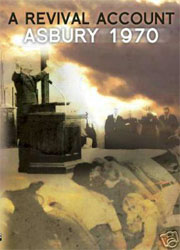
***The service, a routine meeting, was scheduled for 50 minutes. Instead, it lasted 185 hours non-stop, 24 hours a day. Intermittently, it continued for weeks. Ultimately, it spread across the United States and into foreign countries. Some say it is being felt even today.***
________________________________________________
Lately it seems many of us have been sharing many concerns and comments about the latest debacles and the latest false revival. There are many occurring presently and I have watched so many videos of people falling to the ground with false anointings that my head is spinning, my stomach is sick, and my heart hurting.The burden many feel for the church is immense. So many are being deceived and loving it.
I have searched the web for true revivals and the result has been dismal to say the least. Then I was sent a link about the asbury revival. I was skeptical because the link was surrounded by new-age articles. But thank God I was persuaded to watch it anyway. The footage is old and the sound poor to begin with, but it improves in a minute or so.
The Asbury Revival – February 1970 – Wilmore, Kentucky
Dr. Dennis Kinlaw was in Canada, away from the college when he received an emergency message to call the Dean….
I have some quotes from this amazing video. Here goes:
The Dean – “I have a problem…and I don’t quite know how to handle it.”
Kinlaw – “What is it?”
The Dean – “It’s chapel..it’s not over yet.”
Kinlaw – “It isn’t over yet? The morning chapel isn’t over yet? What do you mean it isn’t over yet? It is 7:00 at night. (Chapel starts at 10 am) What happened?”
“GOD IS HERE!”
“…the response lasted until the next Tuesday morning, a week later, at 8:00 when we began classes again.”
More quotes:
“Dr. Kinlaw..I am a liar..what do I do?”….”That was the kind of thing taking place. An honest, candid dealing with personal sin and with personal disobedience and personal problems.”
“It is interesting to me to know what the emphasis was…Holy Spirit in those days. There was an amazing openness and transparency.”
“The emphasis was never upon the gifts of the spirit. The emphasis was upon..sin. The need for repentance, need for restitution, the need for repairing relationships, human being to human being and the need for bringing alive into obedience the need for the highest and the best.”
“The amazing thing was a person would tell what had happened, it would be recapitulated, as a person would go somewhere and tell what God had done in his auditorium … it would take place in the church where the person was telling it!”
“The less impressive the student was the more effective an instrument he was”
“How did it come? What called it?…Our need.”
“We had some students interested in prayer. In October before the Spirit came in February six students came together, banded together in what they called ‘the great experiment.'”
“They covenanted for 30 days to take 30 minutes every morning and spend in prayer with the Word, writing down what truth they got from the Word. They were to obey that day, sharing their faith somewhere in the course of the day, and meeting once a week for those 30 days and checking up on each other to see that each one had done his disciplines that week. So for 30 days they met that way and they worked that way.”
********
Did you get that? What a recipe for revival…… and it is no wonder why there are so few….
Take 30 minutes daily….add prayer while in the Word of God.
Search for truth in the Word of God and apply directly to self in obedience.
Take faith and share daily.
Check weekly for compliance.
DAILY PRAYER DAILY READING THE BIBLE DAILY WITNESSING OBEDIENCE TO THE WORD OF GOD
It is no wonder why the church is in crisis and we have false revivals with false gospels with false anointings.
Here is the video….It is about 37 minutes…Please take the time (just over 30 minutes, hint…hint) to prayerfully watch and compare with the revivals of today. The quotes cover the basics but i left out the ending.
http://vids.myspace.com/index.cfm?fuseaction=vids.individual&videoID=1343001998
Actually, I long to attend some of the so-called revivals of today. I want to be in the back of the room, kneeling on the floor with my Bible on the chair. Or just standing at the back, head down in prayer, Bible in hand. First, one should be totally armed with the spiritual weapons of Ephesians before stepping one foot into a demonic meeting. Please pray with me that those who are truly seeking God will be protected from the evil spirits at these meetings. Pray that the Lord will prick their heart with fear, and warn them with the knowledge that something is wrong and that they need to leave immediately.
Now for that 30 minutes each day… You will set this time aside won’t you? Daily, pray in the Word, obey it and share your faith.
God Bless….
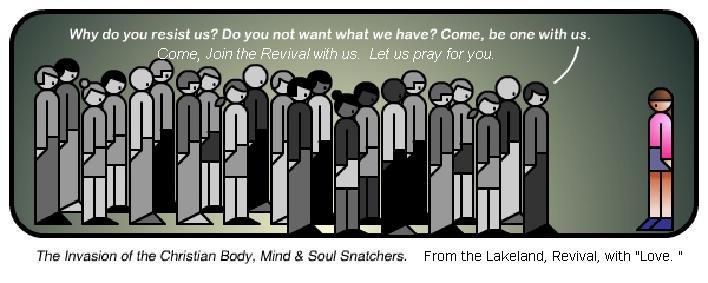
My visit to the Lakeland Revival – Justin Peters
Hello All,
Well, I went to Lakeland, FL to attend the revival services. I was in attendance Monday morning and evening, Tues evening, and Wed. morning. I really did try to go to these services with an open mind, but once there it did not take very long for my mind to begin closing. Todd Bentley does not preach in the morning services. Monday morning the preacher was a 28 year-old lady named Kira Mitchell who is one of Todd’s interns (for lack of a better word). He is apparently mentoring her. She told a great deal of dramatic stories and spoke often about how God speaks to her in dreams, visions, and, on occasion, in an audible voice. Peppered throughout her message were references to the upcoming time where the anointing would begin flowing (to which she referred as “walking in the sauce” which struck me as rather irreverent to say the least) and people would be healed. She called for those with tumors and cysts to come forward because God was telling her that an anointing was there for people such as these. So, many did come forward – particularly women with breast cancer it seemed. She would go person to person down the line and prophesy over him or her (she said to numerous women “You are a daughter of destiny” though she never seemed to elaborate on exactly what that meant) and attempt to slay them in the Spirit. Some went down, some did not. There were people who claimed to be healed of their tumors. Noticeably lacking from those who claimed to be healed, however, were people such as the man who was blind, the woman who was on crutches suffering from crippling arthritis, and the mother with her seven year old little boy who was born without a brain – only a brain stem. None of these poor people were healed.
Then came Monday night. The service began with a solid two hours of “worship.” The music was extremely loud and quite heavy. It was more like a rock concert than worship. People were jumping up and down, speaking in tongues, some were laughing uncontrollably (biblical support for this?), being slain in the Spirit, some lay on the floor twitching and writhing around, some would burst forth in screams. To be fair, the more dramatic manifestations were not the rule but nonetheless did occur with considerable frequency. In short, the worship was highly, highly emotionally charged. Finally, Todd got up to “preach.” Now, I put the word preach in quotes because what I observed of Todd’s messages could not be characterized as preaching by even the loosest definition of the term. He did not read and explain any text of Scripture. He basically performed and told dramatic stories of people being healed. Then came time for the healing to begin. Todd said, ‘If you are sick, I want you to begin doing something that you could not do before. You have to activate your faith by doing something you couldn’t do before. If you’re in a wheelchair, get up out of that wheelchair and start walking. If you couldn’t move your legs, start moving them.’ Well, I’m sitting in the wheelchair section (in my own electric chair) and so people all around me began trying to get out of their wheelchairs. Family members began trying to coax their loved ones out of their chairs and people on crutches stood up trying to walk without them. There was a large man sitting next to me in a wheelchair who was paralyzed from the waist down. He began to try to inch his way to the edge of his seat. His wife and a young lady who I presumed was his daughter encouraged him along. There was another lady standing over him speaking in tongues. Well, this man got to the edge of his seat, slid off, and crumpled to the floor like a rag doll. His wife and daughter kept encouraging him to “just believe.” The other lady kept up her tongues. This went on for a good half hour and the poor man could do nothing. They finally helped him back into his chair. (Probably just didn’t have enough faith, you see.)
A number of people who came in in wheelchairs walked up on stage for Todd to pray over them. Todd would ask them their condition, command them to be healed, and then lay hands on them and yell very loudly into the microphone, “BAM!!” Some would then fall back and lowered to the floor by the ready catchers (one person he even head-butted as he “BAMMED” him). He claimed most, if not all, of these folks healed. Well, these individuals could all walk even though they were in wheelchairs. I watched each one as they came back down the stage and from what I could observe every one of them went back to their wheelchair or stayed on their crutches. I honestly did not see anyone dramatically and unquestionably healed. Some of these individuals I followed and was able to get their names and phone numbers. I will follow up with them in a few weeks to see what if any change in their condition has occurred. There were a few empty chairs that all of the sudden appeared on stage but I did not see anyone actually get out of them.
Larry was another man who made it up on stage but he was not in a wheelchair. Larry, a pastor, has throat cancer with a grim prognosis from his physicians. Larry was very, very weak and feeble. When he spoke his voice was weak and raspy. Bentley claimed his healing and Larry agreed with him. Larry was helped off the stage by a young man and they left the auditorium. I caught up with them out in the hall. There was no discernable change in his condition. I will call Larry in a few weeks to see how he is doing. Please pray for Larry that God would heal him and, if physical healing is not God’s will, that Larry would know sufficient grace and strength made perfect in weakness (2 Cor. 12:7-9).
There were so many people there sick with cancer, in wheelchairs, parents with crippled and sick children, retarded children and the like. I did not witness any miracles that were truly undeniable.
Wednesday morning something interesting happened. The pastor of Ignited Church, Stephen Strader, was preaching. At the end of the service he called for all preachers and evangelists to go into the fellowship hall where he was going to bestow on them “the anointing.” Well, long story short, I found myself in the fellowship hall. Strader came in and said, ‘Ok, I have some instructions for you. I’m about to come to each one of you and lay my hands on you to give you the anointing of this revival so that you can take it to your own church.’ He then admitted that not everything that has been going on at the Lakeland outpouring has been from God. He readily admitted that some people are getting caught up in emotionalism. He said, “I want you to take these next few minutes and pray.Pray, ‘God, if there is anything here You want me to have, give it to me. If there is anything here You do not want me to have, don’t give it to me.’ Now I think that is a fair prayer.” I had to agree with him. It certainly seemed like a fair prayer. But then he said something that really disconcerted me. He said, “Now, when I come up to you to give you the anointing, I want you to stop praying. If you continue to pray while I lay my hands on you, it will hinder the passing of the anointing from me to you. You are not to pray while I’m laying my hands on you and giving you this anointing.” Well, the Scripture that immediately popped into my head was 1 Thess. 5:17, “Pray without ceasing.” Why was the pastor of the church telling me to do something clearly against Scripture??
Let’s also look at this logically. When a person prays, he is communicating with the Triune Godhead. This anointing that is about to be given to me is also, supposedly, from the Tiune Godhead. How could these two acts possibly be in contradiction? How could me praying to God hinder me from receiving something from God? Unless, of course, this anointing was not really from God. Needless to say, huge red flags immediately went up with me. Now, I’m not making an accusation against Strader here, I’m just saying that his instruction to stop praying was patently unbiblical at best and, at worst, possibly a doorway to receive something from some kind of spirit but not the Holy Spirit.
Please know that I am not judging the man’s heart, I’m just saying that this was an unwise and potentially exceedingly dangerous directive on his part. Well, Strader went up to each person, layed hands on them, and loudly yelled into the person’s ear “FIF!!,” (this is how I heard it) or, “FIRE!!” Practically everyone fell down, some twitched and jerked, some laughed, some just lay there. Well, when he came up to me, I was steady praying opting to follow the directives of Scripture rather than his. He layed hands on me, yelled “FIF” but I felt nothing other than concern about what was going on around me.
On a positive note, I attended one of their street evangelism training seminars. I was pleasantly surprised that the accompanying handouts were biblically solid – at least in the section that pertained to presenting the Gospel. The attendees were being trained to give people the Good Person Test by going through the 10 commandments. This is good. However, if someone made a ‘decision for Christ,’ then they were also, apparently, asked if they wanted to speak in tongues and so forth. A discussion on tongues is beyond the scope of my purposes here – I’m just telling what I observed.
Bentley struck me as an exceedingly arrogant person. He claims to have regular angelic visitations, was translated to Australia, and has been to Heaven where they actually did surgery on him [Forgive me if I just don’t believe this. Was Paul allowed to tell us what he saw and heard when he was caught up into heaven in 2 Cor. 12:2-4? No. If the man who wrote half of the New Testament was not allowed to speak of what he saw, I seriously doubt anyone else claiming to be able to do so (especially if they have tapes or books to sell)]
Bentley makes Benny Hinn look conservative by comparison (and I wrote my Master’s thesis on Hinn). On Tuesday night, Bentley got up to speak right after the two hours of music and all of the sudden excitedly said, “Is it raining in here? Is it raining in here?” as he held out his arms looking at them as though he was feeling drops of rain. Then the band, without missing a beat, started playing a chorus entitled “Let It Rain” complete with the lyrics against a backdrop of water being projected on the large screens. This was clearly ed. I was amazed that no one seemed to catch on to the obvious stunt. He claims that he has medical proof of these healings and resurrections. Maybe he does, I’m not sure. Friends, may I kindly offer a bit of caution here? Even if all of what Bentley claims is true (and I seriously doubt that it is), that does not in and of itself validate his ministry. The Bible often speaks of false prophets and false teachers who have performed and will perform signs and wonders. In fact, false Christ’s and false prophets will show signs and wonders so compelling that even the elect will almost be deceived (Matt. 24:24 see also Matt. 7:22-23).
Dear friends, after having been to the Lakeland Outpouring in person, I am very concerned about what is going on. Are there people there who are really saved and love the Lord? I have no doubt this is the case. Could some of the healings be real? They could be but I did not personally observe any – and I looked for them. Is Todd Bentley a man of God or a false prophet? Well, all I can say is that I do not believe him to be an honest man, he is a masterful manipulator of people’s emotions, he is actively engaging in activities that are extra-biblical and flat out unbiblical, and he does not preach the Word. What I am about to say is, I freely admit, subjective and by no means in and of itself authoritative in any way, but my spirit was very troubled the entire time I was there – very troubled. I believe that the Lakeland Outpouring is just the latest manifestation of the counterfeit revivals which broke out in Toronto, Brownsville, and Pensacola back in the ’90’s.
Let me conclude by saying that I long to see revival – true revival. I’m just not at all convinced that what we are seeing in Lakeland is. Let us pray for those sick and crippled who are being manipulated. If some are truly being saved, let us rejoice in that but pray that the focus would cease being on signs and wonders. Let us also pray for those who are leading this movement that they would not deceive or be deceived themselves.
Justin Peters

I just wanted to provide a place for everyone to make prayer requests. We all have someone dear to us that needs the mercy of the Lord, or we may need some prayer for ourselves when we are discouraged from Satan’s attacks. We must expect oppostion from the enemy and prayer gets us through this. All that I ask is that when leave a prayer request make sure you pray for those who have left their own requests.
Be as specific as you like but keep it short. Make sure that anything you say about a friend or family member would not be embarrased by your request.
We have the Word of God to guide and teach us but prayer is how we communicate with the Lord which enhances our relationship with Him.
 DiscernIt

Recent Comments