
History and Structure of Sozo
“SOZO” is a psycho-spiritual deliverance and inner healing methodology birthed out of Bethel Church in Redding, California. But though the Bethel Sozo website banner says, “[A] Ministry of Bethel Church,” the FAQ section disclaims, “The Sozo staff are independent contractors and are not Bethel Church Staff.” Apparently for legal reasons, no one wants to call this “counseling” or “therapy.” Rather, they simply call it “healing prayer” (and yet, they strongly recommend a suggested donation for receiving “prayer” for which recipients (“Sozoees”) must first sign a waiver.
For background, it is interesting to note that Bethel was once an Assemblies of God (AG) church, and Bill Johnson was an AG pastor; but he led his flock out of AG in 2006 to jump into the NAR/River Revival movement. Johnson is now a self-appointed “apostle,” and his church is now a part of his own “Revival Alliance” network, co-founded with Che Ahn (Harvest Rock Church, Pasadena, CA) and John Arnott (Catch the Fire Toronto; formerly Toronto Airport Christian Fellowship; formerly Toronto Airport Vineyard Church).
Although Sozo got its start at Bethel, other Sozo groups have spun off, such as The Freedom Resource (TFR). Headed by author and executive director Andy Reese, TFR publishes its own manuals and presentations on how to use Sozo. According to TFR’s website, no one individual “owns” or controls the copyright for Sozo concepts and “tools” used in the program: “This particular style or format for ministry has evolved (and continues to evolve) from roots in the Argentine revivals, the understanding and writings of various practitioners of inner healing and deliverance, and from the experience of several churches and individuals including Randy Clark’s ministry and Bethel Church in Redding, California. It is changing and growing as we all learn, grow, and share experiences and tools with each other.” [Note: TFR just announced brand differentiation from Bethel Sozo and will now practice under “Freedom Prayer.”]
Apparently, then, the system is very adaptable, malleable, and open-ended. But one thing appears clear: Something else is needed in addition to God’s Word and the Holy Spirit. As Reese acknowledges, Sozo has “evolved…and continues to evolve.” From where? From God’s Word? Are the Scriptures ever-changing? No, Sozo comes from “roots in the Argentine revivals…the writings of various practitioners…and from the experience of…individuals.” Such a description can lead one only to the inescapable conclusion that these “evolving” techniques are adapted from man’s own inventions, not from the inspired Word of God.
Bethel Sozo: Redefining “Salvation [1]“?
The Bethel Sozo website appears to redefine “salvation [1]” not as an accomplishment of Christ at a moment in time but as a process of perpetual deliverance (with the help of their tools, of course):
The SOZO ministry is a unique inner healing and deliverance ministry in which the main aim is to get to the root of those things hindering your personal connection with the Father, Son and Holy Spirit…. SOZO is the Greek word translated “saved, healed, delivered.” Sozo contains the whole package of being made whole or well.
At the very least, this confuses salvation [1] (the purchase of God) with ongoing sanctification of the believer (which comes as we mature in the Lord and respond in obedience to His word). The Sozo tools, according to Bethel, become part and parcel of a believer’s journey to complete the salvation [1] (sozo) process. This subtle shift in terminology raises a critical question: In what then, does Bethel church encourage believers and non-believers to put their faith and hope: Jesus Christ, or the Sozo experience?
The Freedom Resource website makes a telling correlation between itself and the addiction recovery group, Alcoholics Anonymous (AA). Although it refers only to the organizational structure, in fact its use of divination, the technique by which AA’s co-founder Bill Wilson received its 12 Steps methodology, is the main technique of Sozo’s “tools.”
As explained by Dave Hunt in his article “God as You Conceive Him/Her/It to Be” (The Berean Call, July 1997), the principles of AA “came by direct inspiration from the demonic world and they open the door to the occult by introducing members to a false god” (www.thebereancall.org/node/5821). Like AA’s 12 Steps, Sozo utilizes methodologies that are either not found in Scripture or condemned by God’s Word.
Six Tools—Six Visions—Six Spirits?
According to the Bethel Sozo website, there are six tools (psychotherapeutic techniques) that are used by the SOZO team (“Sozoers”): • Father Ladder • Four Doors • Presenting Jesus • The Wall • Trigger Mechanisms (Advanced Tool) • Divine Editing (Advanced Tool).
By using these tools and following the Holy Spirit, wounds are healed, strongholds broken, truth revealed, and “doors” closed…. A Sozo session may last 2-3 hours and is conducted by two team members. The Sozo team will sit down with you and with the help of the Holy Spirit walk you through the process of freedom and wholeness…. Sozo is not a counseling session but a time of interacting with Father, Son and Holy Spirit for wholeness and pursuing of your destiny.
Sozo is indeed a “counseling session,” nevertheless. Dawna DeSilva, founder of Sozo at Bethel, describes the program this way in the Sozo Basic DVD:
“Our mission statement is to provide gentle, yet powerful deliverance in a safe and honoring atmosphere in which the godhead is allowed to direct our means of ministering. You will understand that when we teach you the “father ladder,” when we talk about the godhead. Most people [when we ask] ‘who do you pray to?’ God. Okay, that’s a good place to start. But we’re going to teach you to use the tool for the entire aspect of God. God the Father, God the Son, the Holy Spirit.”
It sounds as though DeSilva has discovered “a new way” to pray—one that believers have somehow missed or forgotten that needs to be “restored.” Jesus not only gave us a model for prayer in Mt 6:9-13, but there are many examples of prayer in Scripture, all directed to the Father, through the Son, and “interpreted” by the Holy Spirit (Rom:8:26
). Though many believers innocently interchange “Jesus” and “Father” in prayer, finding fault in that would be slicing things pretty thin, since Christ declared “I and my Father are one.” Evidently, however, DeSilva suggests we should direct our prayers to three separate entities, depending upon the specific purpose or desired result. As we’ll see, this can be a door for unholy spirits to enter, especially if one is put into a meditative state of mind.
“Climbing Up Another Way”?
Co-founder of Bethel Sozo, Teresa Liebscher, elaborates on one of the program’s “tools”:
[The Father Ladder] is an amazing tool. It’s gonna get you some information, and to the wounds and lies really quick and easy. It’s also a tool that can be used in any way, shape or form, including, once you get healed, it’s gonna be a tool that you’ll be able to access for the rest of your life. I’m going to explain that as we go along. I use it all the time, with myself, with my friends, and a lot of time with my family too. It’s a great tool, you guys are gonna fall in love [with it.]”
So, what exactly is the Father Ladder? The Bethel Sozo website doesn’t say. Even the available YouTube clips featuring Dawna and Teresa only entice, not explain. In order to find out, you have to attend a seminar, or purchase their DVD series. The Basic Sozo DVD course is $105, plus a $10 manual. The Advanced Sozo DVD course is $77, plus a $10 manual, which includes the “continuing treatment” course called “Shabar,” sold separately for $45.
The Freedom Resource “Sozo Network” has authored its own set of guides and materials. The “ladder” is a computer flowchart method of interviewing clients that is designed to reveal what has been popularly described by both secular psychologists and Christian counselors as “the father wound” (although it may be a wound inflicted by someone else, or even yourself). In The Sozo User Manual, Andy Reese explains, “We are interacting with both the person [client] and God throughout the process. We begin by asking the person to picture Papa God, or by asking Papa to give the person a picture of Himself. We might say, ‘What picture comes to mind when I say “Father God”? or ‘Picture Papa God and describe Him to me.’” Curiously, Reese says that “We will use a Father picture to explain [the process] though a Mother or Sibling picture works the same way” (Italics added).
This is violation number one. (Actually, it is a “number two” violation of the Ten Commandments): “Thou shalt not make unto thee any graven image, or any likeness of any thing that is in heaven above…” (Ex 20:4). Many will protest that a graven (three-dimensional) image is not the same thing as an imagined picture. But is this not the first step an artist or sculptor starts with to carve or cast a graven image? “It’s just a representation!” some would protest. “I’m not worshiping it!” Fine. But where in God’s Word are we ever instructed to picture or visualize God or Jesus? Of course, when Jesus walked the earth, He affirmed His deity by declaring, “He that hath seen me hath seen the Father” (Jn:14:9
). Christ also declared, “I and my Father are one” (Jn:10:30
). However, we are also told that “no man hath seen God at any time” (Jn:1:18
, 1 Jn:4:12
).
Scripture instructs us not only to avoid making “graven images,” but also to avoid creating “any likeness” of “any thing that is in heaven above.” Unfortunately, the church has long succumbed to popular culture and mythology when it comes to depicting “angels,” “Jesus,” and “God” in all forms of art and media. But quite logically, any “representation” of Jesus or God today is patently false. Is He black? white? beige? Is He bearded? Long hair or short? Is He more like Santa Claus, or more like Gandhi?
As should be abundantly clear, it is absolutely preposterous (and pointless) to try and imagine God in our minds as a physical being. God’s Word declares, “God is a Spirit: and they that worship him must worship him in spirit and in truth” (Jn:4:24
). Therefore, all attempts to picture or depict God are acts of the flesh at best (“which profits nothing”) or open one up to demonic deception at worst—for God is a Spirit. It stands to reason, therefore, that any imagined image of God is, by definition, the very opposite of Truth.
The “Father Ladder” flowchart then prompts the Sozo counselor to ask, “Is your picture of God a good one, or a bad one?” If it is a good picture, the client is instructed to speak (audibly or silently) to the “image” of Papa God, and ask the dreamlike figure, “What do you think of me?” If the client has a negative picture of God, the facilitator is instructed to find the reason by using other “tools” in the Sozo method, such as the “Four Doors,” “Presenting Jesus,” or probing for the presence of demonic oppression or possession in the individual using “The Wall” tool or “Dealing With Demons.”
Sozo: Presenting “Another Jesus”?
In the “Presenting Jesus” tool, the counselor asks the client to “Picture Jesus and ask for His help.” Once again, any such imagined manifestation of Christ in the mind’s eye can only be false. Jesus warned of false Christs and false prophets who would arise and show great signs and wonders, using all means possible to deceive the very elect: “Wherefore, if they shall say unto you, Behold, [Christ] is in the desert, go not forth: [or] behold, he is in the secret chambers; believe it not” (Mt 24:24, 26).
The Greek word for “secret chambers” is tamaon, which means “a secret room” or “inner chamber.” Is not the mind such a place? The same word is used figuratively for praying “in your closet” (Mt 6:6), and again in Luke:12:3
. Obviously, we are not only to pray “in closets” because we are elsewhere instructed to “pray without ceasing.” We certainly don’t live and work in a closet; neither can we pray out loud all day long, in every situation. Clearly, the meaning is that even secret (“closeted”) prayers, spoken from our innermost “chambers” of the heart and mind, are heard by our Father in heaven.
However, there is no “secret room” (or secret instruction) in God’s Word for visualizing Christ as a means of accessing Him through prayer. In fact, quite the opposite: Scripture repeatedly warns of false Christs who will even appear as “an angel of light” (2 Cor:11:14
). Such demons have deceived countless individuals through the ages, many of whom have spawned some of the most widespread cults, based on doctrines of devils (1 Tm 4:1). Attempting to contact God or Jesus through our “mind’s eye,” therefore, is a form of divination and necromancy (attempting to communicate with spirits of the dead). These variations of witchcraft are expressly forbidden in Scripture.
Ironically, The Sozo User Manual by Andy Reese explains that if the client is unable to see “Jesus” (which could never be the real Jesus) there is a high likelihood of demonic blockage. In order to probe for the presence of a demon, the counselor is told how to gain access to the client’s mind, in much the same way as a hypnotist. In the example given on page 40, the counselor asks the client to “go to the back seat of your conscience [10] right now—sort of like climbing into the back seat of your car, and we’re going to see if there is something that is trying hard to block you from getting freedom [to visualize Christ], Okay?”
Considering just two of the six “tools” found in the Sozo program, it’s clear that it is dangerously flawed. Furthermore, its methodology is indistinguishable from forms used by secular psychotherapists, which have their origin in the occult. Sozo is spiritualized Freudian psychoanalysis that includes psychic determinism and searching out the unconscious through techniques that include various forms of guided imagery. Anyone involved in Sozo needs to take to heart the admonition given twice in Proverbs:
“There is a way which seemeth right unto a man, but the end thereof are the ways of death” (Prv 14:12; 16:25).
Years ago I was involved in a car accident that caused major medical problems for me. I suffered whiplash among back and neck injuries. My insurance allowed chiropractic which helped immensely. I have no qualms about basic chiropractic adjustments if it helps impinged nerves.
I was also allowed some massages as therapy to help my neck. During a couple of sessions I had been witnessing to the therapist about my faith. I enjoyed the sessions but then something happened.
The therapist told me that she was “going to try something new” on me. I was face down but sensed she was holding her hands over the back of my head. Suddenly she yelped and pulled back from me. She exclaimed that she had “just been shocked,” and that she “wouldn’t ever try that again.”
I was not sure what had happened. But noted on her wall that she was a Reiki master. I made it a point to learn what that was all about. It was disturbing to learn that Reiki is the manipulation of a spiritual force from above, entering into the top of the practitioner’s head, then to their hands and then to the patient.
That was the last time I went to that massage therapist and told the referring chiropractor that I had to cease this treatment because of what I believed was wrong with this. He told me other Christians had told him the same thing. He then referred me to a physical therapist to finish up treatment. When I told the physical therapist what had happened he laughed at me saying that it was just massage. I told him he should research it.
I believe on that day that the Lord spiritually protected me from the Reiki treatment. I also wonder if my witness for Jesus was the reason for such a supernatural display of His power.
Please read this article from CANA
REIKI: A DECEPTION MAINSTREAMED
By Marcia Montenegro
“More than 60 U.S. hospitals have adopted Reiki as part of patient services, according to a UCLA study, and Reiki education is offered at 800 hospitals. The Healing Touch Professional Association estimates that more than 30,000 nurses in U.S. hospitals use touch practices every year.” From Washington Post, May 16, 2014, at goo.gl/oyDm8S
~~~~~~~~~~
The quote above is from 2014, so now the numbers are much higher for hospitals that offer Reiki. Reiki was introduced to nursing in the 1980s and 90s and has made deep inroads since then in health care (along with other energy healing modalities).
What is Reiki?
Reiki is based on belief in a universal energy that one can channel healing energy to the patient through a specific process of training. The “ki” in “Reiki” stands for that energy (also spelled “chi” or “qi”).
Some definitions:
Quote==Reiki is a healing modality that is passed down from teacher to student through verbal and energetic lineage.==End quote
Quote==Reiki is a Japanese technique for stress reduction and relaxation that also promotes healing. It is administered by “laying on hands” and is based on the idea that an unseen “life force energy” flows through us and is what causes us to be alive……The word Reiki is made of two Japanese words – Rei which means “God’s Wisdom or the Higher Power” and Ki which is “life force energy”. So Reiki is actually “spiritually guided life force energy.”==End quote
Quote==Reiki energy is a subtle energy. It is different than electricity or chemical energy or other kinds of physical energy. Reiki energy comes from the Higher Power, which exists on a higher dimension than the physical world we are familiar with. When viewed clairvoyantly, Reiki energy appears to come down from above and to enter the top of the practitioners head after which if flows through the body and out the hands….However, the true source of Reiki energy is within ourselves. This does not mean that we use our personal energy when we do Reiki, but that the energy is coming from a transcendental part of ourselves that is connected to an infinite supply of healing energy. ==End quote
~~~~~~~~~~
Where Does Reiki Come From?
Reiki’s recent origins are in the 19th century when Mikao Usui, a Buddhist monk and teacher in Kyoto, Japan, searched for an understanding of healing. Some accounts claim Usui was a Christian minister searching for how Jesus healed, but apparently this account was to make Reiki more palatable to Christians in the U.S. Accounts vary on the origins of Reiki. Usui read the Buddhist sutras (religious writings) in their original languages, and found material on healing and what seemed to him a way to activate its power. After a 21-day fast and retreat, “he welcomed the energy into himself,” the energy being what Usui thought was the healing power (J. Gordon Melton, New Age Encyclopedia [Detroit: Gale Research Inc., 1990], 382).
….In the 1930’s, a dying Japanese-American, Hawayo Takato, returned to Japan and encountered Reiki practitioners whom, it is claimed, were able to heal her. She became the first woman Reiki master and first American Reiki master, and it is she who initiated Reiki training in the United States by touring the country in the 1970’s (Ibid, 383). Barbara Weber Ray, in Atlanta, Georgia, became a teacher of the methods of initiating other Reiki masters in 1978; and Ray founded the American Reiki Association, later called The Radiance Technique Association International (Ibid). Reiki is also known as the Usui Shiko Ryoho System of Healing (Ibid, 382).==From Reiki article by Marcia Montenegro at goo.gl/FqnqLJ
***Comments***
Reiki is based on belief in chi (also spelled qi or ki – note the “ki” in “Reiki”), a supposed universal energy. Those learning Reiki go through an initiation and can progress through three levels, the top one being for a Reiki Master. It is believed that in order to learn Reiki, a Reiki teacher must “attune” the student so that the Reiki energy can be awakened in him or her. This is an occult initiation.
Although Usui claimed this energy was discovered in him after meditation, it is also likely that he cobbled together Reiki from many Eastern spiritual concepts and healing techniques already in existence. Nevertheless, its origins are occultic even if Usui made that story up because the concepts and methods are the same as occult healing worldwide. The terms may differ and some of the concepts may have variations, but in effect, they are all based on channeling, manipulating, or summoning spirits, unquantifiable energy, force or forces, guides, the dead, God (yes, trying to manage “energy” or power from the true God is wrong), or gods for the purposes of healing.
Reiki video that shows the healer using the “symbols” taught in traditional Reiki
goo.gl/YQsR2X
Another video demonstrating Reiki
goo.gl/4p38Si
***Comments***
In the first video, you can see how esoteric Reiki is. Practicing Reiki – and any energy healing – causes the person to gain spirit guides. In fact, many energy healers claim their guides help them in their healing. Barbara Brennan, found of Healing Touch, openly talks about her guide, Heyoan.
~~~~~~~~~~
Healing Touch, Therapeutic Touch, Reiki: What’s the Difference?
All 3 of these are forms of energy healing. They have different origins and the concepts of healing vary somewhat among them, but they are all occult energy healing modalities. So essentially, there are no differences in light of all being occultic and dangerous. See links to previous posts below on Healing Touch and Therapeutic Touch for more information.
Energy healing modalities differ in some terms and concepts, and may have variation in beliefs, but they are all based on channeling, manipulating, or summoning spirits, unquantifiable energy, power, force or forces, guides, the dead, God (yes, trying to manage “energy” or power from the true God is wrong), or gods for the purposes of healing.
All three have occult origins:
*Healing Touch was started by a woman with a spirit guide (and Healing Touch teachings urge healers to contact their guides)
*Therapeutic Touch was taught to a nurse by a psychic healer in the Theosophical Society
*Reiki in its present form originated from a Buddhist monk who supposedly meditated for 21 days and then “welcomed the energy” into himself. (This sounds more akin to Shinto than to Buddhism but in Japan, Shintoism and Buddhism are often blended).
As I’ve said many times, the concept of healing is a central and crucial component of the occult and the New Age. It is a big part of Spiritualism (contact with the dead) and healing played a key role in the development of New Thought. The adversary cleverly uses the idea of healing, which always seems so helpful and good, to deceive.
~~~~~~~~~~
Some Red Flag Words:
Ancient healing, ancient medicine
Biofield
Chi
Chinese medicine
Energy
Energy Healing
Universal energy
Healing touch
Integrative Medicine
Meridians
Meridian System
Natural healing
Preventative medicine
Reiki
Therapeutic Touch
Touch Therapy
Wellness
————————-
More Information
Reiki: Healing with the Force by Marcia Montenegro
goo.gl/FqnqLJ
Other critiques
goo.gl/CUnMpd
Energy Healing Posts:
CANA post on Healing Touch
goo.gl/7fNKA9
CANA post on Therapeutic Touch
goo.gl/zuz4U9


MY BETHEL CHURCH EXPERIENCE ~
by Tony Baugh
Recently, I decided to pay a visit to Bill Johnson’s Bethel Church in Redding, California, ground zero of the New Apostolic Reformation (yes, I know, call me crazy).
Arriving up their very well manicured driveway, it was lined with flag poles and various global flags, along with one complete with the Yin-Yang waving high. It’s a church/Christian college, with lots of the typical, cute college girls and young guys mostly wearing beards, ball caps, or Bill Johnson-style eye glasses, many of which were very effeminate or clearly gay (not a judgement, but an observation). The whole place was crawling with a self-consciousness and sexual energy, and was complete with its own buff, tattooed guys working as security. The place is clearly raking in the big $.
I went into the their Coffee Shop, the girl at the counter was wearing a tank top which read, “As on Earth as it is in Heaven.” I asked her if they sold organic coffee (because I try to drink it when I can), she said no, but they have their own “Bethel Brand” and pointed to bags of coffee, that sure enough, were labeled as such. I bought a cup and noticed that directly across from the coffee bar, was loud music coming from a large hall called the “Sanctuary”, with signs saying, “No Visitors or Family Today. Students Only”. A name tag was required for entry. I peeped inside the door and a full on concert was going on with people dancing and swaying to a live worship band of whom some members were convulsing and flailing around ecstatically while the lyrics were displayed across a large screen. This was not a Sunday worship service, just another average weekday @ Bethel. (To be clear, I do not have an issue with worship music unless the emotional high of the music is being confused with a move of the Holy Spirit.)
I then wandered into their own Bethel bookstore, which was loaded with every apostate book imaginable, many of which were on Quantam Mysticism, with authors like John Crowder and Bill Johnson having their own sections,d loads Jesus Culture worship music CD’s for purchase. Only one small shelf contained bibles, no KJV’s. I asked the two women working at the counter if they carried any books by Warren B Smith (One of the great author/speakers of our day exposing end times deception and apostasy in the modern church and it’s embrace of mysticism). They said they’d never heard of him (of course).
As I sat outside drinking my coffee during class break, I suddenly observe a girl is giving another girl an impartation through the laying on of hands on her forehead, while she looks like she is receiving shock treatment, convulsing, right before my eyes. I kid you not. Pure Kundalini Serpent Spirit Impartations were being handed out as casually and as commonplace as hugs, handshakes or high-fives. I could not believe what I was seeing.
As I drove out, back through all the global flags, the last thing I saw was a student wearing a T-shirt that said “unify”. An ironic, final, punctuation mark for Ecumenical, Globlalist “COEXIST-ence” of the rapidly rising global kingdom of the Antichrist.
This was one weird, weird place. Much more so than I had imagined, absolutely infested with demonic presence and blasphemous perversions in the so-called name of Christ. I felt as if I just entered and exited an alternate reality.
Satan knows his time is short, and is pulling out all the stops in these closing moments. God is indeed sending strong delusion and the Great Apostasy is very much now upon us.
May God have mercy on these lost, misguided souls.


 Your recent article on prayer really helped me. I was always taught that prayer was a two-way conversation. For years, I would talk to God and wait for Him to talk back to me, but He never did. I thought it was because there was unknown sin in my life, or that I didn’t have enough faith, or that God just wasn’t interested in me. It’s so freeing to know the truth.
Comments like this from readers are always bittersweet for me. It makes me practically giddy to hear from Christian women who have been set free from false doctrines they’ve been taught, but it also grieves me deeply to reflect on the years they spent thinking they were somehow deficient as Christians or doubting God’s love for them simply because they were taught, and believed, unbiblical notions and ideas.
Let’s see if we can dispel a few of those…
View original post 1,815 more words
Beth Moore is an ecumenical charismatic who supposedly receives messages and visions from God. She has been instructed by God to pass these messages to the church. Oh really. While some of her teachings may be correct they are also filled with allegory which spiritualizes text. This often changes the meaning of what the text is teaching. She also teaches men from the pulpit which puts her in direct rebellion to scripture. Her emotional stories really tug at the heart of women who need to beware.
Lauran Breaks Free of Beth Moore: A Testimony
The following testimony was submitted to Pulpit & Pen for publication:
My name is Lauran. I am a Southern Baptist from Tennessee. I walked the aisle to accept Jesus at age 5 but I believe I was truly saved 12 years ago at the age of 21. I am currently the women’s Bible study leader at our church as well as the pastor’s wife. I have broken free of Beth Moore.
I grew up attending a flagship in Southern Baptist Church in Tennessee. It was and is one of the most vibrant churches in the convention; its former and current pastors have been the President of the Southern Baptist Convention and both served on the Baptist Faith and Message Committee. At this faithful church, the Bible was proclaimed as God’s inerrant word. Growing up in a church like that, I was often involved in Bible study. One of my favorite Bible study authors was Beth Moore. I was heavily involved in her studies for years. I have seen her speak live multiple times, done countless numbers of her studies and own tons of her books. I’ll never forget the day five years ago when my husband informed me that Beth Moore may not be a sound teacher.
My husband had stumbled across the profile on Beth Moore at the Christian Apologetics Research Ministry (CARM) website. Incredulously, my Baptist husband read Matt Slick’s negative critique of Beth Moore. He was surprised to see that CARM, one of the most trusted online sources for Christian doctrine, did not recommend participating in Beth Moore studies. He knew she was the darling of Southern Baptist women’s studies, a best-selling author at Lifeway. After studying the article, my husband couldn’t help but agree with Slick’s assessment. The evidence was right there. Beth Moore was not a sound teacher. Sheepishly, he informed me that Beth Moore may not be a sound teacher. I was aghast!
“What?!” I exclaimed. “No Way! Beth Moore is a godly woman.” I had been growing in my knowledge of the word in leaps and bounds over the past few years. I had even attended Mid-America Baptist Theological Seminary for a degree in Christian education. It had never been brought up to me in my long Baptist life that Beth Moore, this trusted woman, and leader, might actually be a poor teacher or even a wolf in sheep’s clothing! I had always just assumed that what she was teaching was biblical. All of the churches I had ever attended had endorsed and done her studies as part of their women’s Bible studies. How could they keep doing her studies if her teaching and actions were unbiblical?!
There was only one way to answer this question.
Finish HERE

Dear Dr Brown,
Recently you took aim at Christians and labeled them as, “self-appointed heresy hunters” who “are like a doctor who amputated his patient’s head because the patient needed eye-glasses.” You went as far as to painting them to be “like the hypocrites Jesus spoke of who strained out a gnat yet swallowed a camel.” You’ve unfairly stereotyped them by claiming they are “damning some of God’s children to hell because of a difference over a non-essential doctrine or practice.”
We already know what you think about us with your false accusations and your fallacious arguments as to ignore the claims about you and your theological practices and leanings. Yet you hold to an ideal in hoping “God reveal to them the fullness of His truth and love, and may the discover the fullness of the Spirit’s power.”
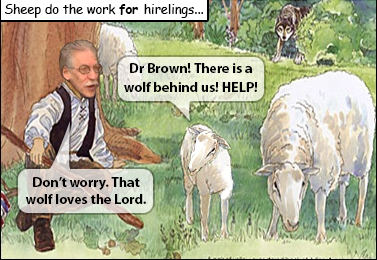
Do you sincerely want that desire to come to pass? Then keep supporting…
View original post 617 more words
Leaving the NAR Church: Christopher’s story
posted by Amy Spreeman on May 5, 2017
“There is a deep sadness in me, a sorrow over wasted years and opportunities. I get angry with myself for having been deluded and so easily led into false doctrine and practice.”
Christopher got swept up in the “Third Wave,” another term for the New Apostolic Reformation. I love how he tells of his journey out! He has allowed me to include his story in this series about a movement called the New Apostolic Reformation, or NAR for short. In this series, I want to take readers beyond the textbook What is the New Apostolic Reformation Movement explanation, into the personal experiences from those who have been there, and what happened when God opened their eyes to the truth.
Here is Christopher’s story in his own words:
You would probably be surprised that I have a degree in Microbiology and that I practice dentistry and consider myself a scientific person. And that I have had a number of wonderful Bible preaching pastors over the years, men committed to the gospel and the inerrancy of the scriptures. And that I was even trained in and practiced inductive Bible Study, accompanies with a reference texts such as Vines and Strong’s. Boy, did I let my guard down and embrace false illumination! And I thought God was in the middle of the craziness. I thought God was doing something wonderful. I even wrote defenses for all of it, to counteract the “haters” and “heresy hunters.”
Four months ago I renounced my twenty years of involvement with the Third Wave charismatic thing as well as a more recent connection with the “New Apostolic Reformation”. I immediately experienced a relief, a lifting of a burden.
I had begun to grow tired of the promises of coming breakthroughs. I had spent my share on books, tapes, and conferences, all promising to prepare me for what was coming next. I went through Inner Healing and SOZO only to become worried that my great grandparents might have done something which I would never be able to discover which might have opened a doorway for spiritual oppression in my life.
I had been Slain in the Spirit many times, and had received my share of “visions”, but the quest became about more and more of it. It was about finding and riding the next wave of the Spirit, always. And it became about speaking things into existence. Doing greater works than Jesus. Doing spiritual warfare. And marching around the church building speaking in tongues, waving flags, blowing shofars, and ignoring the incredulous looks of onlookers.
Two things happened that probably pushed me over the edge.
Finish article HERE
When Did the Gift of Tongues Cease?
by Pastor Dennis Kiszonas
No one was more “charismatic” than the Apostle Paul. He wrote to the Corinthian church that “they came behind no other church” when it came to the gifts of the Holy Spirit (1 Cor. 1:7)—no church had more of the gifts of the Holy Spirit than the Corinthian church, yet Paul says that he spoke in tongues more than all of them (1 Cor. 14:18)!
No one was more charismatic than Paul, yet the Lord revealed to him that those sign gifts were going to cease:
“whether there are prophecies, they will fail; whether there are tongues, they will cease; whether there is knowledge, it will vanish away” (1 Cor. 13:8). 1
Here Paul writes of the gift of tongues, the gift of prophecy and the gift of knowledge (see 1 Cor. 13:1-2) and states that the Lord Jesus had revealed to him (1 Cor. 11:23; 15:3; Gal. 1:11,12) that a time was coming when these sign gifts were going to cease to operate.
The question has always been: when? When would these gifts cease?
This study focuses on that question—when did the sign gifts cease?
Arranging Paul’s letters in the order that he wrote them
We begin by setting up a time line of Paul’s ministry. Paul was saved in Acts 9 when the Lord appeared to him on the road to Damascus. Paul would go on to write 13 letters in the New Testament—from the Letter to the Romans to the Letter to Philemon. When we remember that Paul is the subject of at least half of the Book of Acts, we realize that half of the 27 books in the New Testament are either about him (The Book of Acts) or were written by him (13 letters).
Paul’s letters are arranged in our Bible by two principles: The letters to the churches are put first—nine letters from Romans to 2 Thessalonians, then the four letters written to individuals—from 1 Timothy to Philemon.
The letters are also arranged by length—Romans is longest and is first, then the Corinthian letters, then Galatians, etc. Longer letters are first, shorter ones later.
But to understand when the sign gifts ceased, we need to read Paul’s letters in the order that he wrote them. When we arrange the letters in the order that they were written, all becomes clear!
Paul’s Letters in the order that he wrote them:
The first 6 of Paul’s letters can be fit into the Book of Acts—we can read Acts and then read Paul’s letters and we can see where Paul was when he wrote these letters.
THE LETTER TO THE GALATIANS IS FIRST
In Acts 13,14 Paul and Barnabas went on their first apostolic journey which took them into Galatia—cities like Antioch, Lystra, Derbe, etc. Soon after Paul returned from this journey he wrote the letter to the Galatians (see Galatians 1:6 where Paul writes to the Galatians and says, you are “so quickly turned.”). Galatians was written soon after Paul returned from that first journey—soon after Acts 14:27. That makes Galatians the earliest of Paul’s letters.
1 AND 2 THESSALONIANS
The next letters Paul wrote are the two letters to the Thessalonians. In Acts 17, Paul, on his second apostolic journey, came to Thessalonica and preached there. Many were saved, but Paul was driven out of town. Paul continued on to Corinth where he wrote the two letters to the Thessalonians. Timothy’s return from Macedonia mentioned in Acts 18:5 is also reported in 1 Thessalonians 3:6. And in 2 Thessalonians 2:5 Paul reminds the Thessalonians of his teaching, as if it had not been very long since he had been with them. So the writing of 1 and 2 Thessalonians can be placed into Acts 18 during Paul’s ministry in Corinth, and that makes them the second and third letters that Paul wrote.
1 AND 2 CORINTHIANS
The next two letters that Paul wrote are the two letters to the Corinthians. In Acts 18 Paul spent a year and a half ministering in Corinth—see Acts 18:11. He later returned to his home base at Antioch (Acts 18:22), and later in his third apostolic journey he arrived in Ephesus (his ministry in Ephesus extends all the way through Acts 19—a period of more than two years, see verse 10). It is here in Ephesus during Acts 19 that Paul wrote 1 Corinthians—see I Corinthians 16:19. Shortly after that Paul traveled to Macedonia (see Acts 20:1 and 2 Cor. 2:13) and that is where he wrote the second letter to the Corinthians.
ROMANS
In Acts 20:2,3 Paul arrived in “Greece,” i.e. in Corinth again, and spent three months there enjoying the hospitality of a believer named Gaius (mentioned in 1 Cor. 1:14). In Gaius’s home, in Corinth, Paul wrote the letter to the Romans (see Rom. 16:23).
This is the last letter written during the Book of Acts. In Acts 21:33 Paul was arrested in Jerusalem, and would spend the next 5 years in prison, right through the end of the Book of Acts.
So, to sum up what we have seen so far, from Acts 9 through Acts 28 we read of the earlier ministry of the Apostle Paul and find that during these years he wrote 6 of his 13 letters. The order of these first six books is:
Galatians—end of Acts 14
1 Thessalonians—Acts 18
2 Thessalonians—Acts 18
1 Corinthians—Acts 19
2 Corinthians—Acts 20
Romans—Acts 20
In Acts 21 Paul was arrested and remained a prisoner through to Acts 28, and beyond.
THE PRISON EPISTLES—EPHESIANS, COLOSSIANS, PHILEMON, AND PHILIPPIANS
Shortly after the end of the Book of Acts, while he was still a prisoner, now in Rome, Paul wrote four letters—the “prison epistles”: Ephesians, Colossians, Philemon and Philippians. In each of these letters he writes of his “chains”—see Ephesians 6:20, Colossians 4:18, Philemon 13 and Philippians 1:13.
THE PASTORAL EPISTLES—THE LETTERS TO TITUS, FIRST AND SECOND TIMOTHY
Paul was released from this imprisonment and continued his ministry for a few years, perhaps 3 years. During this time he wrote the three letters known as the “Pastoral Epistles,” because these letters were written to Paul’s co-workers—Pastor Timothy and Titus. Finally at the end of his life he is again in prison. This time he anticipates being beheaded for the Lord and writes the last letter, Second Timothy.
Summary:
We have surveyed the 13 letters written by the Apostle Paul, arranging them in the order in which Paul wrote them:
During the Book of Acts—6 letters:
1. Galatians
2. & 3. The Thessalonian letters
4. & 5. The Corinthian letters
6. Romans
Then after the Book of Acts ends—7 more letters:
The 4 Prison Epistles:
7. Ephesians
8. Colossians
9. Philemon
10. Philippians
Then the 3 Pastoral Epistles:
11. Titus
12. 1 Timothy
13. 2 Timothy
Now let’s read the letters in the order Paul wrote them
Finish Article HERE


Recent Comments